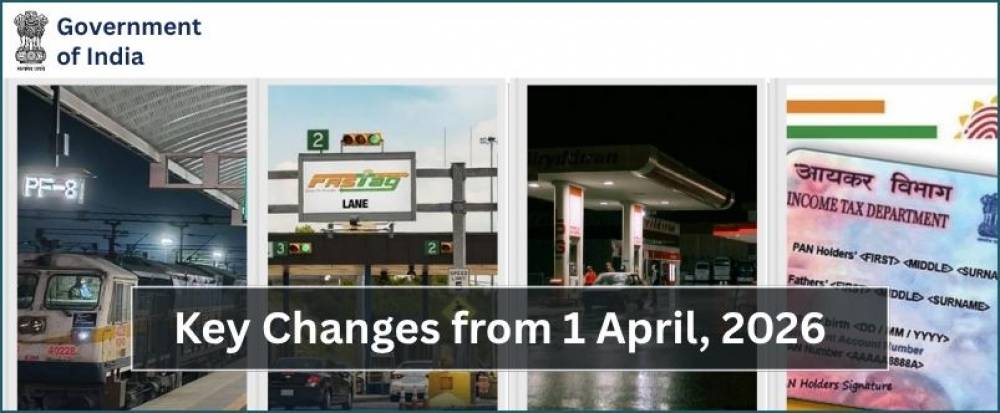
The financial year 2026-27 will begin on 1 April 2026. With the start of the new financial year, several financial and regulatory changes will come into effect. These changes will have a direct impact on the daily lives of Indians. Take a look at the key changes in this news!
List of Key Changes from 1 April, 2026
Here is a list detailing some of the major changes that’ll take place from 1 April, 2026 :-
1. Implementation of New Income Tax Act
One of the most important changes that’ll take effect from 1 April is the enforcement of the new Income Tax Act, 2025. The decades-old Income Tax Act, 1961 will be replaced by the new Act soon. In order to make the Income Tax Act, 2025 more accessible to the general public, unnecessary clauses and outdated terminology have been done away with. Additionally, the new Act brings down the Income Tax Act of 1961's number of chapters from 47 to 23 and its number of sections from 819 to 536.
2. Reduction in Take-Home Salary
If the new labour laws get enforced from 1 April, your take-home salary is likely to witness a reduction. Under the "wages" section of the four new labor codes introduced by the government, companies will be required to pay at least 50% of your salary as the basic wage component. As a result, your provident fund contribution will rise and your take-home pay will be lowered.
3. Adjustment in FASTag Annual Pass’ Charge
For the Financial Year 2026-27, the National Highways Authority of India is adjusting the applicable charge for FASTag Annual Pass from the prevailing Rs. 3000 to Rs. 3075. From 1 April onwards, the change in the price will be implemented in accordance with the stipulations of the National Highways Fee (Determination of Rates and Collection) Rules, 2008.
4. Enhanced Tax Rebate
Under the new tax regime implemented by the Centre, individuals with an annual income of up to Rs. 12 lakh will not be required to pay zero income tax. This is due to an increased rebate under Section 87A.
5. Tightening of PAN Card Rules
For PAN card applications, the Income Tax Department will no longer accept Aadhaar Card alone as proof of date of birth from the applicants. Instead, applicants will now be required to provide documents like Class X certificate and passport.
6. Introduction of New TDS Forms
Beginning from 1 April 2026, the TDS Forms namely Form 16 and Form 16A will be replaced by Form 130 and Form 131, respectively. The new forms are intended to make TDS reporting simpler for the businesses. These forms will provide structured information regarding details like income, deductions and tax.
7. Revision in LPG Price
Amid the ongoing war in the Middle East, the domestic LPG cylinder prices in India might witness a revision from 1 April 2026. Due to the war, there has been supply disruption in India.
8. Changes in Price of CNG, PNG and ATF
The costs of fuels, including PNG, CNG and aviation turbine fuel (ATF), might witness a revision. They will impact airfares and daily transportation across the country. If implemented, these price changes will majorly affect citizens' lives.
9. Changes in Train Ticket Refund Structure
The refund structure for train ticket cancellation has undergone a revision that will help the railway sector to reduce losses. If the ticket is cancelled between 8-24 hours before departure of the train, a 50% refund will be provided to the customer. In case the ticket is cancelled between 24-72 hours before departure, 25% of the amount will be deducted from the ticket price. In case the train ticket is cancelled more than 72 hours before the train’s scheduled departure, minimal cancellation charge applies, not a full refund.
10. Changes in ATM Withdrawal Charges & Limits
Several banks in the country like HDFC Bank, PNB and Bandhan Bank have announced changes to ATM withdrawal rules, fees and limits. These changes will become effective from 1 April 2026 onwards. HDFC Bank will treat UPI cash withdrawals just like regular ATM withdrawals. The Bank will charge Rs. 23 + taxes per transaction after the free limit. PNB has reduced the daily ATM withdrawal limit from Rs. 1 lakh to Rs. 50,000 for select PNB debit card variants.
Bandhan Bank will allow five free financial transactions and unlimited non-financial transactions at its ATMs. At other bank ATMs, free transactions will be limited to three per month in metro cities and five transactions in non-metros. After the free transaction limits get exceeded, the bank’s customers will be charged Rs. 23 per financial transaction and Rs. 10 per non-financial transaction.
Sources:- Livemint & Economic Times
Comments
No comments yet.
Leave a Comment