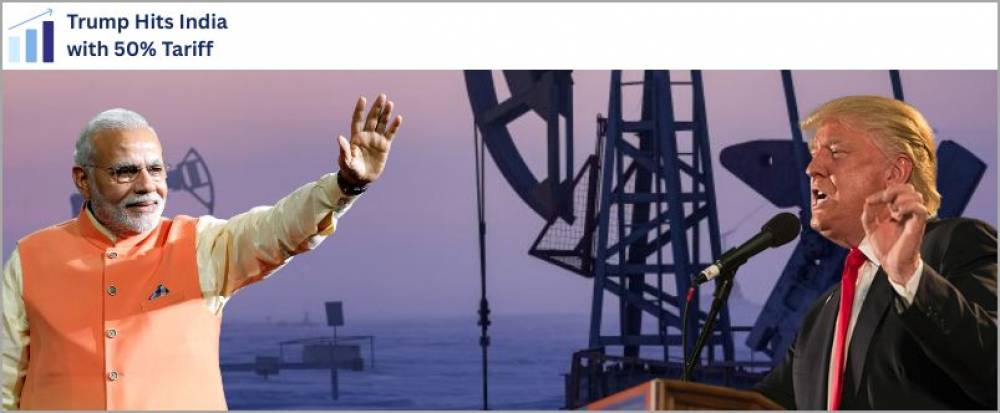
US President Donald Trump has imposed an additional tariff of 25% on India for its crude oil trade with Russia. This brings the total levy on Indian goods to 50%. The decision was made in direct response to what Washington referred to as India's "continued" import of Russian oil.
With the recently announced 25 percent additional tariff on imports, India has now joined Brazil at the top of the list of countries facing the highest import taxes under President Trump’s revised tariff regime.
Brazil previously faced a 10 percent "reciprocal" tariff, but a new 40 percent levy related to the prosecution of former President Jair Bolsonaro, which goes into effect on 1 August, has raised its total tariff to 50 percent.
Experts believe that the 25% tariff move on India could negatively impact the nation’s exports and the overall economy if the tariff persists for an extended period. It is important to mention that Trump has not imposed any additional tariffs on China - the largest purchaser of Russia’s crude oil. This additional duty is anticipated to significantly affect India's textile, marine and leather export sectors.
List of Countries with Highest US Tariffs
Here is a list of countries that face the highest US tariffs:
|
S. No.
|
Country
|
Adjusted Tariff
|
|
1
|
India
|
50%
|
|
2
|
Brazil
|
50%
|
| 3 |
Syria
|
41%
|
|
4
|
Laos
|
40%
|
|
5
|
Myanmar (Burma)
|
40%
|
|
6
|
Switzerland
|
39%
|
|
7
|
Canada
|
35%
|
|
8
|
Serbia/Iraq
|
35%
|
|
9
|
China/South Africa
|
30%
|
List of Other Countries Tariffed by US
Here is a list of other countries facing tariffs by the US:
|
S. No.
|
Country
|
Tariff
|
|
1
|
Vietnam
|
20%
|
|
2
|
Bangladesh
|
20%
|
|
3
|
Sri Lanka
|
20%
|
|
4
|
Taiwan
|
20%
|
|
5
|
Pakistan
|
19%
|
|
6
|
Philippines
|
19%
|
|
7
|
EU
|
15%
|
|
8
|
Japan
|
15%
|
|
9
|
South Korea
|
15%
|
Impact of Trump’s 50% Tariffs on India
The industries that will be impacted by the tariffs include:
The following products will be exempted from the increase in tariffs:
-
Pharmaceutical items
-
Energy resources such as crude oil, refined fuels, natural gas, coal, and critical minerals.
-
Electronic components including tablets, smartphones, computers, solid state drives, flat panel displays and integrated circuits.
According to the export industry representatives, Trump’s move will majorly impact the Indian exports to the United States. Ajay Sahai, DG at Federation of Indian Export Organisations (FIEO), mentioned, "It is extremely shocking. It will impact India's 55% of exports to the US."
Agneshwar Sen, Trade Policy Leader at EY India, said, “It is disappointing to see additional tariffs being announced at a time when we are actively working towards resolving the earlier differences and to strengthen our trade relationship through a trade agreement.” He further added, “Announcing another 25% tariff places unnecessary strain on the trade environment. While nations have the right to address trade concerns through tariff measures, political differences are best resolved through mutual dialogue and established forums, not through such measures. I remain hopeful that the Government of India will continue to engage and seek a balanced resolution with the US. ”
Economists have warned that the tariff's doubling will hit the GDP growth of India. Sakshi Gupta, Principal Economist at HDFC Bank, mentioned, “While Trump's order gives another 21 days for a deal to break through, in case it does not we will have to significantly lower FY26 GDP growth forecast to below 6%, baking in a 40-50 bps hit. This would be double our earlier estimates (of GDP hit from higher tariffs).”
According to a Delhi-based think tank, Global Trade Research Initiative, the tariffs will make Indian goods way more expensive in the US, and could cut US-bound exports by approx. 40-50%. Ajay Srivastava, the former Indian trade official and head of the think tank, “India should remain calm, avoid retaliation for at least six months, and recognise that meaningful trade negotiations with the US cannot proceed under threats or mistrust."
Source:
Comments
No comments yet.
Leave a Comment