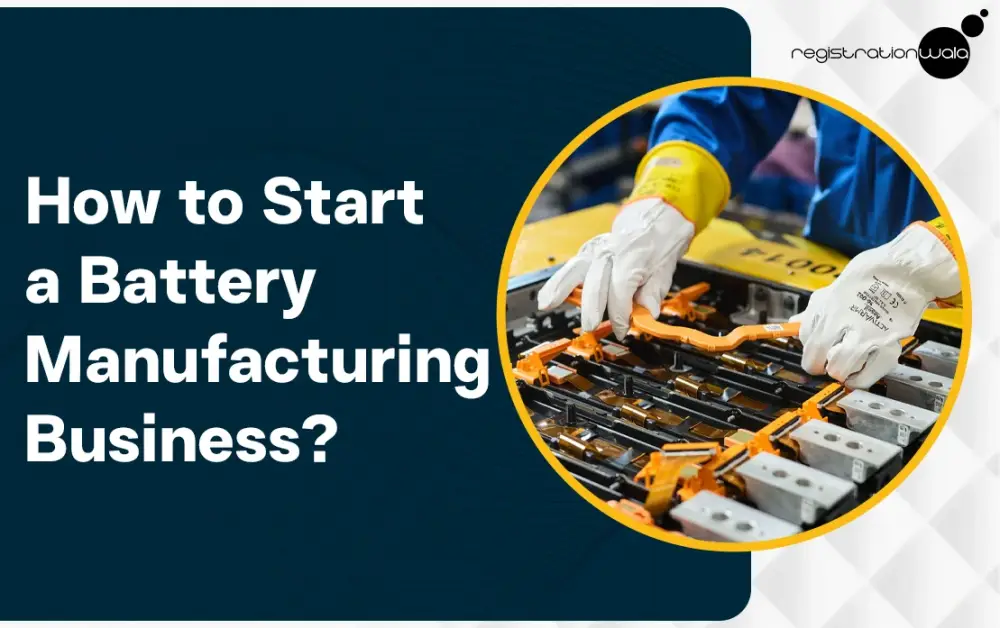
A battery manufacturing business is a kind of industrial enterprise that is engaged in designing, developing and producing batteries, which are then used for various purposes. It uses raw materials like lithium, cobalt, manganese and graphite, electrolytes, etc., and converts them into high performance energy storage solutions for electric vehicles, consumer electronics, renewable energy systems and industrial power backup.
In this blog post, we shall explain to our readers how to start a battery manufacturing business in India, including all the legal and regulatory licensing requirements.
Why Start a Battery Manufacturing Business?
A battery manufacturing business is quite important for the global energy transition. It develops energy solutions that are used for the purpose of powering electric vehicles like electric cars and e-rickshaws, consumer electronics like TV remotes and smartphones and renewable energy systems.
The battery manufacturing sector is a high growth and profitable industry that has a massive market potential. It is driven by rising sustainability needs as well as strong government support through PLI scheme.
Different Types of Batteries Manufactured in India
The different types of batteries manufactured in India include the following :-
-
Automobile Batteries for Cars, Two Wheelers and e-Rickshaws
-
Nickel Cadmium Batteries
-
Lead Acid Batteries
-
Valve Regulated Lead Acid Batteries
-
Lithium Ion Batteries
-
Industrial Batteries
-
AAA Alkaline/Zinc-Carbon Batteries
-
Button Cells
-
Lithium Polymer Batteries
-
Nickel Metal Hydride Batteries
Battery Manufacturing Business in India: Step-by-Step Process
Here is a step-by-step process to help you start a battery manufacturing business in India successfully. Make sure you fulfill each and every step carefully. :-
1. Conduct a Market Research
The first and perhaps the most important step is to conduct market research and create a business plan. You must see the type of batteries that are in most demand or ones that have limited manufacturers. Also, you must analyze the current trends in the market and learn about customer needs as well as the competitors. Then, you must measure the viability of your business idea, and whether you have the right budget for it.
Then, accordingly, you must come up with a business plan. Make sure it’s a detailed plan and outlines what your main goals are, the market you aim to target and the roadmap for product development. You must also decide on the manufacturing process and the marketing strategy so people can learn about your product.
2. Choose Battery Manufacturing Premises
One of the most important steps is to choose the battery manufacturing premises. Ideally, the premises must be located at an industrial area with sufficient land and utility capacity. It must be zoned appropriately and have access to a skilled workforce.
Obviously, manufacturing batteries isn’t a simple process. Therefore, it is important that the workforce hired for the business comes with necessary technical expertise, training and experience so they can handle complex machinery and chemical processes while following safety protocols.
Lastly, make sure the premises is in an area that provides good transportation infrastructure. This would allow raw materials to be sourced easily. It would also enable the finished batteries to be distributed smoothly to domestic as well as international markets without having to face logistical disruptions.
3. Complete Company Registration Process
Once your business plan is ready and you have also chosen the business premises, it is time for you to decide on the business entity type you want to establish. There are multiple types of business entities that can be set up in India such as private limited company, one person company, public limited company, limited liability partnership and partnership firm. Each type has its own fair share of advantages and disadvantages. You must understand each type carefully before ultimately deciding which one is best for you.
Once you decide the business structure, you must register it with the concerned authority. If you choose private limited company, one person company, public limited company or limited liability partnership as your business entity, you must complete the business registration process with the Registrar of Companies (RoC). However, if you choose partnership firm, then registration isn’t mandatory but if you still want to register it, then you can register it with the Registrar of Firms (RoF).
4. Secure GST Registration (if Aplicable)
GST registration isn’t always a mandatory requirement. It is only a voluntary choice as long as the business turnover remains below the prescribed threshold limit of Rs. 40 lakh for goods or Rs. 20 lakh for service providers and the business is not engaged in activities requiring compulsory registration (such as e-commerce activities or inter-state supply of goods or services).
However, if the turnover exceeds the applicable threshold limit or the business falls under the category that requires a mandatory registration, then it becomes mandatory to ensure compliance.
If you need assistance in GST registration, you can connect with our consultants at Registrationwala. We will help your business get GST-registered and enable you to secure the GST registration certificate without any hassle in a smooth manner.
5. EPR Registration for Battery Waste Management
EPR full form is Extended Producer Responsibility, a concept that holds the producers accountable for their products’ entire lifecycle, especially after they are no longer required by consumers and are regarded as waste.
Under the Battery Waste Management Rules 2022, EPR registration with the Central Pollution Control Board is mandatory for producers (manufacturers, importers and brand owners) to collect, recycle and safely dispose of used batteries.
They must meet recycling targets and prevent landfill disposal. To fulfill obligations, they must only use certified battery waste recyclers. You can connect with our EPR consultants at Registrationwala to secure the EPR registration for battery waste management.
6. BIS Certification
BIS full form is Bureau of Indian Standards. In India, it is mandatory to secure a BIS certification for battery products. To obtain this certification, the batteries must be tested only in a BIS recognized lab as well as comply with the applicable IS standard. The lithium ion batteries, for instance, must comply with IS 16046.
7. Environmental & Safety Clearances
The batteries contain hazardous materials like lead, mercury or lithium, etc. These materials can contaminate soil and water and make them harmful for the public.
Therefore, for a battery manufacturing business, it is mandatory to secure Consent to Establish and Consent to Operate from the State Pollution Control Board (SPCB), respectively, under the Air and Water Acts.
Conclusion
In this blog post, we explained to you all the important requirements and steps that are required to open and operate a battery manufacturing business in India. If you need professional assistance for fulfilling the company registration, GST registration or EPR registration process for your business, then you can contact our consultants at Registrationwala. Our consultants will help you fulfill all the legal as well regulatory requirements so that you can run your business smoothly and successfully.
-
Published: December 20, 2025
1933 Views