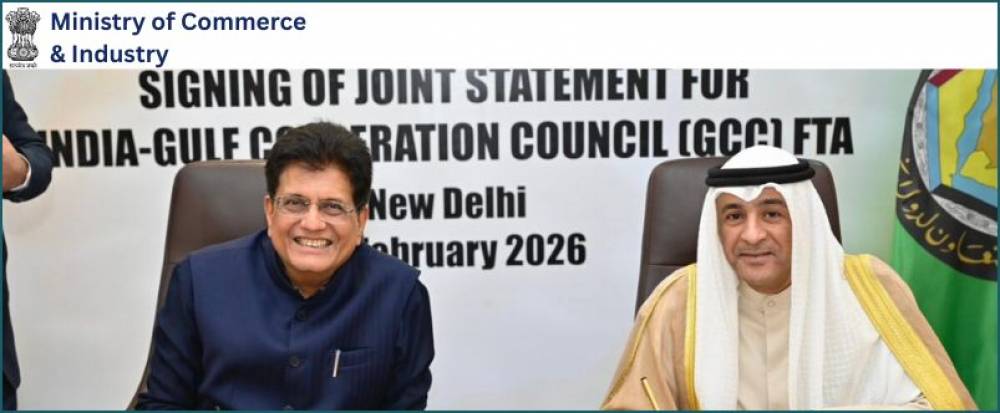
On 24 February 2026 in New Delhi, the Joint Statement on the India-GCC Free Trade Agreement was signed between Shri Piyush Goyal, Union Minister of Commerce and Industry and His Excellency Jasem Mohamed Albudaiwi, Secretary General of the Gulf Cooperation Council. This signing formally launched negotiations for mutually beneficial comprehensive agreement for both the parties. The event was attended by distinguished delegations as well as representatives from both the parties.
During the signing event, Shri Piyush Goyal highlighted the fact that this Statement, along with the Terms of Reference for FTA, which were signed on 5 February 2026, is seen as a major milestone in the relationship between India and the GCC countries. He stressed that the relationship deeply rooted in shared history and cultural connections would gain further momentum from a broad based and mutually beneficial FTA.
Also Read: India and US Seal a Trade Deal
The Union Minister noted that it is an opportune moment amidst global uncertainties to initiate discussions on negotiating a robust trading arrangement that harnesses mutual synergies as well as complementarities. It was emphasized by His Excellency Jasem Mohamed Albudaiwi that the FTA will serve as an important tool for further strengthening of the trade as well as investment ties between India and GCC countries via infusion of predictability and certainty for businesses.
There’s a significant potential that FTA holds for unlocking and expanding trade with an important region with which India has longstanding historical ties in trade and commerce. The GCC is India’s largest trading partner bloc. Their bilateral trade reached 178.56 billion USD (i.e., out this, Exports:- USD 56.87 billion; Imports:- USD 121.68 billion) in 2024-25 fiscal year. They accounted for exactly 15.42% of India’s global trade. Over the past five years, India's trade with the GCC has steadily expanded and registered an annual average growth rate of 15.3%.
The most important sectors of imports from GCC mainly comprise crude oil, LNG, petrochemicals and precious metals like gold. The most important exports from India to GCC include engineering goods, machinery, gems and jewellery and textiles. The GCC countries collectively represent a market of 61.5 million people (as of 2024) and a GDP of USD 2.3 trillion at current prices. They rank 9th globally within this category. The GCC region is also a significant source of foreign direct investment for India. Its cumulative investments exceed USD 31.14 billion as of September 2025.
Also Read: Top 10 Countries by GDP
The GCC is home to nearly a total of ten million Indian community members. This region acts as a living bridge. These strong and enduring people-to-people connections form the foundation of the relationship between India and the GCC countries, further reinforced by the substantial presence of Indian business entities across the region.
It is anticipated that the India-GCC FTA would fully unlock the trade potential between India and the GCC upon signing. It would serve as a force multiplier for global good while facilitating the expansion as well as diversification of exports and strengthening economic integration between the two sides.
Source: Press Information Bureau (PIB)
Comments
No comments yet.
Leave a Comment