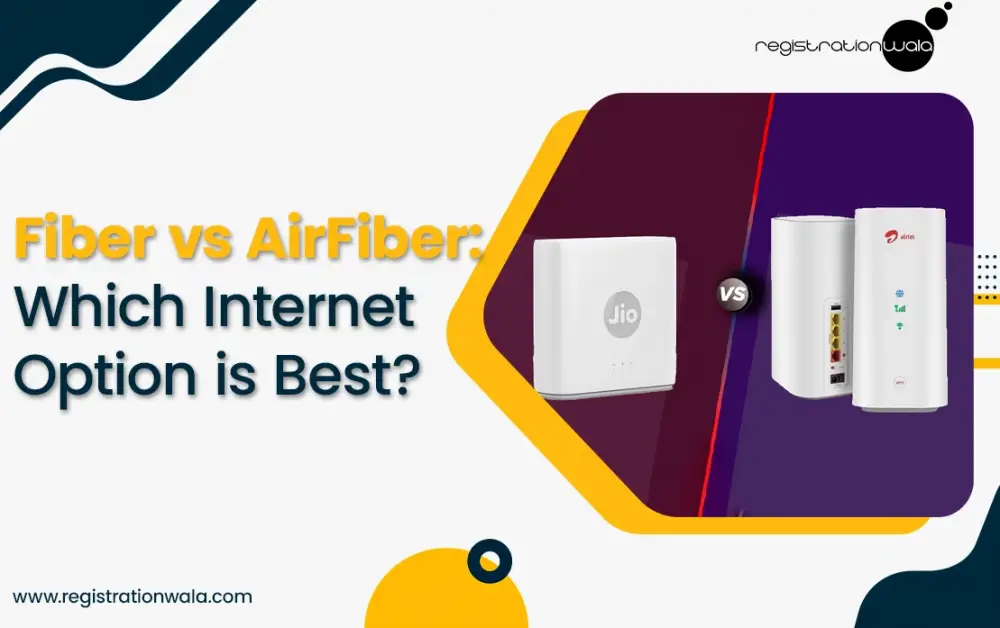
Both Fiber and AirFiber are modern high speed internet technologies that are quite prevalent in India. However, both of them work in very different ways. Fiber technology makes use of physical cables, that are laid underground/overhead, for delivering internet directly to the home of customers. On the contrary, AirFiber technology is a wireless technology that provides internet to customers via signals from nearby towers instead of physical cables.
If you are planning to start an ISP business in India, it is important that you understand all the major differences between these two popular technologies. This knowledge will help you choose the right setup for your business based on your target area, business budget and customer demand.
What is Fiber?
Fiber means an internet technology that delivers internet using thin cables made up of ultra-pure glass/plastic that are roughly the diameter of a human hair. These cables transmit data at near-light speeds over long distances with minimal signal loss and interference and ensure stable and reliable connectivity.
In today’s time, Fiber is inarguably one of the most advanced types of broadband available. Some people prefer wireless options for convenience, but fiber’s wired setup is actually its biggest strength. Because it uses physical cables, it is not affected by walls, distance inside the house or nearby devices. As a result, fibre is reliable for daily use.
Throughout the day, the internet speed offered by fiber tends to stay consistent, whether it’s early morning or late evening. There are minimal slowdowns even during peak hours. Fibre internet is now widely available in metro cities in India like Delhi, Mumbai, Pune, Bangalore, etc., and is quickly making its way to smaller towns as well.
Many ISPs are improving their infrastructure so as to reach more homes. If you are looking for an internet connection that stays consistent throughout the day, fiber internet might be suitable for you.
What is AirFiber?
AirFiber means an internet technology that delivers the internet using radio waves instead of using wires or cables. These radio waves carry internet data from nearby mobile towers to your home. To provide AirFiber, a small receiver or antenna is installed by the internet service provider at your home. AirFiber does away with the need of heavy wiring or drilling since there are no cables involved, making the installation a lot quicker and simpler compared to fiber internet.
In today’s time, AirFiber is becoming a popular broadband option because of its easy setup as well as its flexibility. Some people may wonder why people opt for fiber internet at all if airfiber is much easier to install and doesn’t require any wires. The reason is that AirFiber is a wireless technology that tends to be affected by distance from the tower, physical obstacles like walls and buildings and weather conditions.
For activities like browsing, streaming and attending online meetings, the speed of AirFiber is decent throughout the day. However, the real issue arises during peak hours when there are some speed fluctuations due to network congestion. In many parts of India, this technology is expanding, especially when we talk about areas where fibre infrastructure is limited or not yet available.
If you are looking for an internet connection that is quick to install and does not require cables, AirFiber can be a suitable option. However, it must be noted that while this technology may work for those with light usage, those with heavy usage like HD streaming on OTT platforms, online gaming, large downloads or multiple devices connected at the same time, can struggle due to inconsistent speeds and higher latency.
Fiber vs AirFiber: Comparison Table
Below, we have provided you with a comparison table that compares fiber vs airfiber. Once you go through the table, it’ll be easier for you to decide which internet technology best fits your requirements.:
|
Parameter
|
Fiber
|
AirFiber
|
|
Technology
|
Fiber delivers internet via thin cables made up of ultra-pure glass or plastic.
|
AirFiber delivers internet via radio waves transmitted from nearby telecom towers.
|
|
Ease of Installation
|
Quite complex when compared to AirFiber. For providing internet using fibre technology, the wires need to be installed.
|
Much easier than Fiber. For providing AirFiber technology, a small receiver or antenna needs to be installed.
|
|
Internet Speed Stability
|
Fiber provides extremely stable and consistent internet speed even while streaming on OTT platforms and video gaming.
|
Internet speed provided by AirFibre tends to fluctuate based on signal strength and traffic.
|
|
Performance during Adverse Weather conditions
|
Fiber technology tends to perform better than AirFiber during adverse weather conditions like heavy rains, storms, hailstorms, snowfall, etc. The underground cables are weather-resistant.
|
AirFiber, which is reliant on wireless signals transmitted via air, can experience disruptions/reduced speed during adverse weather conditions due to signal interference.
|
|
Wire Issues
|
Fibre cables/wires are susceptible to cable cuts due to rodents and construction.
|
No wires are used to provide AirFiber. Therefore, no wire issues need to be dealt with.
|
Conclusion
Fiber technology, which requires cable installation, is faster and remains stable even during adverse weather conditions. AirFibre, on the other hand, is wireless and does not require cable installation. Only a small receiver or antenna is needed. However, AirFibre tends to perform less reliably during adverse weather. Both the technologies have their pros and cons. The answer regarding which one is best for customers depends on their location, internet usage requirements and the availability of infrastructure.
Whether you plan to provide fiber internet or airfiber internet to customers, obtaining an ISP license is crucial. For assistance in obtaining this license, contact our team at Registrationwala.
Apply for Your ISP License Now
Frequently Asked Questions (FAQs)
Q1. When was AirFibre technology introduced by Reliance Jio in India?
A. The AirFibre technology was introduced by Reliance Jio in India in September 2023.
Q2. Does Fiber technology perform better than AirFiber technology during adverse weather conditions?
A. Yes, Fiber technology tends to perform better than AirFiber during adverse weather conditions such as heavy rain, storms, hail and snowfall, as its underground cables are more resistant to weather disruptions.
Q3. Is an ISP license required to provide fiber and airfiber internet to customers?
A. Yes, an ISP license is required to legally provide any type of internet service in India, including fiber internet and airfiber internet.