An investment advisory firm is a business entity that provides personalized investment advisory services to clients. In India, all the investment advisory firms are regulated by the Securities and Exchange Board of India (SEBI) under the SEBI (Investment Advisers) Regulations, 2013, as amended from time to time. In this blog post, we shall explain to our readers how to start an investment advisory firm in India.
What is an Investment Advisory Firm?

Investment advisory firm meaning can be explained as a SEBI-registered corporate entity that, in exchange for payment or non-cash benefits, provides investment advice regarding securities or investment products to clients or groups of clients, which can include both individuals and businesses.
By offering personalized investment guidance, the investment advisory firms help the clients to reach their investment goals. Such firms are legally bound by a strict fiduciary duty to shield the client’s interests above all else.
Establishing an Investment Advisory Firm: Key Steps Involved
The key requirements and steps involved in establishing an investment advisory firm in India from start to finish are described below:
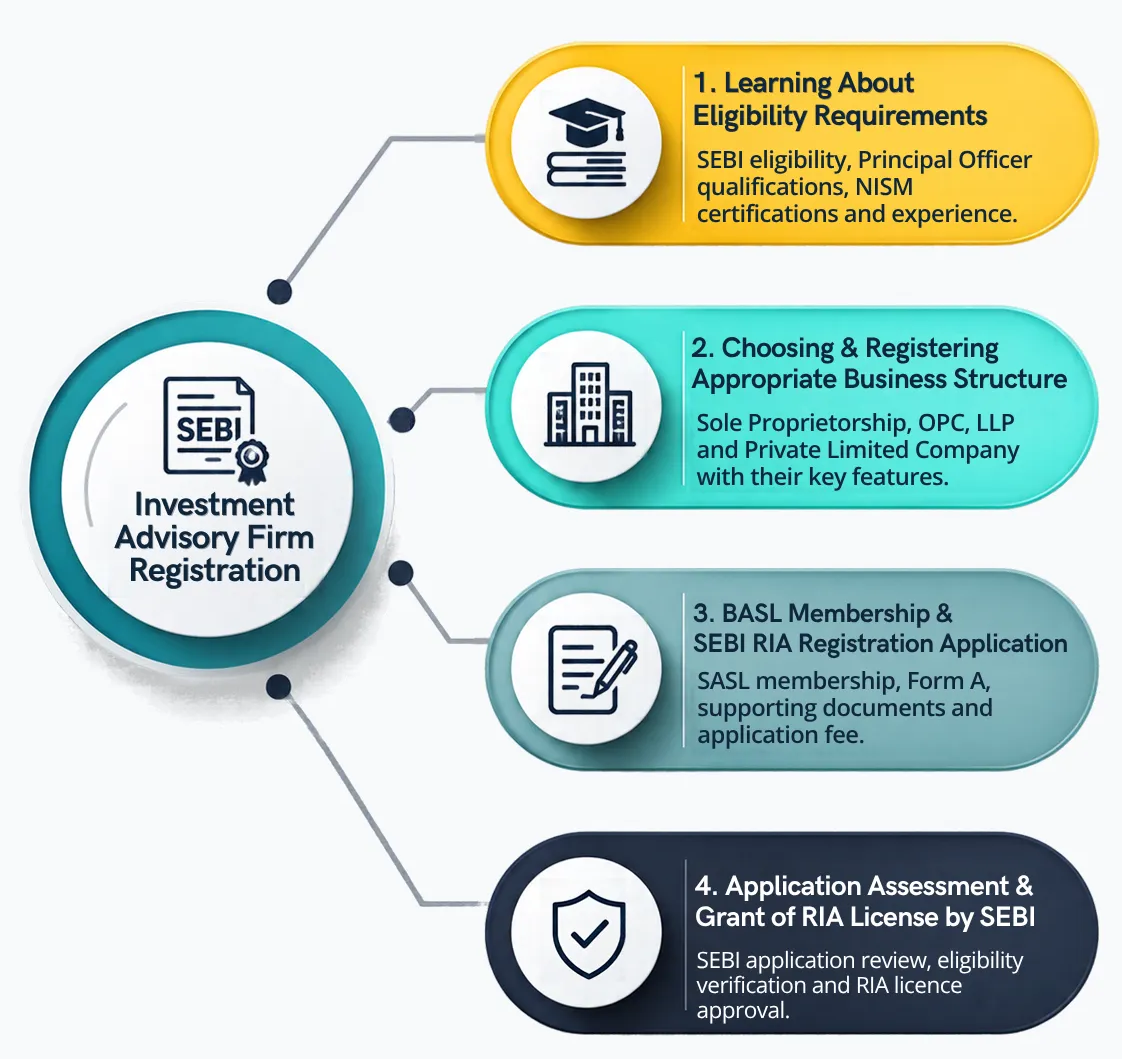
1. Learning About Eligibility Requirements
To start an investment advisory firm in India, you must first ensure that you meet SEBI's eligibility requirements relating to educational qualifications, professional experience and certifications. Each and every investment advisory firm must appoint a Principal Officer.
Such an individual must possess the prescribed professional qualification, postgraduate degree or equivalent qualification in finance, business management, accountancy, commerce, economics, capital markets, banking, insurance or a related field. In addition, the Principal Officer must hold valid NISM Series-X-A and Series-X-B certifications and also fulfil experience requirements.
Make sure all these criteria are met. Otherwise, the application for SEBI registration as an Investment Adviser may not receive approval. Apart from these, all other applicable eligibility and compliance requirements must be fulfilled as well. If you feel that you may be unable to meet any of these strict requirements, it is advisable to seek help from professional consultants.
2. Choosing & Registering Appropriate Business Structure
Next step is to choose an appropriate legal structure for your investment advisory firm. There are both corporate and non-corporate structures available that you can consider. Some popular options include Sole Proprietorship, One Person Company (OPC), Limited Liability Partnership (LLP) and Private Limited Company. Each structure has its own benefits as well as its fair share of limitations. So, it is really important to understand all of them carefully before making a decision.
For example, a Sole Proprietorship is suitable for an individual who wants to operate business independently and has a limited budget. It does not require incorporation with MCA, which leads to saving money that is generally spent on filing incorporation forms. That said, the proprietor has unlimited personal liability for business debts and obligations.
An OPC, on the other hand, offers limited liability and allows a single person to own and manage the company. This means you retain full control over decision-making without having to share profits with other shareholders. However, an OPC can have only one member/shareholder and requires completing a mandatory company registration process with RoC.
A Private Limited Company requires at least two shareholders. This means ownership, profit-sharing and decision-making can be shared between shareholders, depending on their respective shareholding and company's internal arrangements. It also requires mandatory registration.
Similarly, an LLP requires at least two partners. The partners of such a business entity can share profits, responsibilities and decision-making powers as agreed upon in LLP Agreement. This structure also requires undergoing a registration process with RoC. So, you must carefully understand features, benefits and limitations of each structure before choosing one that best aligns with your business objectives.
3. BASL Membership & SEBI RIA Registration Application
The principal officer of your firm must register with BASL (BSE Administration & Supervision Ltd) and obtain membership. After obtaining BASL membership, an application needs to be filed with SEBI for obtaining Registered Investment Advisor License, otherwise known as RIA License.
For filing application, you need to use prescribed form known as Form A. You must also attach necessary documents and pay application processing fee while filing SEBI RIA application.
4. Application Assessment & Grant of RIA License by SEBI
Once SEBI receives your RIA license application, it will carefully review all the details provided in it as well as supporting documents attached to it. This is done to ensure that you meet all the requirements for setting up an investment advisory firm.
If your application meets all the necessary requirements, SEBI will grant you RIA license. However, if it does not, SEBI may reject your application. Once you receive this license, your firm can finally start offering investment advisory services to clients.
Conclusion
A SEBI RIA license is required to start an investment advisory firm in India. However, the journey isn’t that simple. Before applying for this license, you need to understand and meet eligibility requirements, including Principal Officer and NISM certification requirements. Next, you must choose and register a business entity based on your business requirements. Then, you must obtain BASL membership.
Once all these steps are completed, you can proceed with filing your SEBI RIA license application. If SEBI is satisfied with details provided as well as supporting documents submitted, it will grant RIA license.
Need assistance with obtaining your SEBI RIA license? Connect with our team and let us make the entire process much easier for you!
Free RIA License Consultation
Frequently Asked Questions (FAQs)
Q1. What is the validity of SEBI RIA registration?
A. The SEBI registered investment advisor registration comes with a perpetual validity, meaning that it never expires. The registration becomes invalid only in case it is surrendered or cancelled by SEBI.
Q2. Which authority issues the RIA registration to investment advisory firms in India?
A. The Securities and Exchange Board of India (SEBI) issues RIA registration to investment advisory firms in India.
Q3. Which form needs to be filed with SEBI for RIA license?
A. For obtaining RIA license, Form A needs to be filed with SEBI.
Q4. Is it mandatory to obtain BASL membership before filing an application for SEBI RIA registration?
A. Yes. It is absolutely mandatory for you to obtain BASL membership prior to filing an application for RIA registration with SEBI.
-
Published: November 07, 2026
123 Views