In India, mutual fund companies are becoming increasingly popular day by day. This is because more and more individuals are now beginning to realise the potential mutual funds have for wealth creation. Some of the most popular mutual fund companies out there are SBI Mutual Fund, HDFC Mutual Fund and ICICI Prudential Mutual Fund.
If you are a financial entrepreneur who wants to enter asset management space, you can consider starting a mutual fund company in India. In this blog post, we shall explain how to start a mutual fund company in the country by explaining the major structural, capital and regulatory requirements.
What is a Mutual Fund Company?

A Mutual Fund Company is a popular type of investment company registered with the Securities and Exchange Board of India (SEBI) under the SEBI (Mutual Funds) Regulations, 2026, which came into effect on 1 April 2026 and replaced the previously long-standing SEBI (Mutual Funds) Regulations, 1996.
Such a company pools money from various investors, including retail individuals, high-net-worth individuals and institutional investors, and then uses the collected amount to buy a diversified portfolio of securities such as stocks, bonds or other securities. This portfolio is called a mutual fund portfolio or simply an investment portfolio.
As the portfolio’s value goes up, the net asset value of the fund also goes up. This causes the market value of the investors’ shares to rise. In contrast, if the value decreases, so does the net asset value of the fund and market value of investors’ shares. However, the loss is generally lower as the portfolio is managed by experienced professionals who have thorough knowledge regarding how the market works.
Why Start a Mutual Fund Company in India?
Mutual funds companies are seen as high potential ventures by many because they assist investors in achieving their financial goals, such as long term capital appreciation, retirement planning, funding a home or financing education and marriage.
Many investors believe that solely relying on a salary or a single source of income is insufficient to meet their goals in today’s world. Therefore, investing in the right mutual funds schemes is really important. These schemes can help individuals reach their objectives more quickly, although it is important to remember that there is always some level of risk involved.
Helping people meet their financial goals can certainly be a rewarding endeavor. To provide their services, mutual funds companies primarily earn revenue through expense ratio, which is an annual management fee charged as a percentage of total assets under management (AUM).
Eligibility Criteria for Mutual Funds Company Registration
For mutual funds company registration, the eligibility requirements are prescribed under Regulation 5 of the SEBI (Mutual Funds) Regulations, 2026. These requirements include the following:
The “sponsor” means any person who, acting individually or in concert with another body corporate, sets up a mutual fund or a mutual fund lite. As part of eligibility criteria, they shall have a general reputation of fairness and integrity in all business transactions. In addition, they shall fulfill the criteria relating to “sound track record” given under Route 1 or Route 2:
|
Particulars
|
Route 1
|
Route 2
|
|
Experience
|
The sponsor must be carrying on business in financial services for minimum five years.
Appoint Chief Executive Officer, Chief Operating Officer, Chief Risk Officer, Chief Compliance Officer and Chief Investment Officer in the asset management company (AMC) with a minimum of 3 years of relevant experience.
|
Appoint Chief Executive Officer, Chief Operating Officer, Chief Risk Officer, Chief Compliance Officer and Chief Investment Officer in the AMC with total combined experience in the relevant field of at least thirty years and each of them shall have a minimum of 3 years of relevant experience.
|
|
Profitability
|
Net profit in financial services business after providing for depreciation, interest and tax in each of the immediately preceding five years and;
Average net annual profit of at least rupees ten crore, after depreciation, interest and tax, from financial services business during the immediately preceding five years.
|
Under this route, there is no profitability criteria for granting a certificate of registration.
|
|
Net worth of sponsor
|
The sponsor must have a Positive net worth in each of the preceding five years.
|
N/A
|
|
Positive Liquid Net worth
|
Positive liquid net worth is more than the proposed capital contribution of the sponsor in the asset management company.
|
Positive liquid net worth is more than the proposed capital contribution of the sponsor in the asset management company.
|
|
Net worth of asset management company
|
The sponsor shall ensure that the net worth of asset management company is at least fifty crores (Rs. 50 Crores) and deployed in assets as may be specified by the Board, at all times.
The sponsor shall ensure maintaining the net worth requirement on a continuous basis.
|
Net worth of the asset management company shall be at least rupees one hundred fifty crore (Rs. 150 Crores) at the time of registration which shall be infused by the sponsor.
However, the asset management company shall maintain net worth of at least one hundred crores deployed in assets as may be specified by the Board, on a continuous basis: Provided that if asset management company has profits for five consecutive years, the net worth of asset management company shall be maintained at least rupees fifty crore.
The sponsor shall ensure maintaining the net worth requirement on a continuous basis.
|
|
Lock-in Requirement
|
No lock-in requirements for certificate of registration under this route.
|
The initial shareholding equivalent to capital contributed to the asset management company, to the extent of at least Rs. 150 Crores shall be locked-in for a period of five years.
|
Other Eligibility Criteria
Other eligibility requirements include:
|
S.No.
|
Particulars
|
Requirements
|
|
(a)
|
Fit and proper requirement for sponsor and mutual fund
|
Applicant and mutual fund shall comply with fit and proper criteria specified under Schedule II of the Securities and Exchange Board of India (Intermediaries) Regulations, 2008.
|
|
(b)
|
Minimum holding of sponsor in an asset management company
|
The sponsor shall contribute at least 40% to net worth of asset management company: Provided that any person who holds 40% or more of the net worth of an asset management company shall be deemed to be a sponsor and shall be required to fulfill the eligibility criteria specified in this regulation.
|
|
(c)
|
Fit and proper requirement for sponsor, its directors or the key personnel to be employed by the mutual funds company and/or asset management company
|
The sponsor or any of its directors or the key personnel to be employed by the mutual fund and asset management company should not have been guilty of fraud or been convicted of an offence involving moral turpitude or been found guilty of any economic offence.
|
|
(d)
|
Appointment of trustees
|
Appointment of trustees to act as trustees for the mutual fund shall be in accordance with the provisions of the regulations.
|
|
(e)
|
Appointment of asset management company
|
Appointment of asset management company to manage the mutual fund and operate the scheme of such funds shall be in accordance with the provisions of these regulations.
|
|
(f)
|
Appointment of custodian
|
Appointment of custodian in order to keep custody of the securities or goods or gold or gold related instruments or silver or silver related instruments or other assets of the mutual fund held in terms of these regulations, and provide such other custodial services as may be authorised by the trustees.
|
|
(g)
|
Other conditions
|
Other conditions in this regard as may be specified by the Board are complied with.
|
|
(h)
|
Approval to establish a Specialized Investment Fund
|
A mutual fund registered under clause (e) of regulation 3 may be granted an approval to establish a Specialized Investment Fund subject to fulfilling such additional eligibility criteria and in the manner as may be specified by the Board.
|
|
(i)
|
Eligibility criteria for sponsor of mutual fund lite
|
The eligibility criteria for sponsor of mutual funds lite shall be as specified under Chapter X and the above mentioned eligibility criteria shall not be applicable to application for mutual fund lite.
|
Source: SEBI (Mutual Funds) Regulations, 2026, Regulation 5 - Eligibility Criteria for Registration
Mutual Fund Company Registration: Complete Step-by-Step Process
The mutual fund company registration process is as follows:
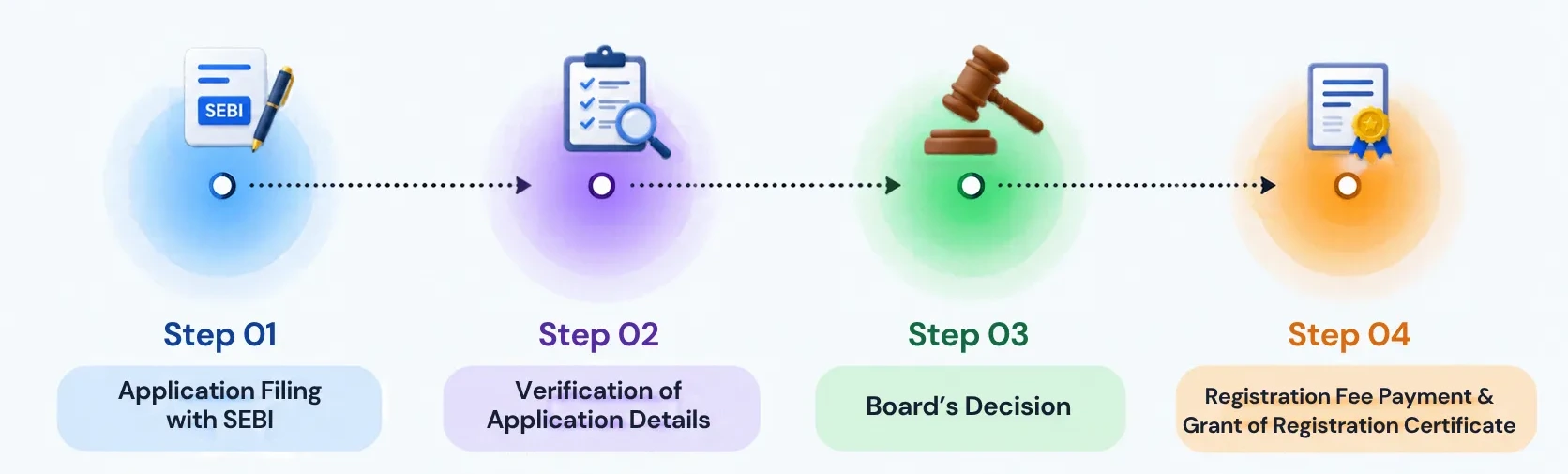
Step 1: Application Filing with SEBI
The sponsor must file a completed application for mutual funds registration with SEBI in the prescribed manner. While filing the application, they must also pay the application fee.
Step 2: Verification of Application Details
After receiving the application, the Board will verify the application details. If required, it may direct the sponsor to provide additional information or clarification.
Step 3: Board’s Decision (i.e., Approval or Rejection of Application)
After receiving all the required information, the Board shall decide whether to approve the application or not.
Step 4: Registration Fee Payment & Grant of Registration Certificate
If satisfied that the application complies with the eligibility criteria and other requirements along with payment of registration fee, the Board shall register the mutual fund and grant the certificate of registration.
However, if the sponsor fails to satisfy the eligibility criteria and other requirements, the application shall be liable to be rejected. If the application is rejected, the same shall be communicated to the applicant.
Also Read: AMFI Code of Conduct for Mutual Fund Distributors
Final Words….
Starting a mutual funds company in India is often a highly profitable venture. However, starting such a company isn’t a cakewalk. It requires fulfilling a lot of strict legal and regulatory requirements pertaining to net worth, track record, leadership experience, and profitability among others.
For assistance in starting a mutual fund business in India, you can get in touch with our SEBI compliance consultants at Registrationwala.
Contact Us
Frequently Asked Questions (FAQs)
Q1. Who is a sponsor under the SEBI (Mutual Funds) Regulations, 2026?
A. Under SEBI (Mutual Funds) Regulations, 2026, a “sponsor” means “any person who, acting individually or in concert with another body corporate, establishes a mutual fund or a mutual fund lite.”
Q2. Which authority issues a certificate of registration to mutual funds companies in India?
A. The Securities and Exchange Board of India issues a certificate of registration to mutual fund companies registered in India.
Q3. What is the validity of the certificate of mutual funds company registration?
A. This certificate offers perpetual validity, meaning that it does not expire unless voluntarily surrendered or revoked by SEBI. That said, the certification holders need to pay an annual fee to SEBI as part of the mutual funds registration compliance requirements.
Q4. Which regulations govern the registration of mutual fund houses in India?
A. The primary regulations governing the registration of mutual funds companies/houses in India are SEBI (Mutual Funds) Regulations, 2026, which came into force on 1 April 2026.
Q5. Which business structure is eligible for SEBI mutual funds registration?
A. For obtaining the SEBI mutual funds registration, the mutual fund needs to be incorporated as a trust under the Indian Trusts Act, 1882. Additionally, the trust deed must be registered under the Indian Registration Act, 1908.
Disclaimer:- This blog post is meant to provide a basic understanding of how the process of registering a mutual funds company works. Apart from the requirements explained in this blog post, there might be additional requirements. Therefore, for complete guidance, we recommend verifying from official government sources or connecting with a professional consultant.
-
Published: November 04, 2026
93 Views