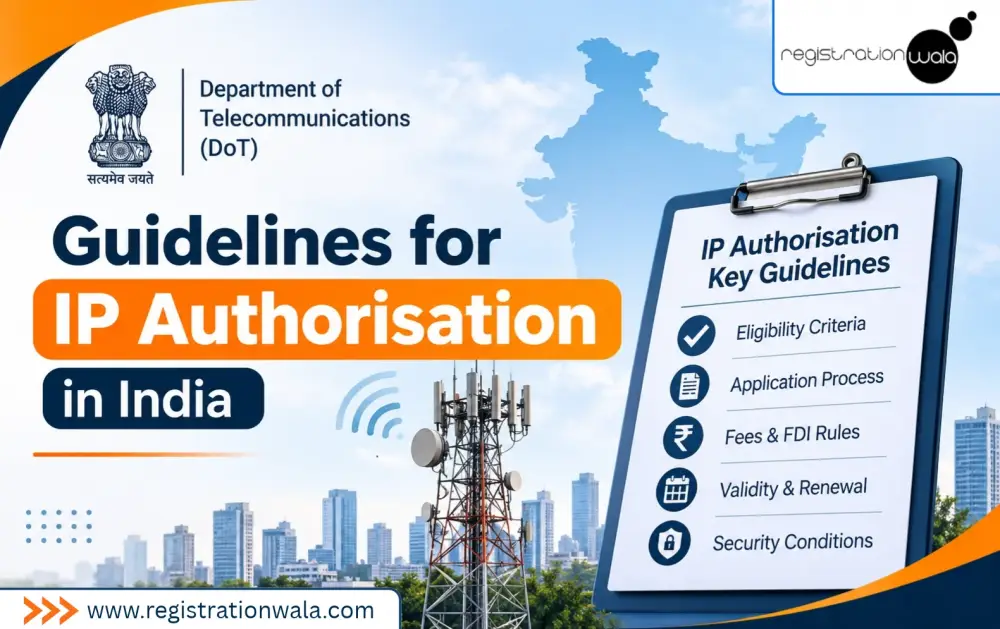
IP Authorisation, formerly known as the IP1 license, is a regulatory permit granted by the Department of Telecommunications (DoT). It allows the authorisation holder to establish, operate, maintain or expand passive telecom infrastructure in India.
In this blog post, we shall discuss the latest guidelines for IP authorisation. If you are planning to apply for this authorisation in near future, knowing about these guidelines is highly recommended.
What is IP Authorisation?
IP Authorisation full form is Infrastructure Provider Authorisation. It is a telecom authorisation issued by Department of Telecommunications (DoT), Ministry of Communications, Government of India. As the name suggests, the ‘Infrastructure Provider’ authorisation allows the authorisation holder to provide telecom infrastructure. Now, what exactly does this infrastructure include? It specifically refers to passive telecom infrastructure such as dark fibre, right-of-way, duct space, towers, antennas, base stations and in-building solution infrastructure.
Entities holding this authorisation can lease, rent or sell these passive infrastructure assets to licensed Telecom Service Providers (TSPs) and earn profits through these arrangements. The infrastructure must be shared with TSPs on a fair and non-discriminatory basis.
The IP authorisation covers the national service area, which includes territory of India, its territorial waters, continental shelf and Exclusive Economic Zone. This authorisation is specifically governed by Telecommunications (Authorisation for Telecommunication Network) Rules, 2026 w.e.f. 20 July 2026. These rules form part of the framework for operationalising Telecommunications Act, 2023.
The latest telecom guidelines for the IP authorisation in India are detailed below.
(a) Eligible Entities for IP Authorisation
The IP authorisation applicant must be a company incorporated under the Companies Act, 2013. In addition, the company must be able to prove skilled management and showcase a responsible track record in telecom sector.
Individual applicants cannot obtain this authorisation. LLPs incorporated under the LLP Act, 2008, partnership firms incorporated under the Indian Partnership Act, 1932, cooperative societies, etc., are also ineligible.
(b) Scope of Authorisation
Infrastructure provider authorization allows entities to establish, operate, maintain or expand passive telecommunication infrastructure, right-of-way or in-building solution infrastructure. Each newly authorized entity is permitted to handle only those telecommunication networks that fall within the scope of its authorization.
They are not allowed to operate any other telecommunication networks that require separate authorization from the Central Government. Every authorized entity must ensure its telecommunications network or installation does not pose a safety or health hazard and complies with all applicable laws.
(c) Application Filing Mode for IP Authorisation
The application for IP Authorisation must be filed with the DoT online through the Telecom eServices Portal, in the prescribed manner. The Department will not entertain any physical or offline applications.
(d) No Entry Fee or Initial Guarantee Requirement
No entry fee or initial guarantee needs to be paid for the IP1 authorisation. Only an application processing fee of Rs. 10,000 needs to be paid by the applicant for this specific authorisation.
(e) Foreign Direct Investment (FDI) is Permitted
Foreign direct investment (FDI) in the IP authorisation holder is permitted up to 100% under automatic route. It must be in conformity with the FDI policy issued by the Government of India from time to time and the applicable laws.
(f) Validity of Authorisation & Renewal Requirement
The infrastructure provider authorisation offers an initial validity period of 20 years. An application for renewal must be filed at least 12 months prior to the expiry of the current authorisation, accompanied by the application processing fee. If this authorisation is not renewed in a timely manner, then it shall expire at the end of the validity period.
(g) Maintenance of Records
Every new authorised entity shall ensure that all documentation, including software details of telecommunications equipment and systems, is obtained in English from the manufacturer, vendor or supplier and properly preserved. It must also maintain records of all software updates and changes and provide details of such updates and changes to the Central Government within fifteen days of their completion as determined by Central Government from time to time.
It is important to note that this particular requirement shall not affect obligations of a new authorised entity relating to critical telecommunications infrastructure under the Telecommunications (Critical Telecommunication Infrastructure) Rules, 2024. Further, the entity must obtain and maintain records of supply chain information of telecommunications equipment and systems from the manufacturer, vendor or supplier at the time of procurement.
It is also required to maintain a manual containing the operation and maintenance procedures along with records of all operations and command logs. These logs must include details of each command, the executing authority, date, time and location. They must be maintained in a manner that enables access by Central Government or its designated agency in real time for at least 12 months and, thereafter, in non-real-time digital format for next 24 months.
(h) Conditions for Migration
The existing licensee (IP-1 license holder) must submit an application for migration in accordance with the Telecommunications (Terms and Conditions for Migration) Rules, 2026.
If the migration includes overlapping authorizations, then in such a case, the relinquishment of those authorizations will take effect from the date the migration becomes effective.
(i) General Security Conditions
Every IP Authorization holder is responsible for the security of its telecommunications network and implement necessary measures to ensure that security. It must offer facilities to respond to situations involving espionage, subversive acts, sabotage or any other unlawful activity. It must take all necessary steps to protect privacy as well as confidentiality of any information related to eligible new authorized entities that it supports with telecommunications network infrastructure.
The IP Authorization holder is also required to create facilities for monitoring all intrusions, attacks and frauds on its technical facilities within 12 months from effective date of the authorisation and submit reports regarding the same through Telecom eServices Portal. Further, every authorization holder must implement appropriate technical and organisational measures along with reasonable security safeguards to ensure effective compliance with provisions of the Rules.
(j) Breach of Security Provisions
Any civil penalty imposed for violating security provisions by the IP authorisation holder shall not affect any other liabilities or criminal proceedings under applicable law.
Also Read: New VNO Authorisation Rules in India 2026
In a Nutshell
The IP authorisation is governed by Telecommunications (Authorisation for Telecommunication Network) Rules, 2026, which came into effect on 20 July 2026. IP Authorisation holders are permitted by DoT to establish, operate, maintain or expand passive telecom infrastructure across India. Obtaining this very authorisation requires applicants to meet certain requirements pertaining to eligibility, application filing, record maintenance, security and compliance.
Companies planning to obtain IP authorisation must ensure that they meet all the prescribed conditions and follow latest DoT guidelines. Need assistance in obtaining the Infrastructure Provider Authorisation from DoT? Get in touch with our telecom consultants at Registrationwala for complete support.
Get Free Telecom Consultation
Frequently Asked Questions (FAQs)
Q1. How long does the infrastructure provider authorisation remain valid?
A. Initially, it remains valid for a period of 20 years. To ensure continuity of business operations after this period, renewal is required. The application for authorisation renewal must be filed 12 months prior to expiry of the current authorisation.
Q2. Which authority grants the infrastructure provider authorisation in India?
A. The Department of Telecommunications grants this authorisation in India.
Q3. Which telecom rules govern the IP authorization?
A. The Telecommunications (Authorisation for Telecommunication Network) Rules, 2026, which came into effect on 20 July 2026, govern the infrastructure provider authorization.
Q4. What is the entry fee, initial guarantee and application processing fee for the infrastructure provider authorisation?
A. There is no entry fee or initial guarantee requirement for this specific authorisation. However, it does require payment of application processing fee of Rs. 10,000.
Q5. Which is the designated portal for filing the IP authorization application?
A. The designated portal for filing the application is Telecom eServices Portal, which is managed by the DoT.
Q6. Are LLPs incorporated under the LLP Act, 2008, eligible for the IP authorization?
A. No. LLPs are ineligible for obtaining this authorization. As part of eligibility requirements, the applicant must be a company incorporated under the Companies Act, 2013.
|
Disclaimer:- This blog post is purely meant for general informational purposes. It should not be relied upon as the sole basis for making any business, finance or investment decisions. Rules and regulations may change from time to time, so readers are advised to check the official DoT website or consult a qualified telecom consultant for latest information.
|
-
Published: November 03, 2026
118 Views