The Virtual Network Operators (VNOs) are vital to the telecom industry. They are basically telecom entities that provide telecom services to customers without owning the underlying telecom network infrastructure. Instead, they use the network infrastructure of a licensed Parent Network Service Operator (NSO) through an agreement.
In this blog post, we shall discuss the latest VNO authorisation rules in India in 2026. If you are planning to enter the telecom industry as a VNO, we recommend you to check out this blog post.
What is VNO Authorisation?
VNO Authorisation, also known as a VNO license, is a legal permit issued by the Department of Telecommunications (DoT) in India under the Telecommunications (Authorisation for Provision of Principal Telecommunication Services) Rules, 2026. It allows a telecom entity to provide telecom services using the network infrastructure of a Parent Network Service Operator (NSO).
A VNO Authorisation comes in different categories, such as Unified Service Authorisation - VNO, which covers multiple principal telecommunication services, and Internet Service Authorisation - VNO, which allows a VNO to provide Internet services to customers within the scope of the authorisation. Each VNO Authorisation in India has an initial validity period of 20 years and can thereafter be renewed for continuous operations.
Latest VNO Authorisation Rules (2026)
To operate as a VNO entity in India, VNO Authorisation must be obtained from the DoT. However, before jumping right into the application process, it is important to know the latest rules and requirements. So, let us take a look at the latest VNO Authorisation rules applicable in India in 2026:-
1. Eligible Business Entities for VNO Authorisation
Only a company registered under the Companies Act, 2013 (except OPC) is eligible for the VNO license India. This means that individuals or business structures like limited liability partnerships and partnership firms are ineligible.
2. VNO Authorisation Cost and Financial Requirements
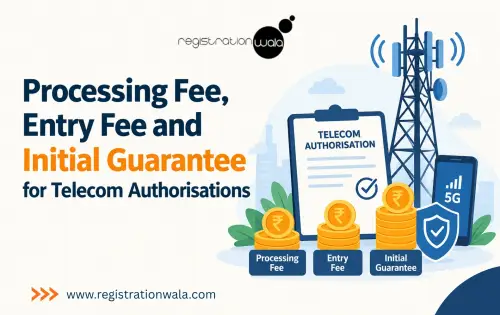
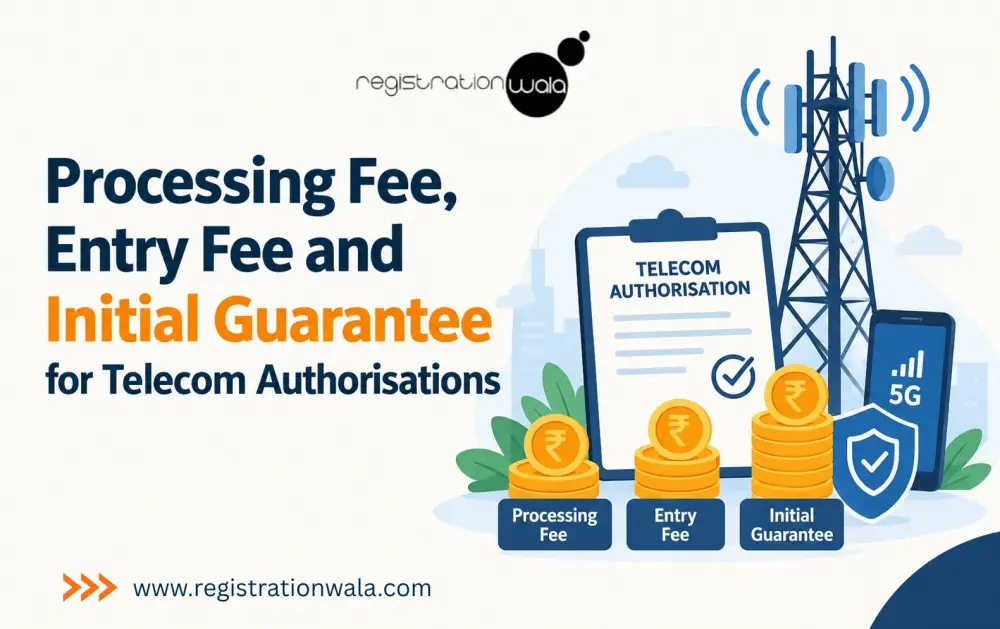
While applying for the VNO Authorisation, the entity must ensure that it is able to fulfil all the applicable financial requirements, including the processing fee, entry fee, initial guarantee, minimum equity capital and minimum net worth. The applicable financial requirements for different VNO Authorisations are given in table below:
| S. No. |
Service Authorisation |
Processing Fee (Rs.) |
Entry Fee (Rs.) |
Initial Guarantee (Rs.) |
Minimum Equity Capital |
Minimum Networth |
| 1 |
Unified Service Authorisation - VNO |
1 Lakh |
3 crores |
4.4 Cr |
10 Cr |
10 Cr |
| 2 |
Access Service Authorisation - VNO |
10,000 |
12.5 Lakh (6.25 Lakh for North East and Jammu and Kashmir) |
20 Lakh |
1 Cr |
1 Cr |
| 3 |
Internet Service Authorisation (National area) - VNO |
10,000 |
10 lakh |
1 Lakh |
10 Lakh |
NIL |
| 4 |
Internet Service Authorisation (Telecom circle/metro service area) - VNO |
10,000 |
50,000 (25,000 NE/J&K) |
10,000 |
1 Lakh |
NIL |
| 5 |
Long Distance Service Authorisation - VNO |
10,000 |
25 Lakh |
50 Lakh |
1 Cr |
1 Cr |
| 6 |
Wireline Access Service Authorisation - VNO |
10,000 |
50,000 (25,000 for North and Jammu and Kashmir) |
10,000 |
1 Lakh |
NIL |
3. Mode of VNO Application
The VNO application form must be filed online through the Telecom eServices Portal. This application form cannot be submitted physically to the DoT. While filing the VNO application online, the processing fee must be paid through any of the payment methods available on the portal.
4. Annual Authorisation Fee
Entities with a VNO Authorisation are required to pay an annual authorisation fee, which is 8% of their Adjusted Gross Revenue (AGR). This fee also includes the contribution towards Digital Bharat Nidhi. Spectrum-related charges are to be paid separately, wherever applicable.
5. Renewal of VNO Authorisation India
VNO Authorisation is initially valid for a period of 20 years. To continue providing telecom services after this validity period, the VNO is required to apply for renewal with the Department. The renewal application must be filed online via DoT Telecom eServices Portal at least 12 months prior to expiry of current authorisation.
However, if the VNO fails to apply within this period, a renewal application may be submitted up to 4 months before the expiry date. However, in this case, the entity will be required to pay applicable late fees and fulfill other conditions set forth by the DoT.
6. Dependency on Parent NSO
A telecom entity that holds VNO Authorisation has to enter into an agreement with a Parent NSO for providing authorized telecom services. The VNO provides services using telecom network of Parent NSO as per terms and conditions of agreement signed by both of them.
A VNO may establish and operate certain systems as permitted by DoT. However, it cannot provide the authorised telecom services independently of the required arrangement with a Parent NSO at any given point in time.
7. Rules for Existing VNO Licence Holders
VNO entities that were authorised under earlier telecom licensing framework can continue to provide services under their existing VNO licence until expiry of the current licence. However, fresh VNO authorisation applications are now strictly governed by Telecommunications (Authorisation for Provision of Principal Telecommunication Services) Rules, 2026.
This means that entities applying for a new VNO Authorisation in 2026 and onwards will now have to apply under new authorisation framework rather than doing it under the earlier VNO licensing regime. Existing VNO licence holders may therefore continue under their existing licence until its validity expires while new applicants will be required to obtain applicable VNO Authorisation under 2026 Rules.
8. Need for Migration under New Authorisation Framework
When a VNO license with definite validity (issued under old framework) is approaching its expiration date, the license holder is required submit an application for migration under Telecommunications (Terms and Conditions for Migration) Rules, 2026. According to the DoT migration rules, applications for the migration of licenses with a defined validity period must generally be filed at least 12 months before the license expires, in accordance with applicable rules and exceptions.
However, if a licensee intends to transition to new framework before license expires in order to expand the scope of services, then they may apply for migration, subject to the approval of Department of Telecommunications.
9. FDI Rules for VNO Authorisation
The Government permits Foreign Direct Investment (FDI) in VNO entities, subject to applicable conditions, including security-related requirements. A VNO entity receiving foreign investment must ensure that such investment is in accordance with FDI policy issued by Government of India from time to time and all other applicable laws.
10. Services Limited to the Authorisation Held
A VNO entity can only provide the services covered under the VNO Authorisation it holds. It cannot provide services that fall under a different telecom authorisation unless it obtains the relevant authorisation.
For instance, a VNO holding a Wireline Access Service Authorisation - VNO cannot provide services covered under Internet Service Authorisation (National Area) - VNO without obtaining applicable authorisation.
How to Obtain VNO Authorisation:- Complete Process
The entire process of obtaining VNO authorisation is digital and needs to be completed via the Telecom eServices Portal of DoT. Below, we have explained all the major steps involved in this process:-
Step 1:- Incorporate a Company
The first step is to incorporate an eligible company under the Companies Act, 2013. For this, the SPICe+ form needs to be filed online via MCA portal. After successful incorporation, the company receives a certificate of incorporation, which serves as official proof of company registration.
Step 2:- Choose the Required VNO Authorisation
There is not just one type of VNO Authorisation in India. There are many different VNO Authorisations and each one of them covers specific telecom services. Therefore, you need to choose the right authorisation based on the services you want to provide. If you are unsure about which VNO Authorisation is suitable for your business, you can connect with our consultants for guidance.
Step 3:- Prepare the Necessary Documents
Before you start filing the online application through the Telecom eServices Portal, make sure that all the necessary documents are prepared and ready. The documents required for the application may vary depending on type of VNO Authorisation you are applying for.
Step 4:- Fill Out & Submit the Application Form
After you’ve ensured that you have all the required documents, you can begin filling out the required details in the application form online. Make sure that all the details you enter are accurate. Don’t skip any of the mandatory fields.
Then, attach all the required documents along with the application. While filing the form, you must also pay the applicable fee as prescribed by the DoT.
Step 5:- Verification by DoT
Once you’ve filed the application online, the DoT shall carefully examine the details provided and the documents attached. If required, it may request clarification or additional information or documents related to your entity
Step 6: Issuance of LoI
After verification, if the Department finds your entity eligible, it shall issue a Letter of Intent (LoI). Your entity must then comply with LoI conditions and also submit VNO entry fee and initial guarantee.
Step 7:- Grant of VNO Authorisation
Upon successful compliance, your entity will finally receive the VNO Authorisation from the Department. Once the authorisation is received, you can begin providing the services authorised under it.
After approval, your entity must also ensure that all post-authorisation compliance requirements are followed at all times, such as payment of the annual authorisation fee, timely renewal, etc.
In a Nutshell
A VNO authorisation is required for entities that want to provide telecom services using the network infrastructure of a Parent NSO. The authorisation is granted by the Department of Telecommunications, with different categories available depending on type of telecom services the entity intends to provide. The entire application process is online through Telecom eServices Portal. Applicants must also comply with applicable rules regarding Parent NSO agreement, annual authorisation fee, renewal and other compliances.
If you need further assistance in understanding the VNO authorisation rules or filing a VNO application, you can connect with our team at Registrationwala.
Get Free Telecom Consultation
Frequently Asked Questions (FAQs)
Q1. Which authority is responsible for granting telecom authorisations in India?
A. The Department of Telecommunications is the concerned authority for granting telecom authorisations in India.
Q2. What is the minimum net worth requirement for Wireline Access Service Authorisation - VNO?
A. There is actually no minimum net worth requirement for this particular telecom authorisation.
Q3. What is the processing fee for Unified Service Authorisation - VNO?
A. The processing fee for Unified Service Authorisation - VNO is Rs. 1,00,000.
Q4. Can a VNO provide telecom services without entering into an agreement with a parent NSO?
A. No. Without entering into a commercial and operational agreement with a parent NSO, it is not possible for a VNO to provide the telecom services.
Q5. What is the validity of a VNO authorisation?
A. VNO authorisation granted by the DoT offers an initial validity of 20 years. For continued operation after this period, VNO authorisation renewal is mandatory.
|
Disclaimer:- This blog post is intended for general informational purposes only and should not be relied upon as the sole basis for making any decision. Rules and regulations may change from time to time, so readers are advised to check the official DoT website or consult a qualified telecom consultant for latest information.
|
-
Published: October 08, 2026
40 Views