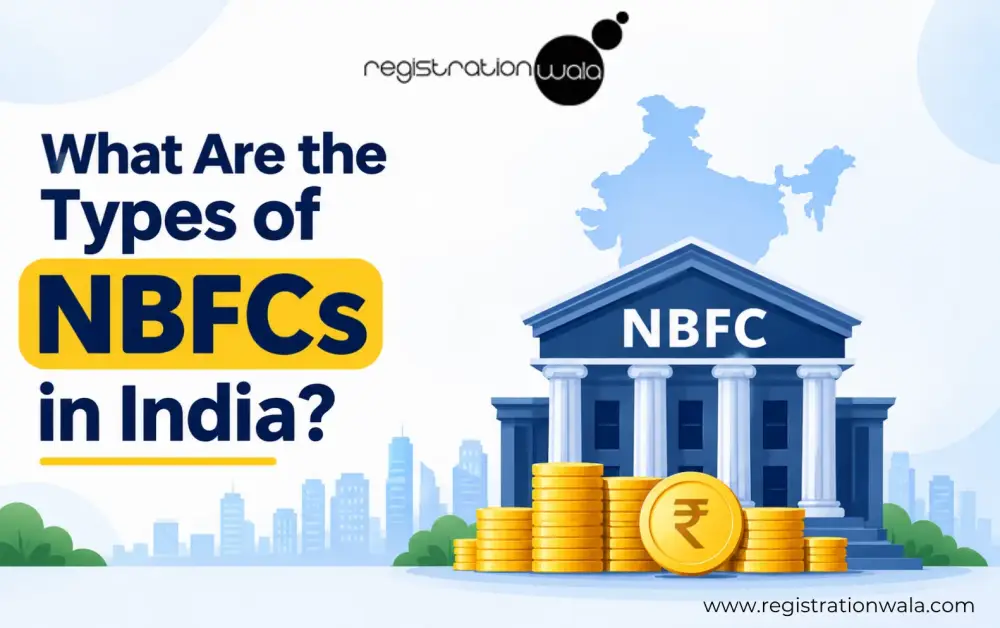
Non-Banking Financial Companies, abbreviated as NBFCs, form an integral part of India’s financial system. These companies provide services quite similar to traditional banks. The NBFCs extend funding to the underserved and unorganized sectors in the country through financial solutions like vehicle loans, loan against property, gold loan, etc. However, they cannot accept demand deposits unlike traditional banks.
The Reserve Bank of India (RBI) is the primary authority for regulating the NBFCs under the RBI Act, 1934. In this blog post, we shall discuss the different types of NBFCs in India.
What is a Non-Banking Financial Company (NBFC)?
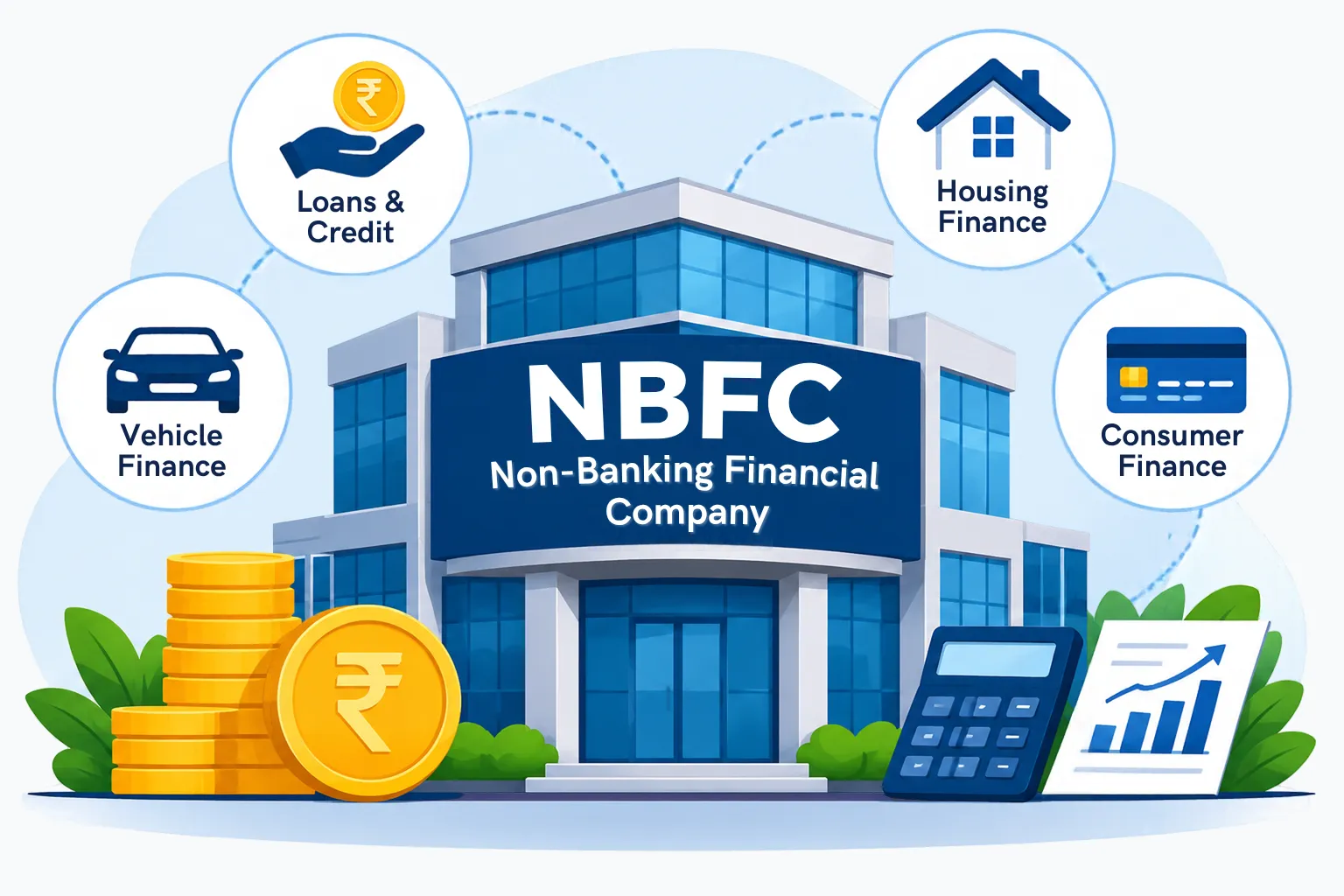
According to the central bank, an NBFC is a “company registered under the Companies Act, 1956 or Companies Act, 2013, and engaged in the business of loans and advances, acquisition of shares/ stocks/ bonds/ debentures/ securities issued by Government or local authority or other marketable securities of a like nature, leasing, hire-purchase, etc., as their principal business, but does not include any institution whose principal business is that of agriculture activity, industrial activity, purchase or sale of any goods (other than securities) or providing any services and sale/ purchase/ construction of immovable property.”
An NBFC helps individuals and businesses meet their financial needs through services such as loans, leasing and investments. It is especially beneficial for underserved and unorganised sectors as it provides them with access to financial services that may not be easily available through traditional banks. While it performs many banking-like functions, it operates without a full banking licence and cannot accept demand deposits like traditional banks.
Different Types of NBFCs in India
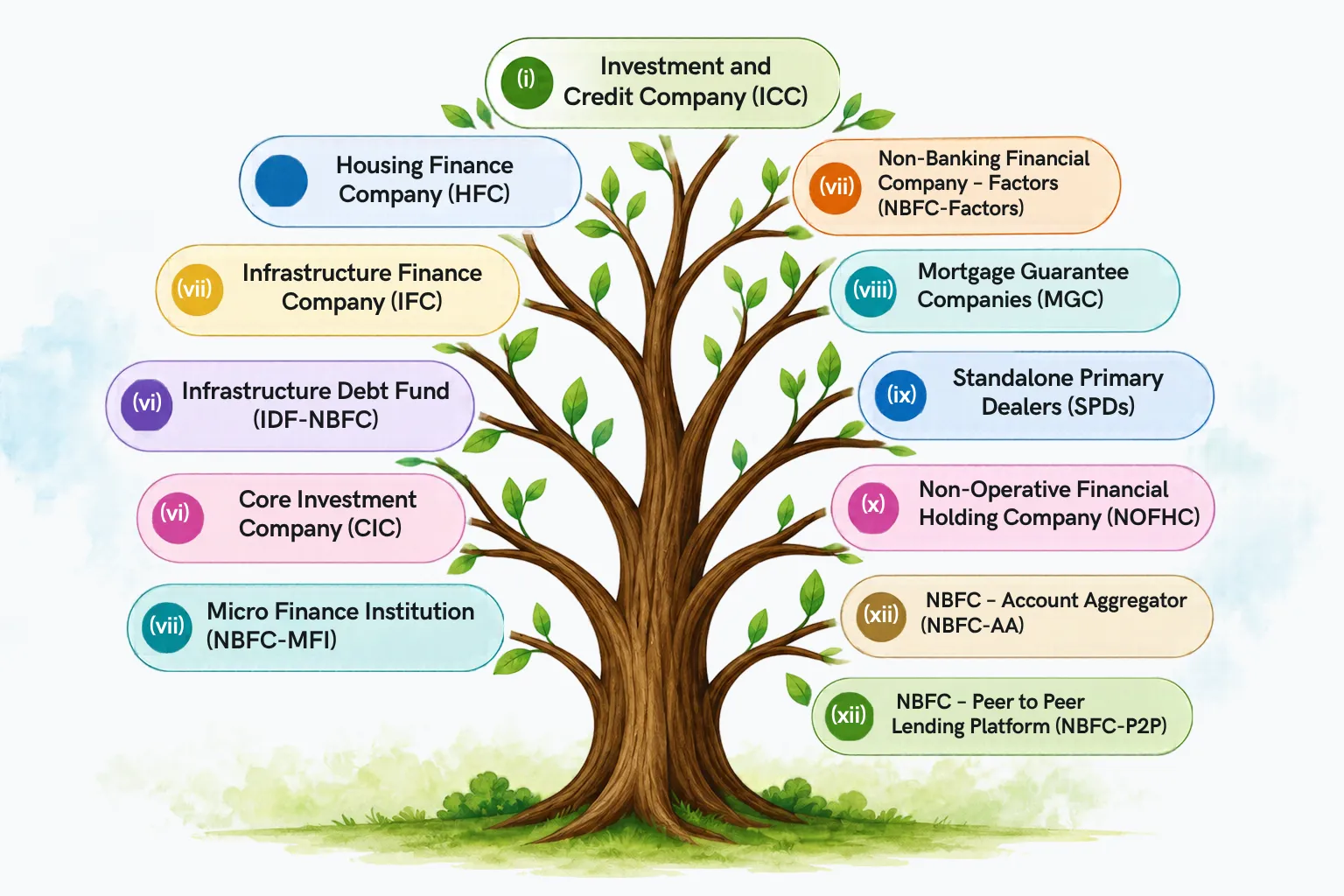
The different types / categories of NBFCs registered with the RBI in India are explained in the table below:
|
S. No
|
Category/Type of NBFC
|
Description
|
|
(i)
|
Investment and Credit Company (ICC)
|
ICC refers to an NBFC company that acts as a financial institution primarily engaged in asset finance. This includes providing financing whether through loans, advances or other means for activities that are not its own, as well as acquiring securities.
|
|
(ii)
|
Housing Finance Company (HFC)
|
HFC shall mean a company that fulfils the following conditions set forth by RBI:
(a) It is an NBFC whose financial assets, in the business of providing finance for housing, constitute at least 60% of its total assets (netted off by intangible assets). Housing finance for this purpose shall mean providing finance as stated in paragraph 10(8) of the Reserve Bank of India (Housing Finance Companies) Directions, 2025.
(b) Out of the total assets (netted off by intangible assets), not less than 50% should be by way of housing finance for individuals as stated at clauses (i) to (v) of Paragraph 10(8) of the aforementioned Directions for HFCs.
|
|
(iii)
|
Infrastructure Finance Company (IFC)
|
IFC is a type of non-banking finance company that deploys at least 75 per cent of its total assets towards infrastructure lending.
|
|
(iv)
|
Infrastructure Debt Fund (IDF-NBFC)
|
IDF-NBFC means a non-deposit taking NBFC which is permitted to (a) refinance post commencement operations date (COD) infrastructure projects that have completed at least one year of satisfactory commercial operations;
and (b) finance toll operate transfer (TOT) projects as the direct lender.
|
|
(v)
|
Core Investment Company (CIC)
|
CIC is a NBFC carrying on the business of acquisition of shares and securities which satisfies the following conditions:
(a) It holds not less than 90% of its net assets in the form of investment in equity shares, preference shares, debt or loans in group companies;
(b) Its investments in the equity shares (including instruments compulsorily convertible into equity shares within a period not exceeding 10 years from the date of issue) in group companies and units of Infrastructure Investment Trusts (InvITs) only as sponsor constitutes not less than 60% of its net assets;
(c) Provided that the exposure of such CICs towards InvITs shall be limited to their holdings as sponsors and shall not, at any point in time, exceed the minimum holding of units and tenor prescribed in this regard by SEBI (Infrastructure Investment Trusts) Regulations, 2014, as amended from time to time. It does not trade in its investments in shares, debt or loans in group companies except through block sale for the purpose of dilution or disinvestment;
(d) it does not carry on any other financial activity referred to in Section 45I(c) and 45I(f) of the RBI act, 1934 except (i) investment in bank deposits, money market instruments, government securities, bonds or debentures issued by group companies; (ii) granting of loans to group companies; and (iii) issuing of guarantees on behalf of group companies;
(e) Its asset size is Rs. 100 crore or above; and
(f) It accepts public funds
|
|
(vi)
|
Micro Finance Institution (NBFC-MFI)
|
“NBFC-MFI” means a non-deposit taking NBFC which has a minimum of 60 percent of the total assets (netted off by intangible assets) deployed towards “microfinance loans” as defined under Reserve Bank of India (Non-Banking Financial Companies – Credit Facilities) Directions, 2025 as under:
(a) A microfinance loan is defined as a collateral-free loan given to a household having annual household income up to Rs. 3,00,000. For this purpose, the household shall mean an individual family unit, i.e., husband, wife and their unmarried children.
(b) All collateral-free loans, irrespective of end use and mode of application/ processing/ disbursal (either through physical or digital channels), provided to low-income households, i.e., households having annual income up to Rs. 3,00,000, shall be considered as microfinance loans.
(c) To ensure collateral-free nature of the microfinance loan, the loan shall not be linked with a lien on the deposit account of the borrower.
(d) The NBFCs shall have a board-approved policy to provide the flexibility of repayment periodicity on microfinance loans as per borrowers’ requirement.
|
|
(vii)
|
Non-Banking Financial Company – Factors (NBFC-Factors)
|
NBFC-Factor is a non-deposit taking NBFC engaged in the principal business of factoring. The financial assets in the factoring business should constitute at least 50 per cent of its total assets and its income derived from factoring business should not be less than 50 per cent of its gross income.
|
|
(viii)
|
Mortgage Guarantee Companies (MGC)
|
MGC means a company registered as mortgage guarantee company which primarily transacts the business of providing mortgage guarantee i.e., a guarantee for the repayment of an outstanding housing loan and interest accrued thereon up to the guaranteed amount to a creditor institution, on the occurrence of a trigger event.
A mortgage guarantee company shall be deemed to primarily transact the business of providing mortgage guarantee when at least 90 per cent of the business turnover is mortgage guarantee business or at least 90% of the gross income is from mortgage guarantee business.
|
|
(ix)
|
Standalone Primary Dealers (SPDs)
|
SPDs are primarily NBFCs which have been granted authorisation to undertake the Primary Dealer activities in Government Securities. SPDs may undertake a set of core and non-core activities which are clearly defined.
SPDs support G- Sec market (both primary and secondary) through various obligations like participating in primary auctions, market making in G- Secs, predominance of investment in G-Secs, achieving minimum secondary market turnover ratio, etc.
|
|
(x)
|
Non-Operative Financial Holding Company (NOFHC)
|
NOFHC stands for Non-Operative Financial Holding Company, which is defined in the Reserve Bank of India (Non-Operative Financial Holding Companies) Directions, 2025 (updated as of 5 December 2025).
This type of non-deposit taking NBFC does not accept deposits. It holds shares of a banking company and shares of all other financial services companies within its group, whether these companies are regulated by the Reserve Bank or by any other financial regulator, as permitted by the applicable regulatory guidelines.
|
|
(xi)
|
NBFC – Account Aggregator (NBFC-AA)
|
NBFC-AA means a non-banking financial company as notified under in sub-clause (iii) of clause (f) of section 45-I of the RBI Act, that undertakes the business of an account aggregator, for a fee or otherwise.
The “business of an account aggregator” means the business of providing under a contract, the service of, retrieving or collecting such financial information pertaining to its customer, as may be specified by the Reserve Bank from time to time; and consolidating, organizing and presenting such information to the customer or any other financial information user as may be specified by the Bank;
Provided that, the financial information pertaining to the customer shall not be the property of the Account Aggregator, and not be used in any other manner.
|
|
(xii)
|
NBFC – Peer to Peer Lending Platform (NBFC-P2P)
|
NBFC-P2P refers to an NBFC that operates a Peer-to-Peer Lending Platform i.e., acting as an intermediary providing loan facilitation services to participants via an online medium or otherwise.
|
Source:- Reserve Bank of India (RBI)
Note:- Apart from the NBFCs mentioned above, a Nidhi Company is also classified as a type of NBFC However, it is not included in the categories of NBFCs registered with the RBI as it is exempt from the requirement of obtaining NBFC registration u/s 45-IA of Reserve Bank of India Act, 1934.
Conclusion
NBFCs are companies registered under the Companies Act 1956/2013 and regulated by the Reserve Bank of India under RBI Act 1934. They offer different types of financial and investment services to individuals and businesses. There isn’t one but many different types of NBFCs registered with the RBI in India, including NBFC – Account Aggregator (NBFC-AA), NBFC – Peer to Peer Lending Platform (NBFC-P2P), Core Investment Company (CIC) and Housing Finance Company (HFC) among others.
Want to start an NBFC in India? Get in touch with our NBFC consultants at Registrationwala for complete professional guidance and assistance.
Connect with NBFC Compliance Experts
Frequently Asked Questions (FAQs)
Q1. What does NBFC mean?
A. NBFC means a company that is registered under the Companies Act and is engaged in the business of providing loans and advances, acquiring shares, bonds or other marketable securities or undertaking leasing or hire-purchase activities as its principal business.
Q2. How many different types of NBFCs are there in India that are registered with the RBI?
A. According to the RBI, there are 12 different types of NBFCs in India that require NBFC registration, namely: (i) Investment and Credit Company (ICC), (ii) Housing Finance Company (HFC), (iii) Infrastructure Finance Company (IFC), (iv) Infrastructure Debt Fund (IDF-NBFC), (v) Core Investment Company (CIC), (vi) Micro Finance Institution (NBFC-MFI), (vii) Non-Banking Financial Company – Factors (NBFC-Factors), (viii) Mortgage Guarantee Companies (MGC), (ix) Standalone Primary Dealers (SPDs), (x) Non-Operative Financial Holding Company (NOFHC), (xi) NBFC – Account Aggregator (NBFC-AA) and (xii) NBFC – Peer to Peer Lending Platform (NBFC-P2P).
Q3. Is Nidhi a type of NBFC? If so, then why isn’t it included in RBI’s list of NBFCs?
A. Yes, Nidhi company is a type of NBFC. However, it isn’t included in RBI’s NBFC categories/types list because it is exempted from registration requirement u/s 45-IA of Reserve Bank of India Act, 1934.
Q4. Do I need to register the NBFC with RBI if I’ve already registered the company with MCA?
A. Yes. You need to register your NBFC with the RBI unless specifically exempted from this requirement, such as in the case of a Nidhi Company. The purpose of registering a company with MCA is to incorporate the company as a legal entity. RBI registration is required separately to obtain authorization from central bank to carry out NBFC business.
Q5. What is a P2P lending NBFC?
A. NBFC-P2P is a specific type of NBFC that operates a Peer-to-Peer Lending Platform i.e., acting as an intermediary providing loan facilitation services to participants through an online medium or otherwise.
Q6. Can NBFCs accept demand deposits?
A. No. The NBFCs are not authorized by the RBI to accept demand deposits.
-
Published: November 06, 2026
100 Views