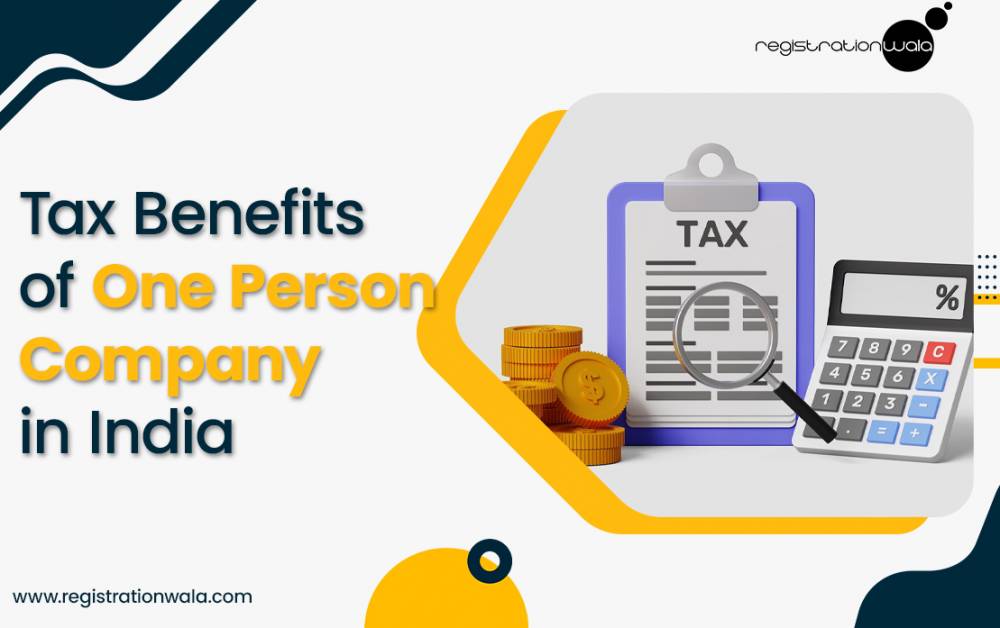
Ever since the concept of a One Person Company (OPC) was introduced in India under the Companies Act, 2013, many entrepreneurs in the country, including the NRIs, have chosen to incorporate this structure to commence business activities. It allows a single entrepreneur to start a company with limited liability protection and perpetual succession through a nominee system. Along with this, OPCs also offer several tax benefits.
Unlike sole proprietorships, where income is taxed as per individual income tax slabs that can go up to 30%, OPCs are taxed like private ltd companies and can enjoy a corporate tax rate between 22-25% under Income Tax Act. OPCs can also claim deductions on many business expenses. Apart from these advantages, there are several other tax benefits available to OPCs, which we will discuss in detail in this blog post.
Definition of One Person Company (OPC)
OPC definition can be explained as a type of company that is incorporated under the Companies Act, 2013, and is owned and managed by a single person/shareholder. The sole shareholder of the OPC is entitled to all the company’s capital and profits. An Indian citizen, including a Non-Resident of India (NRI), can register an OPC in India, as long as they’re a non-minor. An artificial person cannot form an OPC. Only a natural person can.
Like in the case of a Private Limited Company, the liability of the owner in an OPC is also limited to the amount of subscribed capital. This means the personal assets of the owner generally remain protected from business liabilities. The shares of an OPC are also restricted in terms of transfer.
This means that these shares cannot be freely traded to the general public or listed on any of the stock exchanges. In case of the owner’s demise or his incapacity, the shares are transferred to the nominated person or rightful shareholder.
Navigating the Companies Act doesn't have to be complicated. Let Registrationwala handle your MOA, AOA, and SPICe+ filing while you focus on growing your business.
Start Your Registration Process
List of Top Tax Benefits Enjoyed by OPCs in India
The top tax benefits enjoyed by OPCs registered in India are listed below. If you are planning to register an OPC, it is important to understand these benefits so that you can make better business and financial decisions:
A. Reduced Tax Rates Compared to Proprietorships
Sole proprietorships in India are taxed based on individual income tax slabs, which can go up to 30%. However, as far as OPCs are concerned, they are taxed the way pvt ltd co are. OPCs enjoy a flat corporate tax rate of 22-25% under Income Tax Act subject to applicable conditions.
Unlike individual taxation, there is more predictability in tax liability, and the tax rate does not increase with higher income slabs. As business income grows, an OPC can therefore become more tax efficient as compared to a proprietorship.
B. Deductions on Business Costs
The OPCs can claim tax deductions on a variety of general business costs like office rent, utility bills, salaries and wages, professional fees, depreciation on assets and travel expenses. Due to these deductions, such companies can reduce their taxable income to a great extent.
C. Depreciation Claims on Business Assets
OPCs can claim depreciation on business assets. This includes tangible assets such as machinery, equipment, computers, furniture, vehicles and buildings. They can also claim depreciation on intangible assets as well, including on their patents, copyrights and know-how that’s used in their business. Because of this benefit, OPCs can reduce their taxable income and save tax.
D. Carry Forward Losses
An OPC can carry forward its normal business losses (except for the speculative losses) for up to 8 assessment years under Income Tax Act. These losses can be adjusted against future business profits and help reduce future tax burden of such companies. This benefit is especially useful when we look at startups and new business ventures in their early years when they are more likely to face losses.
E. No Mandatory Presumptive Taxation
Unlike proprietorships, HUFs and partnership firms, OPC companies don’t need to follow presumptive taxation scheme under Income Tax Act. Under this scheme, taxpayers need to declare income at a fixed percentage of their turnover regardless of whether the actual profit is lower or higher.
However, since OPCs are not bound by this scheme, they can show actual business profits and claim deductions for genuine business expenses. As a result, OPCs get more flexibility when it comes to managing taxable income through expenses like salaries, rent and depreciation instead of having to pay tax on a fixed income percentage.
The Takeaway
The OPC offers numerous tax benefits such as those mentioned in this blog post. Therefore, we can say that this structure is a tax efficient structure for solo entrepreneurs. For professional assistance in OPC registration, get in touch with our experienced company registration experts at Registrationwala. We will help you prepare all the necessary business incorporation documents, such as the Memorandum of Association, Articles of Association and Digital Signature Certificate, assist in accurately filing the OPC registration application (using SPICe+ form) with the MCA and ensure that your OPC is incorporated within a short period of time.
Also Read: Advantages and Privileges of One Person Company (OPC)
Frequently Asked Questions (FAQs)
Q1. Can an NRI register an OPC in India?
A. Yes, an NRI can register an OPC in India.
Q2. Can a minor register an OPC in India?
A. No, an OPC cannot be registered by a minor. Only a non-minor can register it.
Q3. Can an artificial person register an OPC?
A. No, an artificial person cannot register an OPC. Only natural persons can go for One Person Company registration.
Q4. Do OPCs pay higher tax than sole proprietorships?
A. No, it is quite the opposite. Usually, the OPCs are subject to lower tax than sole proprietorships. The sole proprietorships are taxed on the basis of personal income tax slabs (up to 30%). On the other hand, the OPCs are taxed at a flat corporate tax rate, which is generally 22-25%.
Q5. Do OPCs need to conduct a tax audit?
A. Yes, the OPCs need to conduct a tax audit if their annual turnover or gross receipts exceed Rs. 1 crore (or Rs. 10 crore if mostly digital) in a financial year.
Disclaimer:-This article is for informational purposes only. The views expressed in this article do not necessarily reflect views of Registrationwala and its employees. While the author has made every effort to ensure the information provided in this article is accurate and up to date, we do not guarantee its 100% completeness, accuracy or reliability. Readers are, therefore, advised to verify the information with official sources.