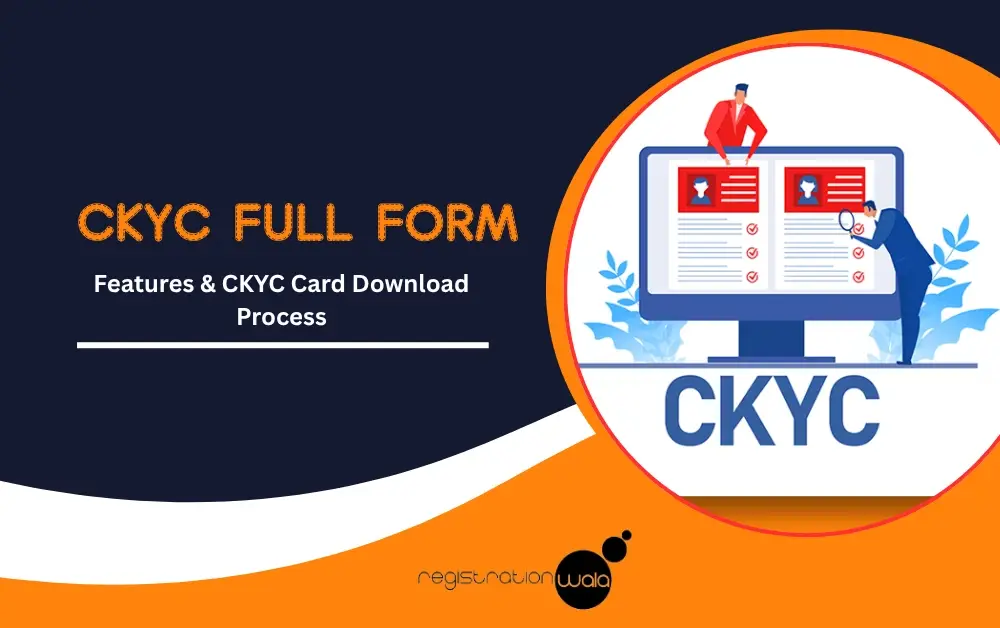
CKYC full form is Central Know Your Customer. It is a centralized repository system that stores customer KYC records securely. CKYC was a directive of the Ministry of Finance, Government of India. It was first announced in Union Budget 2012-2013. Subsequently, it became functional from 2016.
In this blog post, we shall discuss what CKYC is in a detailed manner, and also explain its key features and registration process. We shall also explain the process for downloading CKYC card.
CKYC full form is Central Know Your Customer. CKYC means a centralized digital repository system managed by CERSAI (Central Registry of Securitisation Asset Reconstruction and Security Interest of India). This system safely stores the KYC details of customers and investors, such as details like their identity proof and address proof. When a person successfully completes CKYC for the first time, the system generates a 14-digit KYC Identification Number (KIN), also called a CKYC number. This no. tends to remain valid for lifetime.
When banks, mutual fund companies, insurance companies and other financial institutions regulated by RBI, SEBI, IRDAI or PFRDA add new customers, they can use this KIN to check and verify the customer’s KYC details from the CKYC registry. This helps customers avoid submitting the same physical documents for CKYC again and again.
Salient Features of CKYC
The salient features of CKYC are as follows:
-
It securely stores details of customers and investors in a digital system.
-
The 14-digit, permanent identifier known as CKYC number is linked to the customers and investors’ Identity Proofs like Aadhaar and Permanent Account Number (PAN).
-
During the CKYC process, the bank or company checks your documents with the original issuer like UIDAI for verifying aadhaar and confirming identity.
-
CKYC number remains the same and consistent for customers and investors’ lifetime across all financial institutions.
-
In case you update your address or phone no., all the companies using CKYC will get to learn about the change.
-
Only the authorized companies can gain access to your details. The CKYC system is highly secure to ensure your details are in safe hands.
Documents Required for CKYC Process
The following documents are usually required during the CKYC registration online or offline:
-
Documents to establish Proof of Identity of the customer, such as PAN Card, Aadhaar Card, Passport, Driving License, Voter ID & NREGA Job Card.
-
Documents to establish Proof of Address of the customer, such as Aadhaar Card, Passport, Driving License, Voter ID, latest Utility bill (not older than 3 months) & Registered Rent Agreement.
-
A recent passport-size photo of the customer.
-
Customer’s signature on the KYC form.
CKYC Registration Process 2026
The CKYC registration process involves completion of the steps explained below:
Step 1: The customer or investor must visit a bank, mutual fund office, insurance company, or any financial institution that offers CKYC services.
Step 2: Then, they must submit the required documents along with original copies for verification.
Step 3: The institution then verifies the documents with the concerned authority to confirm that the information provided by the customer/investor is correct and not misleading. For example, the details pertaining to aadhaar are verified via issuer, i.e, UIDAI.
Step 4: After successful verification, CERSAI issues a unique 14-digit CKYC number to the customer. This number is usually shared to them through email, SMS or letter.
CKYC Card Download
To download CKYC certificate or card online, you need to follow the simple steps explained below:
Step 1: Begin by visiting the official website of CKYC @ https://www.ckycindia.in/ckyc/index.php.
Step 2: Once you are on the homepage of the website, you need to click on the option ‘View Your CKYC Card’. This option is available at the top right corner of the page.
Step 3: Now, you will land on a new page, where you must enter ‘Mobile Number’ as well as ‘Captcha’. Make sure these details are entered correctly.
Step 4: After that, you need to click on the ‘Submit’ button.
Step 5: Once the details you entered are verified, you can view and download CKYC card PDF.
Once you complete all the simple and easy above-mentioned steps, your CKYC certificate download process will be completed successfully.
Conclusion
The full form of CKYC in banking is Central Know Your Customer. Managed by CERSAI, it is a centralized repository system that stores customer KYC records in a safe and secure manner. When a person successfully completes the CKYC process for the first time, the system generates a unique 14-digit CKYC number/KIN. This number helps banks and other regulated companies to access the customer’s KYC details easily without asking for the same documents again and again. As a result, it helps to save the customer/investor’s time and simplifies the verification process.
Also Read: KYC Full Form, Importance & Process
Frequently Asked Questions (FAQs)
Q1. What is CKYC full form?
A. CKYC full form is Central Know Your Customer.
Q2. When was CKYC launched?
A. It was launched by the Government of India in 2016.
Q3. Which authority manages CKYC?
A. The Central Registry of Securitisation Asset Reconstruction and Security Interest of India, abbreviated as CERSAI, is responsible for managing CKYC.
Q4. Is CKYC mandatory for SBI?
A. Yes, CKYC is mandatory for new SBI customers for opening bank accounts, investing in mutual funds and for obtaining new credit cards.
Q5. Is CKYC mandatory for everyone?
A. Yes, it is mandatory for all new customers engaging with financial entities that are regulated by RBI, SEBI, IRDAI or PFRDA, like banks, mutual fund houses and insurance companies to name a few.
Q6. Are CKYC number and KIN same?
A. Yes, CKYC number and KIN one and the same thing, i.e., the 14-digit KYC Identification Number issued under the CKYC system.
Q7. How many digits does KIN contain?
A. The KYC Identification Number (KIN) contains a total of 14 digits.
Q8. Can CKYC details be updated by banks?
A. Yes, CKYC details can be updated by RBI-regulated banks. To support the changes, the customers must provide the valid documents so that the banks can submit them to the CERSAI.
Q9. What is CKYC full form in Hindi?
A. CKYC full form in Hindi is केंद्रीय केवाईसी.
Disclaimer: This article is for informational purposes only. The views expressed in this article do not necessarily reflect views of Registrationwala and its employees. While the author has made every effort to ensure the information provided in this article is accurate and up to date, we do not guarantee its 100% completeness, accuracy or reliability. Readers are, therefore, advised to verify the information with official sources.