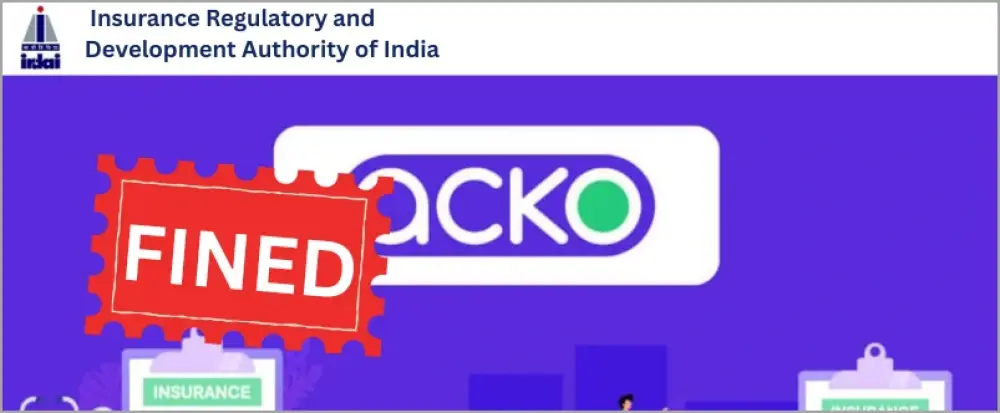
Quite recently, India’s insurance regulator Insurance Regulatory and Development Authority of India (IRDAI) imposed a Rs. 1 crore penalty on Acko General Insurance for several violations related to outsourcing and commission arrangements. A key concern was the general insurance company’s collaboration with Ola Financial Services Private Limited (OFSPL) to market or facilitate the sale of insurance products, even though OFSPL was not officially authorized to perform such activities.
Acko reportedly compensated OFSPL in ways that resembled commissions or incentives for promoting insurance, disguised as payments for advertising, branding, and API infrastructure services. These practices contravened the Insurance Act, 1938.
As IRDAI’s enforcement order noted, “the insurer (Acko) entered into this arrangement just to pass on excess payments to OFSPL under the guise of an API agreement, which is not otherwise permitted by the regulations. And though the insurer entered into an advertisement agreement with OFSPL on 14th November, 2018, they started making payments under this head prior to the agreement.”
Are Acko or Ola-issued insurance policies still valid?
Yes. Priya Dhankhar, Counsel at SKV Law Offices, clarifies: “The IRDAI order issued against Acko General Insurance pertains to regulatory issues, not to the core insurance policies issued to consumers. There is no suggestion in the order that policies issued via OFSPL are invalid, unenforceable, or compromised in any way.”
She adds, “As such, there is no direct adverse impact on policyholders. All insurance policies sold by Acko, including those issued during the period under scrutiny, remain legally valid and enforceable. Policyholders can continue to avail themselves of claims and policy benefits per their contractual terms.”
Shashank Agarwal, Founder of Legum Solis, agrees: “As there is nothing in the order or in the law that talks about such policies falling through, there does not seem to be any impact on the policyholders who bought Acko policies.”
What are the risks of buying policies through unregistered agents or intermediaries?
According to IRDAI’s findings, “From FY 2018-19 to January 2021, OFSPL was neither a corporate agent nor an intermediary of the company. OFSPL became a corporate agent of the company only in January 2021. OFSPL was purely a service provider of the company, appointed for technology and marketing services.”
The order also stated that OFSPL lacked the necessary expertise to deliver infrastructure support for issuing insurance policies via APIs or to provide advertising services.
Since OFSPL was not a licensed corporate agent during the period in question, it was not legally permitted to solicit insurance business. Engaging with such entities can pose several risks to policyholders, such as receiving incorrect or misleading information about insurance products. Unregulated agents might prioritize sales volume and commissions over customer welfare.
Dhankhar warns, “When insurers use unlicensed or unauthorized entities to distribute insurance products, it poses several risks to consumers. First, such intermediaries may not have the required training, regulatory oversight, or ethical obligations, which increases the likelihood of mis-selling or inaccurate disclosures.”
She adds, “Consumers may receive misleading information about product features, exclusions, or claim procedures. Second, there is little recourse available in case of grievances, unlicensed agents are not accountable under IRDAI's framework, leaving policyholders unprotected. Lastly, if such intermediaries are driven by non-transparent or unregulated incentives, their advice may prioritise commissions over the consumer’s best interests.”
While OFSPL did receive a certificate of registration valid from September 11, 2019, to September 10, 2022, the order noted this did not justify the “advertisement and API charges paid to them by Acko, which were in the nature of rewards.”
In summary, Acko made payments to OFSPL i.e., a firm not authorized to solicit insurance for part of the relevant period. However, OFSPL is now a registered corporate agent, with its current license valid through September 10, 2025.
Trinath Tadakamalla, a partner at Solaris Legal, adds, “Payments made to unlicensed intermediaries also may not be securely handled. There is likely to be a lack of accountability, which may impact consumers’ right to recourse. Unregulated intermediaries are also not obligated to adhere to any data protection standards.”
How can consumers verify if an insurance seller is legally authorized?
To stay protected, consumers should verify the credentials of anyone selling them an insurance policy. IRDAI maintains a publicly accessible registry of licensed agents and intermediaries at https://irdai.gov.in/list-of-corporate-agents, where individuals can search by name or license number.
Consumers should also request IRDAI registration details from the intermediary and confirm whether they are operating as a corporate agent, broker, or web aggregator. For the policies that are sold through digital apps or websites, it is the duty of the buyers to ensure the platform is listed as an authorized partner by the insurer. If unsure, they should contact the insurance company directly to confirm the seller’s legitimacy and ask about any commissions or incentives involved.
Source: Economic Times
Comments
No comments yet.
Leave a Comment