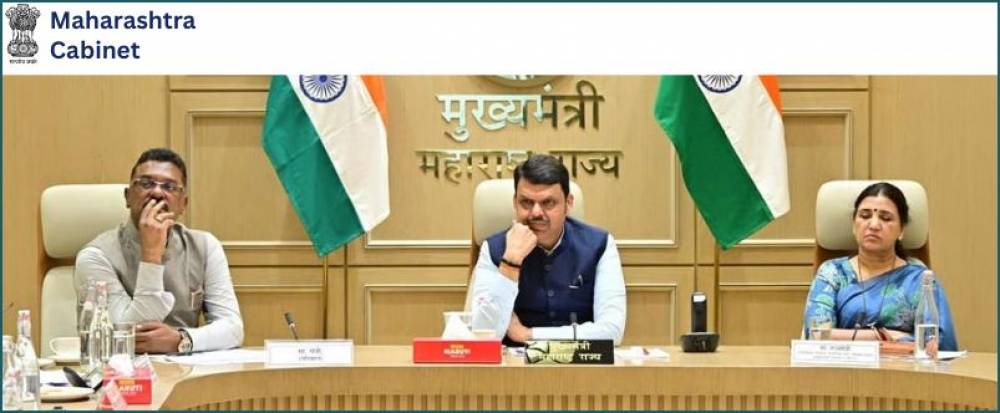
The Maharashtra State Compressed Biogas Policy 2026 has received approval of the Maharashtra Cabinet. This move is perceived as a major step towards ensuring sustainable energy as well as waste management in a scientific manner.
The decision, taken by the Cabinet under the chairmanship of Chief Minister Devendra Fadnavis, aims to convert organic waste into green fuel. At the same time, it furthers India’s circular economy and climate goals.
Rs. 500 Crore Support for Projects under CBG Policy 2026
The policy provides funding of Rs. 500 crore for FY 20260-27 to support project developers via Public-Private Partnership (PPP) and Hybrid Annuity Model (HAM). This funding aims to reduce investment risks and speed up the large-scale CBG plants’ rollout in the state of Maharashtra.
Focus on Addressing Maharashtra's Rising Waste Challenge
Under the policy, priority will be given to addressing Maharashtra's mounting waste challenge. Each and every day, the 423 urban local bodies in Maharashtra state tend to produce a large amount of municipal solid waste. A lot of this waste is organic and still ends up in landfills.
The policy requires strict source separation to make sure that wet waste gets sent to scientific processing facilities. Not only does this cut down on methane emissions and the amount of trash that goes to landfills but it also makes sure there is a steady supply of feedstock for producing biogas.
Objectives & Features of CBG Policy 2026
Under the policy, several objectives are outlined. They include (i) boosting energy self-reliance via expansion of CBG use in households, transport and industry, (ii) decreasing greenhouse gas emission in alignment with the net-zero ambitions of India and (iii) enhancing scientific waste management systems.
Moreover, the policy explores integration of agricultural residues like napier grass to supplement feedstock supply, especially in regions like Marathwada. The CBG policy’s notable feature is the Hybrid Annuity Model’s introduction. Under this model, the project costs will be shared by the government with private developers via periodic payments.
Rs. 500 crore outlay under the policy will serve as a viability gap funding. It will offer financial stability despite challenges pertaining to uncertain feedstock supply and market linkages. For proper implementation of the policy, a state-level steering committee led by the Chief Secretary will handle coordination. The district-level committees led by collectors will manage land allocation as well as waste supply.
The policy also encourages cluster mapping as it allows smaller municipalities to combine resources and support centralized CBG plants. The policy is in alignment with GOBARdhan initiative and promotes the use of byproducts like organic manure in agriculture, thereby creating a waste-to-wealth cycle.
If implemented well, the compressed biogas policy 2026 can create employment, reduce environmental pressure and help Maharashtra become a leader in the waste-to-energy sector of India.
Source: The Hindu Business Line
Comments
No comments yet.
Leave a Comment