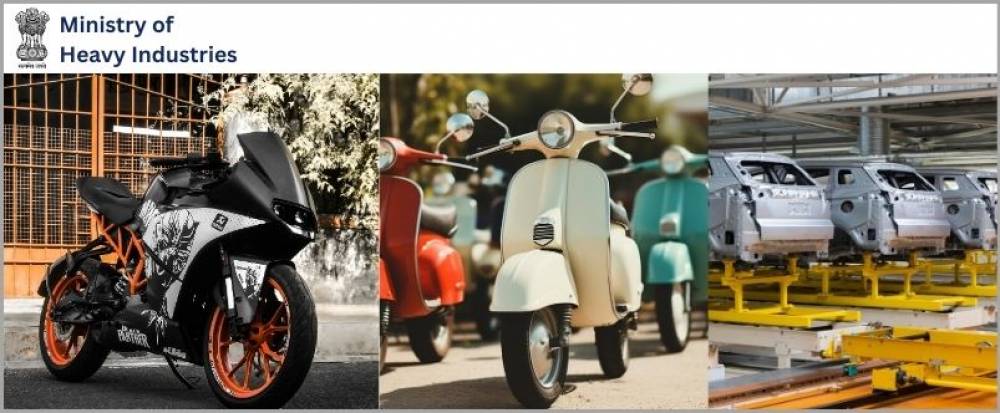
The new GST rates and slabs, that will come into effect from 22 September onwards, will have a high impact on many items related to Heavy Industries. Its detailed clarifications are provided herein:
Automobiles
The points below explain how the new GST rates/slabs will impact the automobiles sector:
-
For the automobile sector, the rate cuts are across different categories, including bikes (upto 350 cc which includes bikes of 350cc), buses, small cars, medium/luxury cars, tractors (<1800cc), etc.
-
The reduced rates will be applicable on auto parts as well.
-
Reduced GST will give a push to demand, help automobile manufacturers and the large ancillary industry (tyres, batteries, glass, steel, plastics, electronics, components, and so on.)
-
Due to GST rate cuts, individuals will be encouraged to replace their old vehicles with new ones that are fuel efficient. This will support cleaner mobility.
-
Vehicles’ growing sales will increase orders for these components. It will create a multiplier effect of MSMEs - entities that form a part of this supply chain.
-
The entire auto industry directly and indirectly supports over 3.5 cr jobs in areas such as manufacturing, sales, financing, and maintenance. An increase in demand will lead to new hiring at dealerships, transport services, logistics companies, and component micro, small, and medium enterprises.
-
Jobs in the informal sector, incl. drivers, mechanics and small service garages, will also benefit.
-
Since vehicle purchases are also credit-driven via NBFCs, banks & fintech lenders, a revival in auto sales will boost retail loan growth and expand financial inclusion in semi-urban regions across India.
Two-Wheelers (From 28% to now 18%)
Due to lower GST, the prices of bikes upto 350cc will be reduced. As a result, such bikes will become more affordable for youth, professionals and lower middle-class households. Since bikes are the primary mode of transportation in rural as well as semi urban areas, cheaper bikes will directly benefit farmers, daily wage earners and small traders.
The GST cut is anticipated to help gig workers and boost their savings via reduced costs and EMI for 2-wheeler loans.
Small Cars (To 18% from 28%)
The cars that fall within the affordable segment will become cheaper. This will encourage first time buyers and expand household mobility. Smaller cities and towns that witness dominance of small cars will see an increase in sales due to reduced GST.
Due to higher sales, car dealerships, drivers, service networks and auto finance companies will benefit.
Large Cars (Flat 40% with no cess)
The additional cess’ removal has not only lowered the rates but also made the taxation simpler and more predictable. Even at 40%, the cess absence will lower effective tax on bigger cars and make them more affordable for the buyers.
By bringing tax rate to 40% and removing cess, the GOI ensures that these industries are eligible for ITC fully. Previously, ITC could only be utilized upto 28% and not for cess component.
Tractors (From 12% to now 5%)
For road tractors used for semi-trailers with engine capacity more than 1800 cc, the GST is down from 28% to 18% now. Tractor parts are reduced to 5%. Tractor manufacturing components like tyres and gears will also be taxed at 5%.
One of the world’s largest tractor markets in India. The cut in goods and services tax will push demand in domestic as well as export segments. It will strengthen India’s standing as a global leader in tractor manufacturing.
The mechanism in the agriculture sector will be increased due to increased affordability of tractors. As a result, productivity of staple crops like paddy and wheat will be improved.
Buses (From 28% to 18%)
For buses with seating capacity of 10+ persons, GST is down from 28% to 18%. The upfront cost of businesses and minibuses with 10+ seats will reduce due to lower tax rate. This will lead to a rise in demand from fleet operators, schools, corporates, state transport undertakings and tour operators.
It might make ticket fares more affordable for passengers, especially those in semi urban and rural areas of the country. It will encourage shift from private vehicles to shared public transports. As a result, the congestion and pollution will be reduced.
Commercial Goods Vehicles (From 28% to 18%)
For commercial goods vehicles like trucks, delivery-vans, etc., the GST is down from 28% to 18%. Trucks are India’s supply chain’s backbone as they carry 65%-70% of goods traffic.
Reduction in GST leads to reduction in upfront capital cost of trucks. This lowers freight rates per tonne km. This has a cascading effect. It’ll cause cheaper movement of agri goods, FMCG, e-commerce deliveries, cement, steel, etc. It’ll lower inflationary pressures.
This rate cut will support MSME truck owners who form a major share of the road transport sector of the country. Logistics cost will be reduced directly by cheaper trucks and improve export competitiveness.
Auto Components
The GST rate has been reduced to 18% for the majority of components that are used in manufacturing motor cars and motor bikes, i.e., auto components.
It is also noteworthy to mention that services related to the transportation of goods and passengers have experienced significant changes and rationalization. Rates have been reduced, wherever necessary, and the Input Tax Credit has been applied to avoid the cascading effect.
Further, businesses engaging in goods transportation and passenger transportation by road have the option to select from two rate choices: 5% or 18%, based on specific business requirements.
Source: Press Information Bureau
Comments
No comments yet.
Leave a Comment