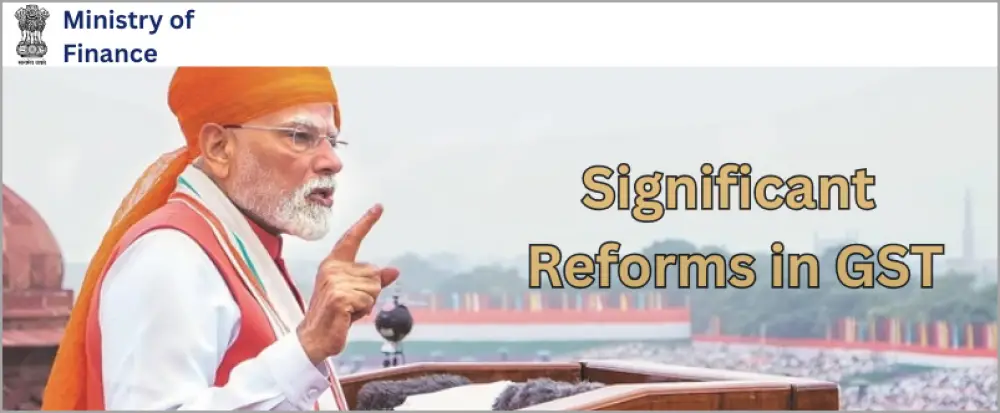
On the occasion of India’s 79th Independence Day, PM Shri. Modi highlighted how the Goods and Services Tax (GST) - that came into force in 2017 - is a major reform that has benefitted the country. The Prime Minister emphasized the importance of upcoming reforms under the Goods and Services Tax (GST), which aim to provide relief to the common man, farmers, the middle class, and Micro, Small and Medium Enterprises (collectively known as MSMEs).
To establish an 'Atmanirbhar Bharat' (i.e., self-reliant India), the Central Government is proposing significant reforms in GST, focusing on three key pillars:
1. Structural reforms
2. Rate rationalization
3. Ease of living
The Central Government has submitted its proposals on GST rate rationalization and reforms to the Group of Ministers formed by the GST Council for the examination of these issues.
Key areas identified for the next-generation reforms include rationalization of tax rates to benefit all segments of society, especially the common man, women, students, the middle class and the farmers.
The reforms will also aim to reduce classification-related disputes, rectify inverted duty structures in specific sectors, ensure greater rate stability and enhance the ease of doing business. The intention of these measures is to strengthen key economic sectors, stimulate economic activity and facilitate sectoral expansion.
Centre’s Proposed Reforms’ Key Pillars
The key pillars of the proposed reforms by the Centre are explained as follows:
Pillar 1 - Structural Reforms
These include the following:
-
Rectification of inverted duty structure: The inverted duty structures’ correction is necessary for alignment of input and output tax rates so that there’s a reduction in the input tax credit’s accumulation. This would enhance the domestic value addition.
-
Fixing classification problems: Resolving the issues pertaining to classifications to streamline rate structures, reduce disputes, make compliance processes simpler and make sure there’s greater equity as well as consistency across sectors.
-
Stability and Predictability: Providing long-term clarity regarding the rates and policy direction to propel industry confidence and assist better planning for businesses.
Pillar 2 - Rate Rationalisation
Pillar 2 includes the following reforms:
-
Tax reduction on common man items and aspirational items: This would lead to affordability, increase consumption and make essential as well as aspirational items more accessible to the general public.
-
Reducing the tax slabs: Shifting towards simple tax having two slabs i.e., standard and merit. Applying special rates solely for select few goods.
-
Compensation cess: The compensation cess’ end has led to fiscal space, offering greater flexibility to rationalize and align tax rates within GST system for long term sustainability.
Pillar 3 - Ease of Living
For ease of living, the proposed reforms include:
-
Registration: Process of registration to be seamless, time bound and advanced tech driven, especially when it comes to small businesses and startups in the country.
-
Pre-filled returns: Implementation of pre-filled returns in order to reduce manual intervention and rule out the possibility of mismatches.
-
Automated refunds: Faster and automated refund processing for exporters and those with inverted duty structure.
The proposal of the Centre anchored on the three foundational pillars has been shared with the Group of Ministers. This initiative has been taken by the Centre with the objective of forming a constructive, inclusive and consensus based dialogue among the concerned stakeholders.
The Centre, in the cooperative federalism’s true spirit, is dedicated to working closely with the states. It’ll form a broad-based consensus with states in the upcoming weeks for implementation of next generation of reforms pictured by PM Modi.
When the GST council meets next, it’ll deliberate the Group of Ministers’ recommendations and transparent tax regime that supports inclusive growth, strengthens the nation’s formal economy and encourages ease of doing business.
Comments
No comments yet.
Leave a Comment