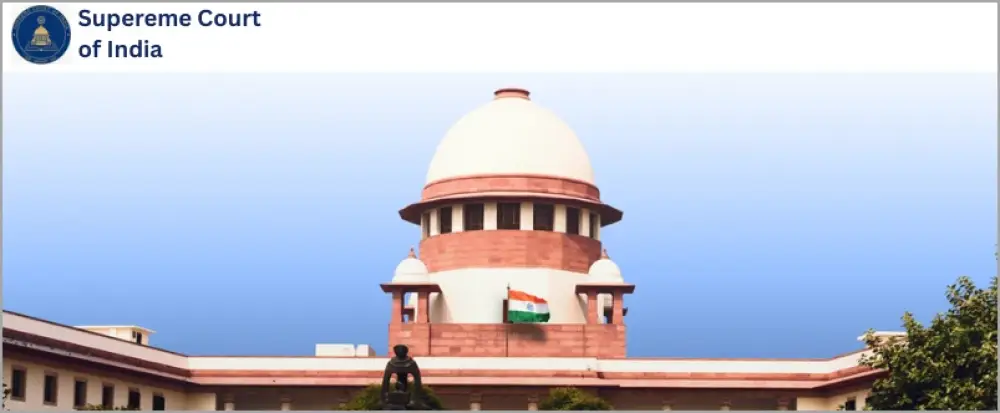
On 20 May 2025, the Hon’ble Supreme Court upheld the requirement that candidates must possess at least three years of legal practice before they can appear for civil judge (junior division) exams. This significant ruling impacts judicial appointments all across the country.
The minimum practice requirement was reintroduced by the Hon'ble Supreme court after it was abolished in 2002. "We hold that the three-year minimum practice requirement to appear for civil judges junior division exam is restored," said Justice AG Masih, who delivered the decision on behalf of the bench, which included Chief Justice of India BR Gavai.
As per the bench consisting of Justices AG Masih and K Vinod Chandran and Chief Justice of India (CJI) BR Gavai, "Allowing recent law graduates to enter the judicial service without any prior practical experience has led to many issues."
The court also noted that justices must deal with the issues of litigant's life, liberty, property, and reputation as soon as they take office. As was correctly noted, pre-service training and book knowledge cannot fully replace first-hand understanding of how the legal system functions and how justice is administered.
"Some of the Civil Judges (Junior Division) who do not possess any experience at the Bar, appointed straight away from the college to the court, are not treating the bar members and staff members in good spirits and that the officers are finding it difficult to handle the courts when faced with procedural issues," stated the bench.
A lawyer with ten years of standing at the bar must certify and endorse a candidate's legal professional experience. According to the court, judicial service applicants must complete a year of training prior to sitting as judges' law clerks, and experience working as a law clerk to judges will also be taken into consideration.
Hiring recent law graduates as judicial officers for the past 20 years, without allowing them to practice at the bar for even a single day, hasn’t been successful. The Hon'ble court went on to clarify the reasoning behind the ruling. It said that such recent law graduates have caused many problems.
However, the bench did clarify that the ruling will only be applicable to future hiring and will not affect the current hiring procedures.
Initially, the rule was in effect across various states. However, the Supreme Court lifted the restriction in 2002 and enabled recent law graduates to apply for positions as Munsiff Magistrates. Then, the Supreme Court received petitions asking for the reintroduction of the requirement that only active attorneys should be eligible. The decision to reinstate the minimum practice requirement was also endorsed by a number of High Courts.
Source: India Today
Comments
No comments yet.
Leave a Comment