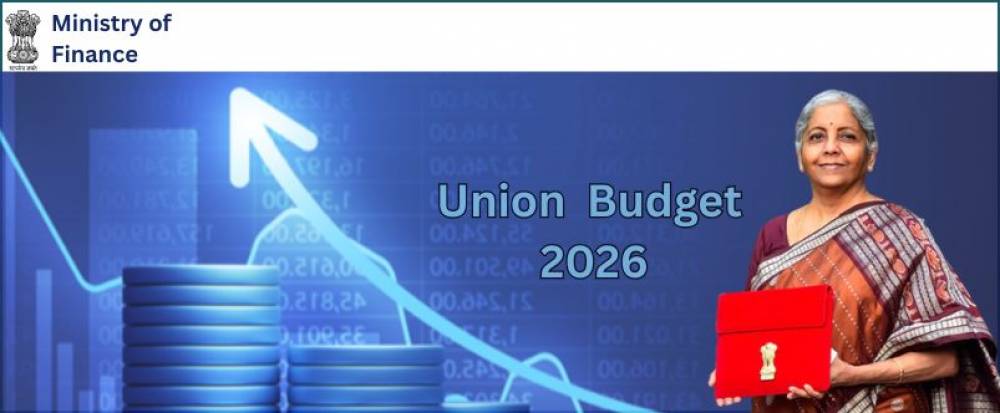

On 1 February 2026 (Sunday), the Union Finance Minister Smt. Nirmala Sitharaman will present her ninth consecutive budget. The budget will mark the second full-year budget of Prime Minister Narendra Modi's 3.0 government.
The experts predict that this year’s budget will focus on sectors like railways, defence and MSMEs. Check out this post to learn about the key expectation from Union Budget 2026.
According to Mint’s earlier reports, this year’s Union Budget will prioritize key sectors like MSMEs, defence, railways, infrastructure and green energy, and the central government seeks to carry forward the consumption push from the previous year.
Here are the key expectations from the upcoming Union Budget that will commence on 1 February 2026 :-
Over the past three years, the govt. has reduced tax slabs gradually under the new tax regime. Last year, it provided the biggest relief. Since the taxpayers are already receiving regular benefits, only minor changes are expected this year.
After the introduction of GST 2.0 in FY 2025–26, efforts have focused on improving tax collection and compliance. More simplification of GST rules, especially Input Tax Credit, is expected to help businesses manage cash flow more easily.
Union Budget 2026 is expected to help India connect better with global markets, especially since the USA imposed tariffs. Policies may encourage foreign investment, technology sharing and international business partnerships.
New technologies like artificial intelligence, robotics, and automation are likely to receive continued government support. These sectors are important for increasing efficiency and future economic growth.
It is expected that, in the upcoming Union Budget, the government may announce steps in order to extend support local manufacturing. The said support could include subsidies on raw materials and machines along with better export incentives.
The MSME industry is undoubtedly crucial for the growth of Indian economy. Therefore, the MSMEs are expected to remain a key focus area in Budget 2026. Measures for them may be taken with the aim to improve access to credit, ensure stable cash flow and handle global economic risks.
Clean mobility has become an important policy focus in recent years for most governments in the world, including the Government of India. In the upcoming Budget, strong support is expected for electric vehicles, wider charging networks beyond cities and local battery production and recycling.
Last year, India was at war with Pakistan after the Pahalgam attack. Security needs to be tightened and more needs to be spent on the defence, especially with the growing global tensions. Therefore, it is expected that the government will increase spending on defence made in India. Higher investment in local defence production and reduced dependence on imports are likely to be the priorities.
Both the railway sector and the road sector are the backbone of infrastructure. Once again, these sectors are expecting higher capital expenditure allocations. Both sectors are likely to fully utilize their current capex by year end and have several ongoing projects. As a result, capacity expansion for these sectors is essential to support continued economic growth.
Please note the above-mentioned points are merely expectations from the upcoming Budget and it is totally up to the government to decide the industries it’ll prioritize the most.
No comments yet.
Want to know More ?
Choose the type of company that you want to register to kick start your business.
Choose the type of license to operate your preferred telecommunication facility .
Choose the type of license for an effortless embarkment on your insurance business.
Choose suitable legal metrological certificate for your product and trade you are dealing in.
Choose the kind of IPR services to protect your intellectual property from theft and plagiarism.
Choose the type of license that you want to register for your technology driven finance company.
Choose the type of compliance to safeguard your business from non-adherence to laws which increases risks of penalties, fines and lawsuits.
Choose the type of certification to ensure customers of your high-quality products and services.