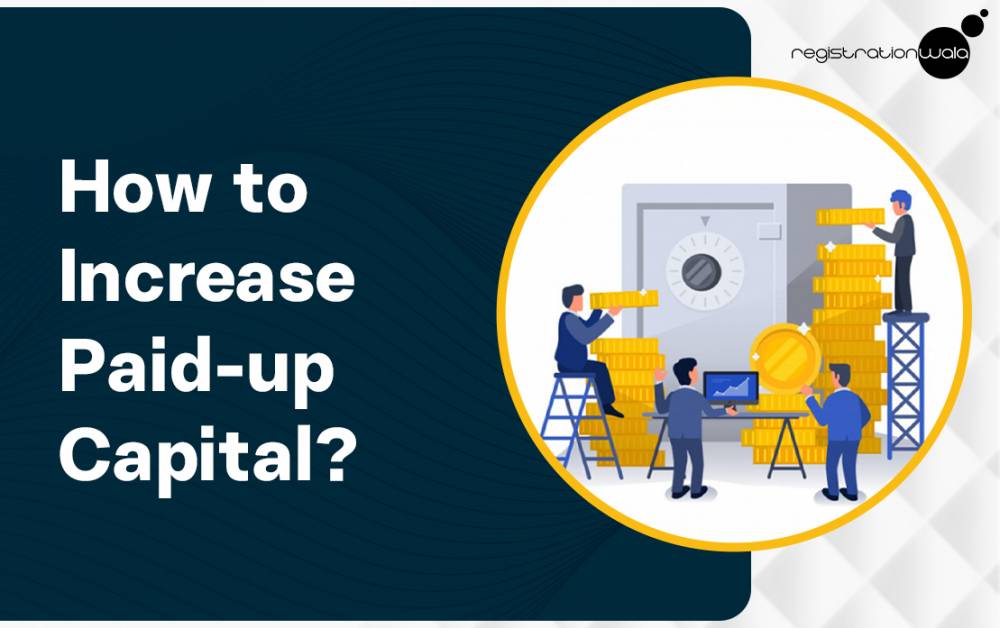
Paid-up share capital refers to the total amount of money that a company has actually received from its shareholders in exchange for shares issued. It is always less than or equal to the authorized share capital. To expand business or meet financial requirements, the paid-up capital of a company may be increased upon receiving the approval of board of directors and shareholders.
In this blog post, we shall guide our readers how to increase paid-up capital in a detailed manner by carefully describing all the required steps involved in the process.
What is Paid-up Capital?
Paid-up capital is a popular term in the business world. In the Companies Act, 2013, paid-up capital’s definition is provided in Section 2(64). According to this Section, “paid-up share capital or share capital paid-up means such aggregate amount of money credited as paid-up as is equivalent to the amount received as paid-up in respect of shares issued and also includes any amount credited as paid-up in respect of shares of the company, but does not include any other amount received in respect of such shares, by whatever name called.”
To put it simply, paid up capital is the amount of money that the company has received from shareholders in exchange for shares of a stock. It is also known as contributed capital, paid-in capital or equity capital. A company with higher paid-up share-capital demonstrates greater financial strength.
Such a company finds it easier to obtain loans as well as attract investors. Paid up capital can be increased either by issuing new shares or by making calls on the unpaid amount of shares already issued to the shareholders
Paid-up Capital Increase Process
The procedure to increase the paid-up capital is explained below. Once you read all the steps, you will be able to learn how a company’s paid up capital can be increased:-
Step 1:- The company must first check whether the Articles of Association (AoA) permit an increase in the paid-up share-capital. If not, the AoA must be amended to authorize the increase. Along with this, the authorized share-capital should also be verified. If the proposed increase exceeds the authorized capital limit, this capital must first be increased by passing a resolution in a general meeting.
Step 2:- Thereafter, a board meeting must be convened. In this meeting, the proposal for raising funds gets approved, the valuation of shares is determined and the method of issue (such as rights issue or preferential allotment) is decided.
Step 3:- Subsequently, a notice for an Extraordinary General Meeting (EGM) must be sent to all concerned shareholders in order to pass a special resolution for the purpose of authorizing the new share allotment.
Step 4:- After obtaining the required approval at the EGM, the necessary forms (such as Form SH-7 for authorized capital and PAS-3 for allotment of shares) must be filed with RoC along with payment of prescribed fees.
Step 5:- Finally, the shares must be allotted to the shareholders within a period of 60 days of receiving application money. Thereafter, the share certificates must be issued within 2 months from the date of allotment to formally complete the process.
After going through all the steps, we hope all your doubts are clear about how to increase the paid-up capital of a company.
Conclusion
The company’s paid-up capital can be increased for the purpose of meeting its financial requirements or to support business expansion. The process of increasing paid-up capital is a systematic procedure. It involves obtaining board of directors’ approval during the board meeting, passing of necessary resolutions and filing required forms with RoC. Finally, the shares must be allotted and share certificates must be issued within prescribed time limits for successful completion of the process. Remember that if the AoA does not authorize such an increase, it needs to be amended first. Only after AoA’s amendment can the company proceed with increasing its paid-up capital to the desired amount.
If you need professional guidance/full-fledged assistance in company registration process or in ensuring compliance with MCA regulations and provisions of Companies Act, 2013, you can get in touch with our experienced consultants at Registrationwala.
Frequently Asked Questions (FAQs)
Q1. What’s the difference between paid-up capital and paid-in capital of a company?
A. Both paid up capital and paid up capital carry the same meaning, i.e., the total amount of money that a company has received from its shareholders in exchange for shares issued.
Q2. Can the paid up share capital of a company be higher than authorized share capital?
A. No, the paid up share capital can never be higher than the company’s authorized share capital.
Q3. Which Section of the Companies Act, 2013, provides the definition of paid-up capital?
A. Section 2(64) of the Companies Act, 2013, provides this definition. According to this Section, “paid-up share capital or share capital paid-up means such aggregate amount of money credited as paid-up as is equivalent to the amount received as paid-up in respect of shares issued and also includes any amount credited as paid-up in respect of shares of the company, but does not include any other amount received in respect of such shares, by whatever name called.”
Q4. What exactly is AoA?
A. AoA stands for Articles of Association. It refers to an important company document that contains the necessary rules and regulations to govern the internal management of a company.
Q5. Can a company’s paid up capital be increased if the AoA does not permit it?
A. No, a company’s paid up capital cannot be increased if the Articles of Association (AoA) does not permit it. The AoA must first be amended to allow such an increase.
Q6. Why does a company increase its paidup capital?
A. A company usually increases its paidup capital so it can raise funds for expansion or to improve its financial standing.
Q7. Can a company decrease its paidup capital?
A. Yes, a company can decrease its paidup capital provided that the AoA authorizes such a change. If not, then the AoA must be amended first.
Q8. What is PAS-3 form?
A. PAS 3 is a mandatory return of allotment filed with RoC to report the issuance of securities.
Q9. What is Form SH-7?
A. Form SH-7 is a form filed with RoC to notify it regarding an alteration in a company's share capital.
Q10. What is EGM? How is it different from Board Meeting?
A. EGM stands for Extraordinary General Meeting. It is basically a meeting of shareholders that is called at any time to deal with urgent/important business. It is different from a Board Meeting, which is conducted by company directors for management of day-to-day affairs.
-
Published: April 10, 2026
1137 Views