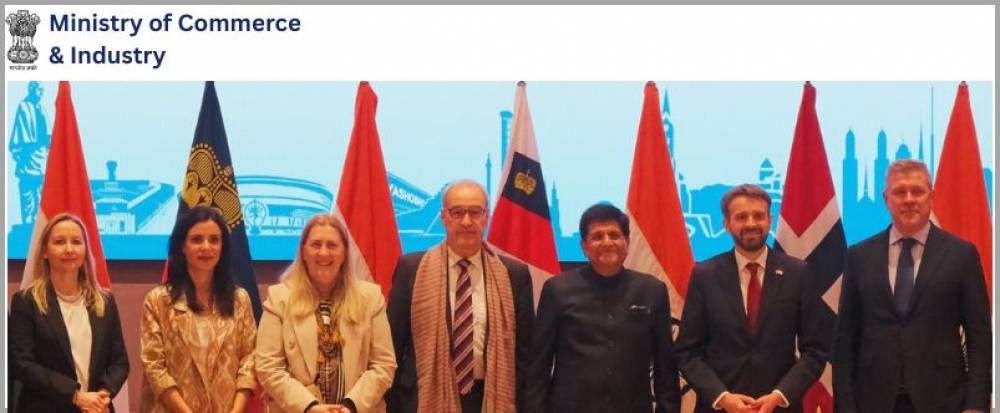
India-European Free Trade Association (EFTA) Trade and Economic Partnership Agreement (TEPA) has become effective from today, i.e., 1 October 2025. This agreement was signed at New Delhi, on 10 March 2024. TEPA incorporates a commitment linked to job creation and investment.
The agreement consists of 14 chapters and primarily focuses on market access for goods, rules of origin, trade facilitation, trade remedies, sanitary and phytosanitary measures, technical barriers to trade, investment promotion, market access for services, intellectual property rights, trade and sustainable development as well as other legal and horizontal provisions.
Under agreement, the EFTA’s market access offer covers 100% of non-agricultural products and provides tariff concessions on processed agricultural products. Sensitivities related to production linked incentives (PLI) in sectors like pharmaceuticals, medical devices and processed food have been considered when extending these offers.
TEPA goes beyond goods and services for promotion of investments aimed at increasing foreign direct investment in India by USD 100 billion over the next 15 years, and to facilitate the creation of 1 million direct jobs in India through these investments.
What is EFTA?
EFTA stands for European Free Trade Association. It is a crucial regional group that provides several growing opportunities for improving global trade in goods as well as services.
The European Free Trade Association is one of the most essential economic blocs out of the three (other two are - EU & UK) in Europe. Switzerland is the biggest trading partner of India, followed by Norway, among the EFTA countries.
Key Features of TEPA Agreement
Here are the key features of the TEPA agreement:
-
TEPA will empower Indian exporters by giving them access to specialized inputs. It will create a conducive trade and investment environment.
-
EFTA states aim to raise foreign direct investment from their investors into India by USD 50 billion within 10 years from the entry into force of the Agreement, and an additional USD 50 billion in the succeeding 5 years. This will amount to a total of USD 100 billion over 15 years.
-
The EFTA states aim to facilitate generation of 1 million direct jobs in India resulting from these investment inflows. This investment commitment explicitly excludes foreign portfolio investment (FPI). It focuses on long term capital for productive capacity building.
-
EFTA has offered 92.2% of tariff lines under TEPA. These lines encompass 99.6% of India’s exports. It includes 100% of non-agricultural products and tariff concessions on Processed Agricultural Products (PAP).
-
India has offered EFTA covers 82.7% of tariff lines and accounts for 95.3% of EFTA exports. Over 80% of these imports are Gold, with no change in effective duty on Gold.
-
India has made commitments in 105 sub-sectors. The commitments from the European Free Trade Association (EFTA) include 128 from Switzerland, 114 from Norway, 107 from Liechtenstein, and 110 from Iceland.
-
The Trade and Economic Partnership Agreement (TEPA) facilitates the establishment of Mutual Recognition Agreements (MRAs) in professional services, including nursing, chartered accountancy, and architecture.
-
TEPA will facilitate technology collaboration and give access to world leading technologies in the following: precision engineering, health sciences, renewable energy, Innovation and Research & Development.
-
The agreement unlocks opportunities across several industries. Indian exporters in sectors like machinery, organic chemicals, textiles and processed foods will enjoy majorly improved access to EFTA markets.
-
The agreement will increase competitiveness, reduce compliance costs and accelerate access to EFTA market.
-
TEPA also offers opportunities in various areas such as IT, business services, cultural and recreational services, education and audiovisual services.
-
The agreement ensures IPR commitments at TRIPS level.
-
TEPA also lays emphasis on sustainable development, social progress, environmental protection and inclusive growth.
-
The agreement will speed up the creation of large no. of direct jobs for the Indian youth in next 15 years. It will create better facilities for vocational and technical training.
-
A dedicated EFTA Desk has been operational since Feb 2025. It is a single-window mechanism for investment facilitation to help EFTA businesses in investing, expanding and establishing their operations in India.
-
TEPA will assist joint ventures, SME collaborations and technology partnerships with the Desk streamlining regulatory navigation for EFTA businesses.
Conclusion
India-EFTA agreement, known as Trade and Economic Partnership Agreement (TEPA), marks a historic milestone. It is India’s first foreign trade agreement with four developed European countries. The agreement commits USD 100 billion in investments and 1 million direct jobs over 15 years. TEPA is a “model agreement” that showcases the readiness of India to build a thriving future with EFTA.
To know more, you can visit the official website of the Press Information Bureau.
Comments
No comments yet.
Leave a Comment