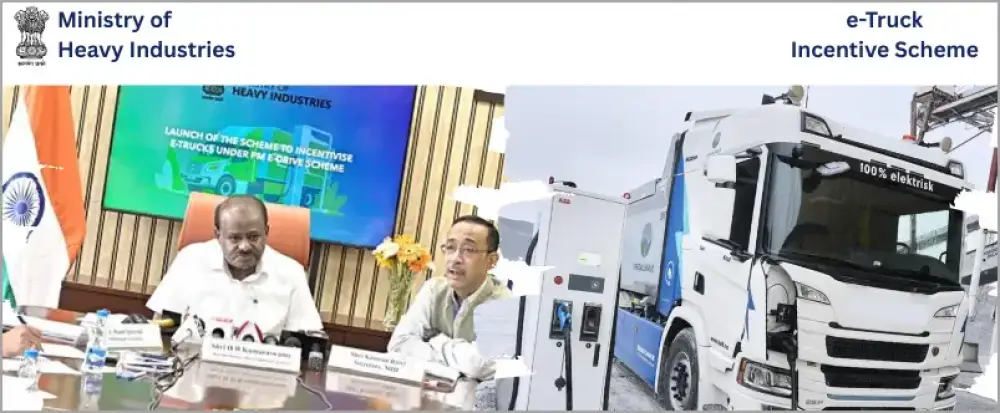
A one-of-its-kind scheme has been launched by the Government of India (GOI) to provide financial incentives for electric trucks (e-trucks) under the PM e-Drive initiative. The scheme has been rolled out under the visionary leadership of PM Shri. Narendra Modi and expert guidance of the Union Minister for Heavy Industries and Steel, Shri. HD Kumaraswamy.
The Indian Government is extending direct support for e-trucks for the first time via the new scheme. It envisions to speed up India’s transition to efficient, clean and sustainable freight mobility.
The Union Minister, highlighting the scheme’s importance, said, “Diesel trucks, though constituting only 3% of the total vehicle population, contribute to 42% of transport-related greenhouse gas emissions and significantly worsen air pollution. This pioneering scheme, guided by the visionary leadership of Prime Minister Shri Narendra Modi, represents India’s first dedicated support for electric trucks. It will drive our nation toward sustainable freight mobility, a cleaner future, and the realization of Viksit Bharat by 2047, in alignment with our net-zero emissions goal by 2070.”
Incentives for N2 and N2 Electric Trucks
The scheme will provide demand incentives to e-trucks falling under N2 and N3 categories, in accordance with Central Motor Vehicle Rules. The N2 category includes trucks that have a gross vehicle weight between 3.5 tonnes to 12 tonnes.
On the other hand, N3 category trucks are those with gross vehicle weight more than 12 tonnes and up to 55 tonnes. Incentives will only apply to only N3 category’s puller tractor as far as articulated vehicles are concerned.
Manufacturer-Backed Warranties Mandatory for Scheme
The scheme makes manufacturer-backed warranties mandatory to ensure performance and dependability. The battery must come with a warranty for 5 years or 5 lakh km., whichever is earlier. Additionally, the vehicle and motor must come with a warranty of 5 years or 2.5 lakh km., whichever is earlier.
Incentive Amount Per Vehicle
The exact incentive amount under the e-truck incentives scheme will depend on the electric truck GVW. The maximum incentive a vehicle can receive is decided at Rs. 9.6 lakh. The GOI will offer the scheme's incentives as an upfront reduction in purchase cost and reimbursement to OEMs through PM e-Drive Portal in a first come, first served manner.
Deployment of Trucks and Key Sectors under the Scheme
The GOI expects the scheme to assist approx. 5,600 e-trucks’s deployment across India. In Delhi, a dedicated provision has been made for 1,100 Delhi-registered e-trucks. The estimated outlay for the provision is Rs. 100 crore. It aims to address the challenging air quality issues in the capital.
The scheme will benefit major sectors like the logistics sector, cement sector, steel industry and ports sector. Several leading OEMs, including Tata Motors, Ashok Leyland and Volvo Eicher, are already involved in electric trucks’ manufacturing in the country and are working towards enhancing the indigenous capabilities under GOI’s Atmanirbhar Bharat vision.
Response Received by the e-Truck Incentive Scheme
The e-truck incentive initiative has received a positive response from manufacturers as well as users of e-trucks. They acknowledge the potential of the new scheme to reduce costs associated with logistics and lower carbon emissions.
The Steel Authority of India Limited (SAIL) has committed to purchase 150 e-trucks over the next two years for deployment in various areas as a powerful demonstration of CPSE leadership. Furthermore, it has established an internal goal to ensure that at least 15% of all vehicles rented by its groups are electric vehicles.
Final Words
The Ministry of Heavy Industries’ incentive scheme for e-trucks aligns with GOI’s broader mission to develop a self-reliant electric mobility ecosystem in the country. The scheme aims to lower operational costs for transporters by offering incentives. It promotes the adoption of clean energy in the heavy vehicle domain. Further, it intends to improve air quality in urban and industrial areas, and bring the country closer to a low-carbon, sustainable economy.
Source: Press Information Bureau (PIB)
Comments
No comments yet.
Leave a Comment