On 9 October, the Union Minister for Road Transport and Highways, Shri Nitin Gadkari, addressed the 120th Annual Session of the PHD Chamber of Commerce and Industry (PHDCCI) in New Delhi. He expressed his gratitude towards all stakeholders for the contributions they’ve made to drive India’s economic growth.
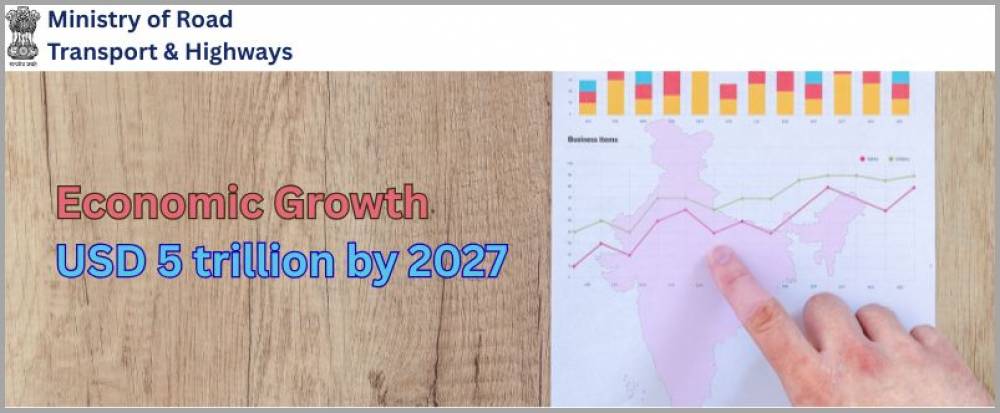
He also reiterated the Government’s goal of achieving a USD 5 trillion economy by 2027 under the leadership of the Hon’ble PM Shri Narendra Modi. Additionally, he highlighted the national vision of turning India into a developed country by 2047.
Shri Gadkari emphasized that along with physical progress, three key pillars namely Ethics, Economy and Ecology/Environment should guide national development. He highlighted that ethical values are vital for maintaining a healthy social and family structure and stressed the need for integrated thinking, coordination and cooperation among all industries.
Using the automobile industry as an example, the Minister noted that when the current Government took office in 2014, India’s automobile industry ranked seventh globally and was valued at Rs. 14 lakh crore. He reported that India has now surpassed Japan to become the third-largest automobile market in the world and that our industry size is Rs. 22 lakh crore.
He expressed his confidence and said that with advancements in research, innovation and the adoption of alternative fuels like ethanol, methanol, biodiesel, LNG, electric and hydrogen fuels, India could emerge as the top automobile manufacturing country globally within a period of five years.
Further, it was noted by the Minister that utilizing alternative fuels would lead to reduction in crude oil imports that cost Rs. 22 lakh crore annually. He explained how the reforms in ethanol production policy have led to a rise in the market price of maize and benefitted the farmers, especially the ones who are in Uttar Pradesh and Bihar. It has added Rs. 45,000 crore to their income.
He emphasized that reduction in imports and increase in domestic production will lead to higher growth, improved purchasing power and increased employment. He cited the recent launch of electric truck battery swapping in Sonipat as an example and highlighted its economic viability as compared to diesel.
He pointed out that the cost of electricity per kilometer is way lower than that of diesel, which helps to reduce logistics costs. He noted that due to infrastructure improvements, India’s average logistics costs have decreased from 16% of GDP.
Shri. Gadkari expressed confidence that by the end of this year, these costs would fall to single digits (around 9%). The Minister also mentioned the importance of innovation, research and entrepreneurship and stated that “no material is waste and no person is waste.”
He mentioned projects like converting sewage sludge in Mathura into bioenergy and utilizing legacy waste for construction of roads. He reported that approx. 80 lakh tonnes of waste have already been used in road projects and contributed to environmental sustainability.
The Minister put emphasis on the need for balanced development across these sectors: agriculture, manufacturing, and services sectors. He urged for prioritizing the growth of the agriculture and allied sectors. He noted that balanced growth was crucial for reducing migration and strengthening rural economy of the country.
He reinforced that the backbone of the economy is infrastructure development. It generates employment and government revenue and contributes majorly to the growth of GDP of the country. He mentioned that an investment of Rs. 100 in national highways contributes to Rs. 321 to GDP.
While referring to the models implemented in development of roads, the Minister outlined that under Infrastructure Investment Trust (InvIT) and Toll-Operate-Transfer (TOT) models, the Ministry has successfully mobilized funds via the capital market.
He said that, within hours, the first InvIT bond issue was oversubscribed seven times. This demonstrates investor confidence. He mentioned the importance of decentralizing wealth to strengthen the economy by making small investors as well as workers prosperous.
In addition to this, he also spoke about the ongoing infrastructure projects like 25 greenfield expressways that connect major cities and ports across the nation. It was informed by him that new tunnels as well as corridors like Zojila Tunnel and Delhi-Katra-Amritsar Expressway are being constructed to enhance connectivity and reduce travel time for all. He highlighted that religious tourism will be promoted and revenue will be generated through the development of tourism circuits such as Buddhist Circuit and ropeways in Kedarnath.
The Minister concluded his speech by reiterating that the Government vision lays emphasis on forming a safe, sustainable and economically prosperous infrastructure that increases employment opportunities, boosts exports and supports inclusive national development.
In addition to his speech at the 120th Annual Session of the PHD Chamber of Commerce and Industry (PHDCCI) in New Delhi, he also presented PHDCCI Business Practices & Awards 2025 and recognized excellence in Industry.
Source: Press Information Bureau (PIB)
Comments
No comments yet.
Leave a Comment