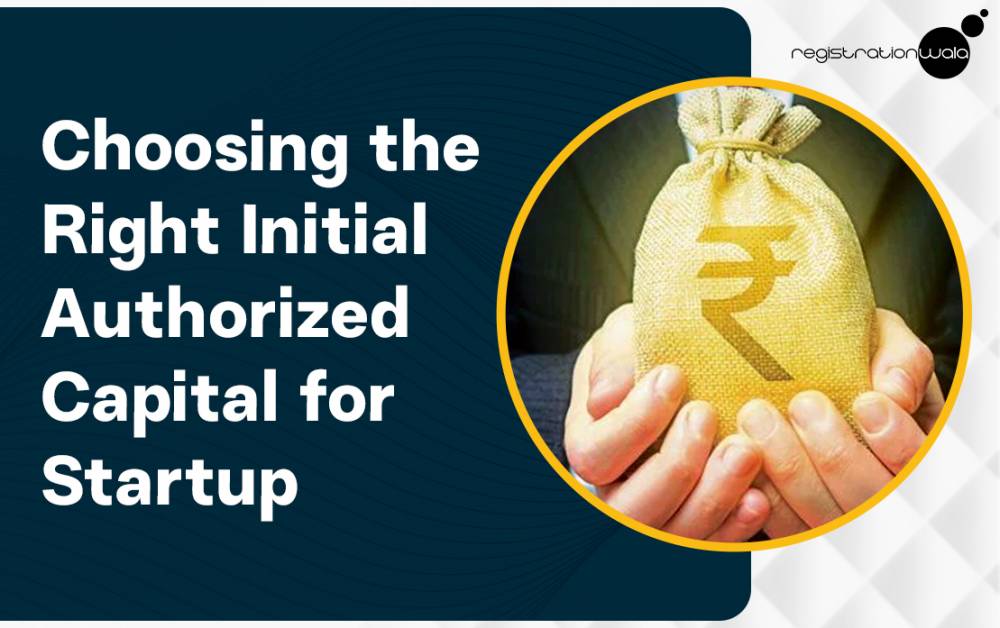
A startup is basically a young, innovative company. It is founded by an entrepreneur to offer a unique product or service, disrupt existing markets or create new ones. When incorporating a startup, choosing the right initial authorized capital is extremely important. This is because this amount sets the maximum legal limit for shares a company can issue and defines its long term growth capacity.
If you’re wondering how to choose the right initial authorized capital for your startup, you’re on the right track by visiting this blog post. Here, we shall provide you with useful tips for choosing the right amount.
What is Initial Authorized Capital?
Authorized capital means the maximum amount of share capital a company is legally permitted to issue to shareholders. This amount is defined in the Memorandum of Association under the Capital Clause. Basically, initial authorized-capital is the authorized-capital amount that is decided by the promoters at the time of company incorporation. It is important to note that, as of 2026, there is no mandatory minimum authorized-capital requirement for private limited companies under the Companies Act, 2013.
While there is no prescribed minimum authorized-capital requirement, it is advisable to keep a reasonable authorized-capital amount as it enhances credibility, supports future fundraising and helps avoid the cost and compliance involved in increasing capital later. As a general rule, the authorized-capital amount must be equal to or higher than paid-up capital amount. The paid-up capital can never be more than authorized-capital amount.
Deciding on initial authorized capital can be a bit technical, but you don't need to worry. Registrationwala's expert team will help you choose the right capital structure and make the incorporation process smooth.
Register Your Startup Now
Tips to Choose the Right Initial Authorized Capital for your Startup
Here are a few tips to help you choose the right initial authorised capital at the time of startup
registration in 2026 :-
-
Stamp duty is calculated as a percentage of the authorised share capital. So, if you want to save up on stamp duty fees, you should start with a low amount initially.
-
While starting low, you must make sure the amount you decide on is high enough to cover initial founder contributions as well as early stage investment for the startup.
-
If you plan to raise money from angel investors or venture capitalists within 6 to 12 months of startup incorporation, then deciding on a higher initial authorized capital is recommended as it can help you save on future legal and compliance fees for increasing it later on.
-
Remember that the authorised share capital needs to be equal to or higher than the initial paid-up capital. So, it is advisable to first determine your paid-up capital and then set the authorized shares capital slightly higher. Doing so would provide flexibility for future funding needs without requiring any immediate legal changes.
Conclusion
After going through this blog post, we hope you can choose the initial authorized share capital easily now. Make sure this amount isn’t less than the paid-up capital you decide on. Also, don’t forget to mention the authorized share capital amount in the Memorandum of Association under the Capital Clause.
If you need assistance in startup registration in India, you can get in touch with our experienced consultants at Registrationwala. We will help you to incorporate/register a startup in a smooth and hassle free manner while adhering to the mandatory legal and regulatory requirements.
Also Read:- Legal Requirements For Startup Business Registration
Frequently Asked Questions (FAQs)
Q1. Under which clause is the authorized share capital mentioned in the Memorandum of Association?
A. The authorized share capital is mentioned under the Capital Clause in the Memorandum of Association.
Q2. Can authorized shares capital be lower than paid-up capital?
A. No, authorized shares capital can never be lower than paid-up capital. This is because the authorised capital acts as the maximum legal ceiling.
Q3. Can a private limited company’s authorised capital be as low as 1 Rupee?
A. Yes, a private limited company’s authorised-capital can be as low as 1 Rupee. After the implementation of the Companies (Amendment) Act, 2015, the minimum statutory capital requirement of Rs. 1 lakh was removed.
-
Published: April 06, 2026
861 Views