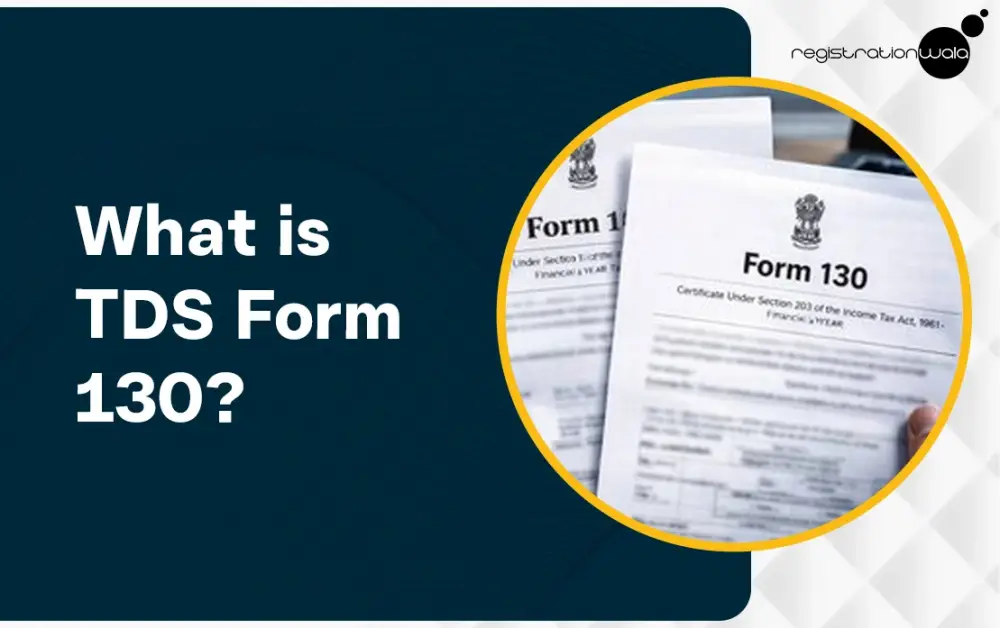
On 1 April 2026, under the new Income Tax Act, 2025 and Income Tax Rules, 2026, TDS Form 130 was made the mandatory annual TDS certificate that employers must issue to salaried employees, replacing the previously used Form 16.
While the form number has changed, its main purpose remains the same, i.e., to provide details about salary paid and TDS deducted. In this blog post, we shall explain to our readers key details regarding this form.
What is TDS Form 130?
TDS Form 130 is the new mandatory Tax Deducted at Source (TDS) certificate for salary and pension. Effective 1 April 2026, it has officially replaced TDS Form 16 under the Income Tax Act 2025, for reporting Tax Deducted at Source (TDS) on both salary and pension income.
Employers are required to issue this form annually to their employees, while banks are required to provide this form to the pensioners. The form certifies that taxes have been deducted and deposited with the government.
This document is essential for filing Income Tax Returns as it serves as a mandatory TDS certificate for verifying that tax has been deducted and then successfully deposited with the government.
Part A, B and C of Form 130
Form 130 is divided into three parts, i.e., Part A, Part B and Part C. Below, we have explained them one by one :-
-
Part A :- Part A of the form is the first part. It includes details of the employer/specified bank and also the details of the employee/senior citizen to whom the form is issued.
-
Part B :- In the second part of the form, which is Part B, details of amount paid/credited and tax deducted at sources are mentioned.
-
Part C :- In the final part of the form, which is Part C, there are two annexures.
- Annexure-I of Part C applies where the tax is deducted from the salaried income of employees. It includes a comprehensive computation of taxable income like break-up of gross salary, deductions, exemptions, total taxable income, tax payable, relief u/s 157, TDS/TCS paid and net tax payable among other details.
- Annexure-II of Part C applies to specified senior citizens only. It includes their pension income details, interest income under the head “Other Sources” paid by specified bank, deductions, total taxable income, tax payable, relief u/s 157, net tax payable among other details.
New TDS Form 130 vs Form 16: How is the New Form Different?
Although Form 130 has the same purpose as previously used Form 16, the new form has introduced new structural changes, such as :-
-
Aligned with ITA 2025:- The new TDS Form-130 has been introduced under the Income Tax Act 2025 Sections 392/395, replacing Form 16 issued under the Income Tax Act, 1961 Sections 192/203.
-
Tax Year vs Assessment Year:- References to “Assessment Year” have been replaced with “Tax Year” in line with the new framework. This means that the concepts of "Previous Year" (i.e., year when income is earned) and "Assessment Year" (i.e., year when taxes get assessed) are replaced by a single unified "Tax Year".
-
More disclosure regarding TDS:- The form now requires mentioning the applicable tax deduction rate along with the amount deducted and deposited in the employee summary section.
-
TIN 2.0 system integration:- TDS reporting is now aligned with upgraded systems (such as TIN 2.0) that replace the earlier OLTAS-based framework for reporting.
-
Improved taxpayer and employer details:- The updated form introduced under the new Act includes a few extra fields like email ID, contact number and country code so as to support digital reporting.
Benefits of TDS 130 Form
The benefits of this form are as follows :-
-
This form, issued by the employer to the employee, ensures that the salary interest income is officially deposited with the government.
-
It is an important document at the time of ITR filing. It allows the taxpayer to accurately claim credit for the TDS deducted by the deductor.
-
It serves as an official proof of TDS deduction and showcases compliance with the tax rules.
-
The form provides a summary of salary income, deductions and tax deductions.
-
It makes ITR filing easier as it consolidates data from various sources.
Conclusion
Form-130 serves as official proof of TDS deducted from salary. Earlier, Form 16 was used; however, following the implementation of the Income Tax Act, 2025, Form-130 has been in use from 1 April 2026. This form must be mandatorily issued by the employer to the employee after the successful deduction of TDS.
If you need assistance in TDS return filing, you can get in touch with our consultants at Registrationwala.
Frequently Asked Questions (FAQs)
Q1. Which form did the 130 Form replace?
A. TDS Form-130 replaced Form 16.
Q2. When was Form 130 introduced in the tax system?
A. Form-130 was introduced from 1 April 2026.
Q3. Which Act governs 130 Form?
A. Form 130 is governed by the Income Tax Act, 2025.
Q4. Which form does an employer issue to an employee to certify TDS deduction from salary and successful deposit with the government?
A. Form-130 is issued by the employer to certify TDS deduction from salary and its successful deposit with the government.
Q. How many parts is Form-130 divided into?
A. Form-130 is divided into three parts, namely, Part A, Part B and Part C.
-
Published: April 04, 2026
1045 Views