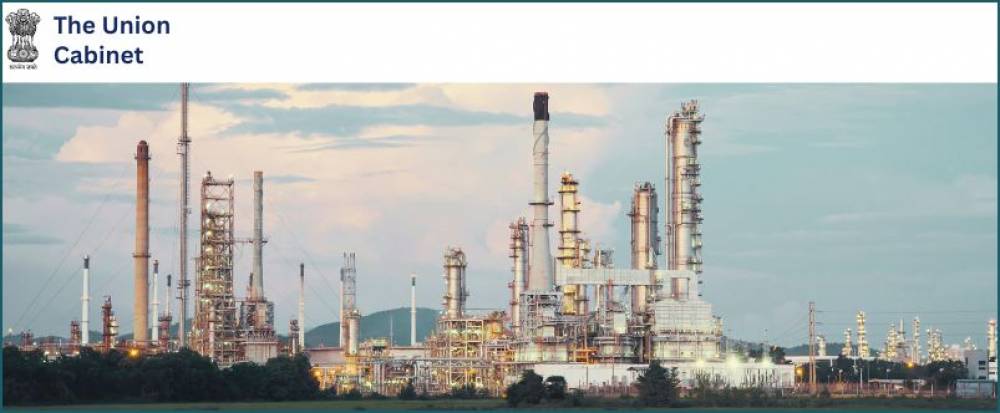
The Union Cabinet chaired by Prime Minister Shri Narendra Modi has approved the Bharat Audyogik Vikas Yojana Rasayan. This scheme is also known as BHAVYA Rasayan Scheme. It aims to establish three dedicated Chemical Parks in India. This scheme was announced in Union Budget for fiscal year 2026-27.
The total financial outlay for the scheme is Rs. 3,030 crore. Out of this amount, a total of Rs. 3,000 crore will be allocated for the establishment of Common Infrastructure Facilities and Basic Utilities within the parks while the remaining amount of Rs. 30 crore will be designated for administrative expenses.
The scheme will be implemented over a period of five years, starting from FY 2026-27 to FY 2030-31. Under this scheme, the central government will provide a grant of up to Rs. 1,000 crore for each chemical park, contingent upon a minimum contribution of Rs. 500 crore from concerned State Government.
Expected Benefits of BHAVYA Rasayan Scheme
It is anticipated that the BHAVYA Rasayan Scheme 2026 will bring the below-mentioned benefits to the economy:
-
The scheme will promote the growth of the chemical industry across the entire value chain, including upstream, downstream and ancillary sectors. This will lead to more efficient resource utilization as well as reduced logistics costs.
-
By providing shared common infrastructure facilities and basic utilities tailored to the needs of the chemical industry, the chemical park scheme will enhance cost competitiveness as well as help the Indian industries to compete globally.
-
The scheme will allow the Indian chemical industry to better integrate in Global Value Chains. It will lead to greater exports as well as higher import substitution.
-
The initiative will assist Indian chemical industry in better integrating into global value chains. This will result in increased exports as well as lead to greater import substitution.
-
The BHAVYA Rasayan Scheme aims to develop Indian chemical industry in an environmentally sustainable manner. It will create an eco-friendly ecosystem via centralized facilities like Common Effluent Treatment Plants, Treatment, Storage, and Disposal Facilities and Hazardous Waste Management infrastructure. This approach will ensure better compliance with environmental regulations as well as promote eco-friendly industrial development.
-
The development of chemical sector will have a ripple effect. It will lead to enhanced growth in downstream sectors of economy. This, in turn, will generate more employment opportunities and contribute to overall economic development. It will help to achieve the goal of Viksit Bharat by 2047.
The BHAVYA Rasayan Scheme will facilitate sector development by recognizing that the chemical and petrochemical sectors supply various downstream industries such as agriculture, textiles, pharmaceuticals, nutraceuticals, construction, automobiles and electronics.
It will attract domestic and foreign investments alike, enhance domestic production capacity and generate employment. Ultimately, this will boost the sector's global competitiveness and promote self-reliance (Atmanirbharta) in the country.
Key Features of BHAVYA Rasayan Scheme
In terms of the BHAVYA Rasayan Scheme 2026,the Centre will support the development of three dedicated Chemical Parks by the State Governments through the Challenge Route. Each park will require a minimum contiguous area of 8 square kilometers (approximately 2,000 acres) of land that is free of any encumbrances.
These parks will offer plug-and-play infrastructure, which will include Common Infrastructure Facilities and Basic Utilities specifically designed for the chemical industry, such as:
-
Common Effluent Treatment Plant (CETP),
-
Treatment, Storage, and Disposal Facility (TSDF),
-
Solvent recovery and distillation facilities,
-
Steam generation and distribution network,
-
Interconnected pipeline network,
-
Water supply and distribution systems,
-
Logistics and warehousing facilities.
Source:- Press Information Bureau (PIB)
Comments
No comments yet.
Leave a Comment