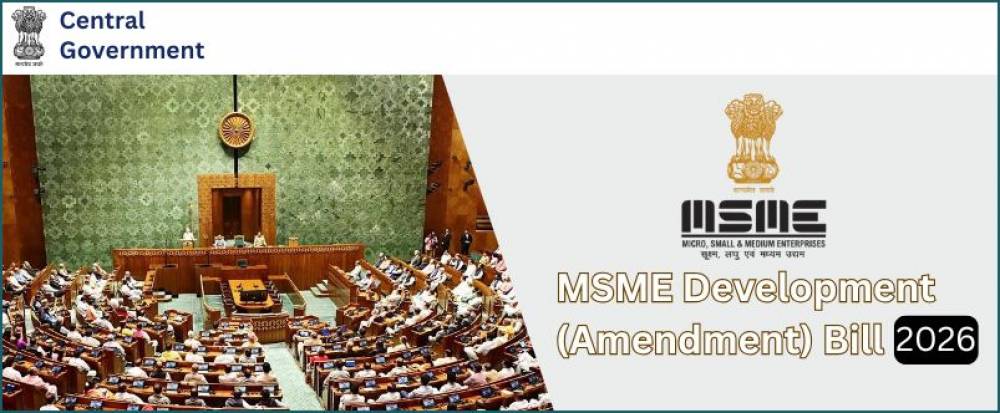
The Central Government has proposed certain changes to Micro, Small and Medium Enterprises (MSME) Development Act, 2006. The changes proposed by the Centre aim to improve cash flows, reduce delays in payments and make regulatory compliance much simpler for small businesses.
Key Reforms under Proposed Bill
The MSME Development (Amendment) Bill, 2026 tabled in Parliament aims to make digital invoicing mandatory for payments made by Central Public Sector Undertakings, establish new national registration platform, speed up dispute resolution and decriminalise certain offences under existing MSME law.
The proposed legislation also states that a key provision in the Bill requires that all invoices raised by MSMEs on Central PSUs must pass via Trade Receivables Discounting System (TReDS) platform. State governments may lay down similar requirements for their own public sector undertakings. The move is expected to improve liquidity for MSMEs with faster access to working capital and reduction in payment delays.
To streamline registration and make government schemes easily accessible, the Bill proposes a free national digital registration platform for MSMEs. Moreover, the proposed law requires the state to set up additional MSME facilitation councils to strengthen grievance redressal by ensuring faster resolution of disputes pertaining to payments.
Measures to Strengthen Cash Flow for MSMEs
According to the Bill, buyers who challenge an award passed in an MSME’s favour may have to release a minimum of 50% of awarded amount in case the legal challenge continues to be pending for more than 6 months.
Furthermore, the Bill will empower the Courts to direct payments from amount deposited during appeal procedure. This provision of the proposed law intends to ease cash flow pressures that small businesses face.
Decriminalisation and Changes to Facilitation Councils
The bill also seeks to decriminalize certain offences and replace criminal fines with graded monetary penalties and warnings. It also creates an appellate process for businesses so as to contest penalties.
The composition of MSME Facilitation Councils has also been rationalized. Under the Bill, councils will have 3-5 members and one of them must be a legal expert.
Expected Impact of Proposed Amendments
The proposed amendments seek to make the MSME ecosystem more efficient with better access to finance, improved dispute resolution and reduced compliance burden while maintaining safeguards for businesses as per the Bill’s provisions.
Source: MSN
Comments
No comments yet.
Leave a Comment