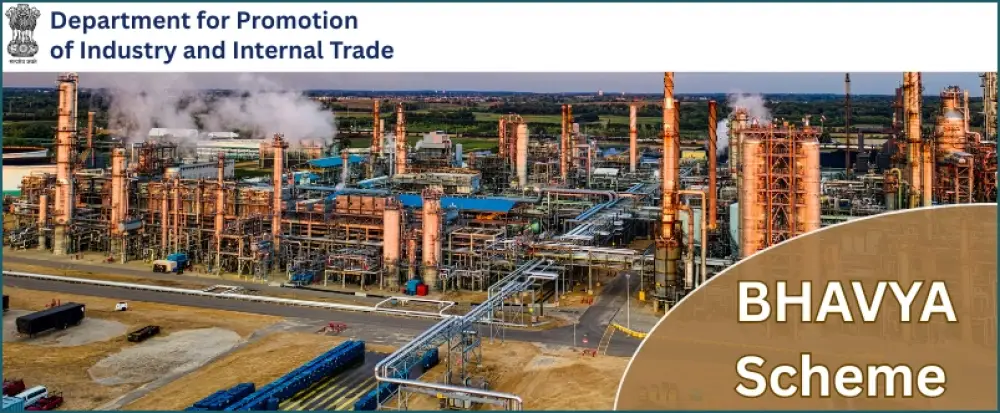
The detailed operational guidelines for BHAVYA Scheme’s implementation have been notified by the Department for Promotion of Industry and Internal Trade (DPIIT), Ministry of Commerce & Industry, Government of India.
The scheme is a landmark Central Sector Scheme aimed at developing state-of-the-art industrial parks across the country. To know what this scheme is all about and the operational guidelines released by DPIIT for the scheme, continue reading.
BHAVYA Scheme full form is Bharat Audyogik Vikas Yojna. It is a Central Sector Scheme that focuses on development of world-class, plug-and-play industrial parks across India. It was approved by the Cabinet on 18 March 2026. It is designed to enhance India’s manufacturing ecosystem by creating integrated industrial infrastructure that aligns with the objectives of Make in India, PM Gati Shakti and the broader vision of the Government to establish India as a globally competitive manufacturing destination.
The scheme outlines plans for the development of 100 industrial parks over six years, i.e., from 2026-27 to 2031-32. It has a total financial allocation of approximately Rs. 33,660 crore. In the scheme’s initial phase, up to 50 industrial parks will be developed via a challenge-based competitive selection procedure.
-
Under the BHAVYA Scheme guidelines released by DPIIT, a comprehensive framework is laid down. It covers the eligibility criteria, project selection methodology, structure of funding, governance architecture, monitoring systems and implementation modalities for industrial parks under the scheme.
-
The scheme majorly focuses on creating “investment-ready” industrial ecosystems having features like plug-and-play infrastructure, multimodal logistics connectivity, reliable utility systems, worker-support infrastructure, digital governance systems and sustainable development.
-
The Guidelines allow for the development of both greenfield and eligible brownfield industrial parks. A minimum land requirement of 100 acres has been established for non-hilly states, while 25 acres is required for hilly states, northeastern states, Union Territories and smaller states.
-
The Scheme also accommodates the possibility of larger parks, up to 1,000 acres.
-
Proposals will be evaluated using a challenge-based selection framework with objective criteria, including multimodal connectivity, site suitability, quality of infrastructure, strength of the industrial ecosystem, policy facilitation, readiness for digital governance and long-term sustainability.
-
Under the guidelines, evaluation criteria is provided for the quality of infrastructure in various components like underground utility systems, water and waste management, common effluent treatment systems, renewable energy infrastructure, worker housing, testing labs, skill development facilities, integrated common infrastructure, etc.
-
Projects under the BHAVYA Scheme will be implemented via Special Purpose Vehicles (SPVs) created under Companies Act, 2013. These SPVs will be responsible for project planning, development, operation, management, investor facilitation and the long-term maintenance of the assets created under the Scheme.
-
The Scheme will offer financial assistance in the form of equity contributions tied to the value of land transferred to the SPV and the achievement of specified project milestones.
-
The National Industrial Corridor Development Corporation, abbreviated as NICDC, has been designated as the Project Management Agency, abbreviated as PMA, for overseeing the scheme’s implementation and monitoring.
-
Additionally, the Guidelines include structured provisions to involve private developers in development of industrial parks via project-specific SPVs. These provisions also establish clear governance frameworks and transparency safeguards as well as accountability mechanisms.
-
To ensure effective implementation and transparency of the scheme, the Guidelines incorporate certain features, i.e., GIS-based monitoring systems, periodic progress reporting, audit mechanisms and oversight by National Level Steering Committee chaired by Secretary of DPIIT.
-
Furthermore, the Scheme's guidelines promote convergence with relevant initiatives from both Central and State Governments related to logistics, skill development, sustainability, renewable energy, utility infrastructure and industrial development.
The guidelines released by the DPIIT is a crucial step towards the BHAVYA scheme’s implementation and establishment of industrial infrastructure that meets global benchmarks. The infrastructure would attract large-scale manufacturing investments, strengthen domestic supply chains, generate employment and improve India’s integration into global value chains.