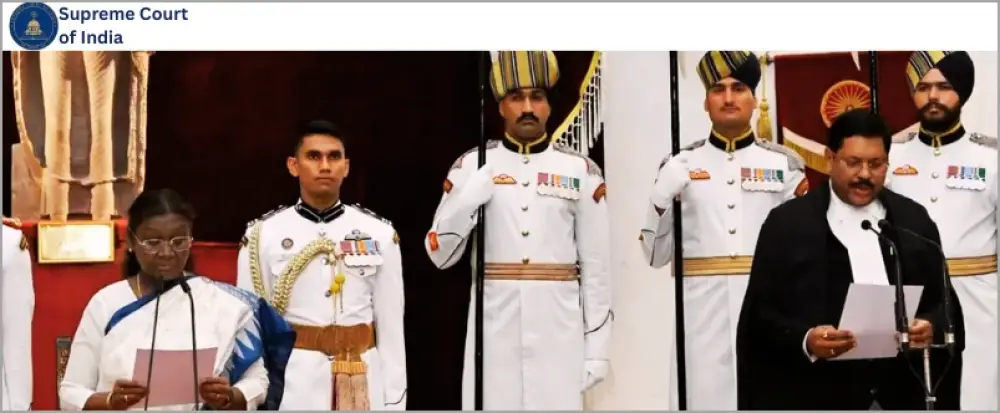
On May 14, 2025, Justice Bhushan Ramkrishna Gavai took the oath as the 52nd Chief Justice of India (CJI). He marked a historic moment as the first Buddhist and only the second individual from the Scheduled Castes to rise to the apex of the Indian judiciary. His appointment holds deep symbolic significance, reflecting the principles of inclusivity and constitutional integrity that the judicial system stands for.
Justice Gavai will hold the office of Chief Justice until his retirement on November 23, 2025. As he assumes this prestigious role, the nation's attention will be focused not only on the rulings he issues but also on the judicial legacy he will leave behind.
Throughout his tenure, Justice Gavai has contributed to several prominent benches that passed influential decisions, notably those that opposed unlawful demolition drives and implemented strict guidelines to regulate such actions.
He was also a member of the Constitution Bench responsible for several significant rulings, such as:
-
Affirming the Central Government's abrogation of Article 370,
-
Invalidating the electoral bonds scheme,
-
Upholding the 2016 demonetisation decision by the Centre, among others.
A bench led by Justice Gavai granted bail to Aam Aadmi Party (AAP) leader Manish Sisodia in a money laundering case, a judgment that served as a precedent for similar bail orders in the same matter. He also headed the bench that stayed Rahul Gandhi’s conviction in the defamation case related to the "Modi surname" remark and approved regular bail for civil rights activist Teesta Atul Setalvad in a case tied to the 2002 Godhra riots.
Born on November 24, 1960, in Amravati, Justice Gavai began his legal career by enrolling with the Bar on March 16, 1985. From 1987 to 1990, he practiced independently before the Bombay High Court, after which he predominantly appeared at the Nagpur Bench of the same court. He served as Standing Counsel for the Municipal Corporations of Nagpur and Amravati, as well as for Amravati University.
Between August 1992 and July 1993, he held the role of Assistant Government Pleader and Additional Public Prosecutor at the Nagpur Bench. He was later appointed Government Pleader and Public Prosecutor there on January 17, 2000.
Justice Gavai was appointed as an Additional Judge of the Bombay High Court on November 14, 2003, and confirmed as a permanent judge on November 12, 2005. During his tenure, he handled a broad spectrum of cases at the Mumbai Principal Bench and its branches in Nagpur, Aurangabad, and Panaji.
On May 24, 2019, he was elevated to the Supreme Court of India. As per data available on the Supreme Court’s website, over the past six years, Justice Gavai has served on approximately 700 benches, addressing diverse matters across constitutional, criminal, civil, administrative, environmental, educational, commercial, and arbitration laws.
He has authored nearly 300 judgments, including notable Constitution Bench decisions, reinforcing the rule of law and protecting the core rights of Indian citizens i.e., constitutional, legal, and human rights.
Source: India Today
Comments
No comments yet.
Leave a Comment