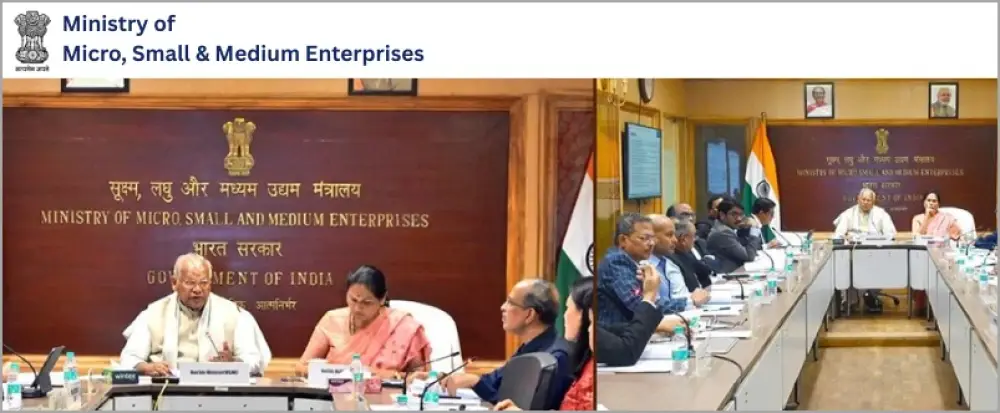
The Ministry of Micro, Small and Medium Enterprises, a.k.a. MSME Ministry, has established a support system to promote export by setting up 65 Export Facilitation Centres in its field offices, namely, MSME Development and Facilitation Offices, MSME Technology Centres and MSME Testing Centres.
These Export Facilitation Centres support MSMEs by guiding them through necessary processes like documentation, accessing markets, securing financing, adopting new technologies, and getting training.
In Short:
-
The Ministry of MSME has set up 65 Export Facilitation Centres to help the MSMEs with exports, documentation, market access, financing, technology, etc.
-
The International Cooperation Scheme gives reimbursements to first-time exporters and helps MSMEs to participate in global trade events.
-
Schemes like MSME Champions, RAMP, TIES, and Trade Connect enhance MSMEs’ competitiveness,innovation, and strengthen their global reach.
International Cooperation Scheme for Exporters
The Ministry of MSME also runs the International Cooperation Scheme, which includes the Capacity Building of First-Time Exporters initiative. This program reimburses new Micro and Small Enterprises (MSEs) for costs related to getting their Registration-cum-Membership Certificate (RCMC) from Export Promotion Councils, export insurance premiums, and expenses for testing and quality certifications.
Another part of the IC Scheme, called Market Development Assistance, helps eligible government bodies and industry associations with the costs of getting MSMEs involved in international exhibitions and trade fairs abroad. It also supports organizing international conferences in India, which are aimed at promoting technology upgrades, modernization, and potential joint ventures.
MSME Champions Scheme
The MSME Champions Scheme takes a more comprehensive approach to strengthening MSMEs. It includes three sub-schemes: the MSME-Sustainable (ZED) Certification Scheme, the MSME-Competitive (LEAN) Scheme, and the MSME-Innovative Scheme, which covers incubation, design, and intellectual property.
Together, all these sub-schemes unify and align various programs to make MSMEs become more competitive on the global level.
Other GOI Initiatives for Boosting MSMEs’ Global Presence
Other efforts to boost MSMEs’ global presence include the Ministry of Commerce and Industry’s Trade Infrastructure for Export Scheme (TIES) and the Market Access Initiative (MAI). These initiatives help the Indian exporters partake in international trade events like exhibitions and buyer/seller meets. Programs like Districts as Export Hubs work on identifying the potential of export, removing the hurdles exporters face, and supporting local businesses.
Additionally, the Trade Connect e-Platform offers a wide range of services for both new and established exporters, acting as a one-stop resource for international trade information and support.
The Raising and Accelerating MSME Performance Scheme, a.k.a RAMP scheme, is yet another scheme for MSMEs. It boosts the growth of Micro, Small, and Medium Enterprises by improving their access to the latest technology upgrades, markets, and credit. It does this by enhancing the capacity and efficacy of both Central and State-level institutions that support MSMEs.
Ending Note
From time to time, the Government of India introduces dedicated schemes to boost the growth of MSMEs not just within the country, but also on the global scale. These initiatives emphasize on enhancing the market access, promoting exports by exporters, supporting and encouraging innovation, and enabling technology upgrades to make Indian MSMEs globally competitive.
Source: PIB
Comments
No comments yet.
Leave a Comment