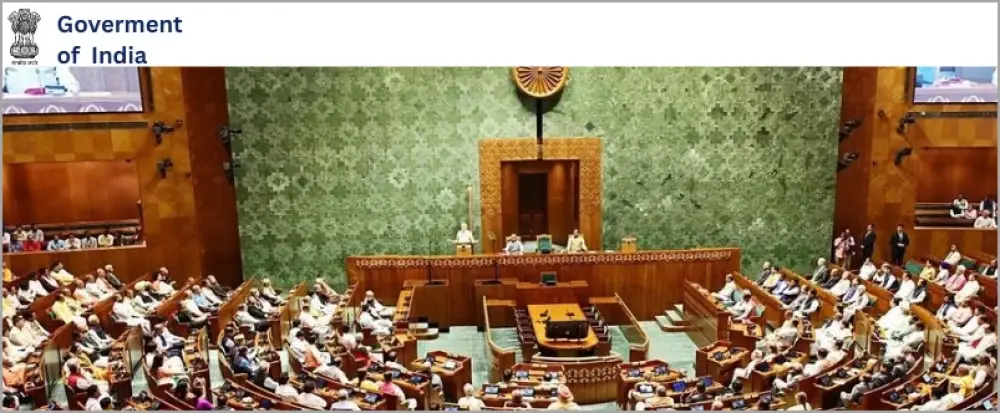
Parliament passed the Waqf (Amendment) Bill 2025 on Friday, April 4, after nearly 14 hours of debate in the Rajya Sabha. The bill received 128 votes in favor and 95 against. The Opposition accused the government of trying to relegate Muslims to "second-class citizens." They also questioned the “intent and content” of the legislation. The government denied any bias and said the bill aims to increase transparency in the management of Waqf properties.
In Short:
-
Parliament passed the Waqf (Amendment) Bill 2025 after a 14-hour debate; 128 MPs supported it, 95 opposed.
-
Opponents called it anti-Muslim and questioned its intent; the government said it ensures transparency.
-
The bill sparked protests, black attire in Rajya Sabha, and fiery exchanges over minority rights and religious property issues.
The Lok Sabha had already cleared the bill a day earlier, with 56 votes in favor. In the Rajya Sabha, the vote margin was narrower. DMK MP Tiruchi Siva proposed an amendment to stop non-Muslims from being nominated to the Waqf Board and Central Waqf Council.
The House rejected the motion with 125 votes against and 92 in favor. Some Opposition MPs wore black in protest. At 12:55 p.m., Union Minister for Minority Affairs Kiren Rijiju delivered his closing remarks.Further, he said the government had taken all viewpoints into account. He pointed to the differences between the original version of the bill and the final one passed by Parliament.
Rijiju dismissed the Opposition’s objection to non-Muslim members in the Waqf bodies.
He called it baseless and unfounded. Further, he also pushed back against comparisons to other religious endowment boards.
He noted that those do not include members from other faiths. “The Waqf Boards are statutory bodies and not religious bodies like the Hindu endowment boards. A statutory body should be secular,” he explained.
Rijiju reiterated that non-Muslim members won’t have decision-making powers. “They are here only to contribute,” he said. “I have said repeatedly that in the Central Waqf Council of 22 members there can only be four non-Muslim members… still the Opposition repeatedly raised the issue.”
Earlier in the day, Congress MP Syed Naseer Hussain led the criticism. He called the bill a “targeted legislation against the Muslim community” and said it aimed to treat Muslims as second-class citizens. He also accused the ruling party of introducing the bill in 2024 to shore up its vote bank after securing only 240 seats in the Lok Sabha.
RJD MP Manoj K. Jha also voiced concerns. He cited instances of minority mistreatment and said the bill’s “content and intent” were both questionable. He criticized the inclusion of non-Muslims on Waqf boards, saying it was being passed off as a secular gesture, even though such provisions don’t exist in boards of other religions.
Congress MP Imran Pratapgarhi targeted the government over timing. He said that while the Lok Sabha passed the bill late Wednesday night, U.S. President Donald Trump announced 26% reciprocal tariffs on India and added that the government needs to decide its priorities.
Later, AAP MP Sanjay Singh sparked uproar in the House. He alleged that while the government tries to protect Waqf properties, it turns a blind eye to scams involving temple lands. He cited a “13,000 acres land scam in Ayodhya,” triggering loud protests from treasury benches. BJP MPs stormed into the aisles, shouting in response.
Source: The Hindu
Comments
No comments yet.
Leave a Comment