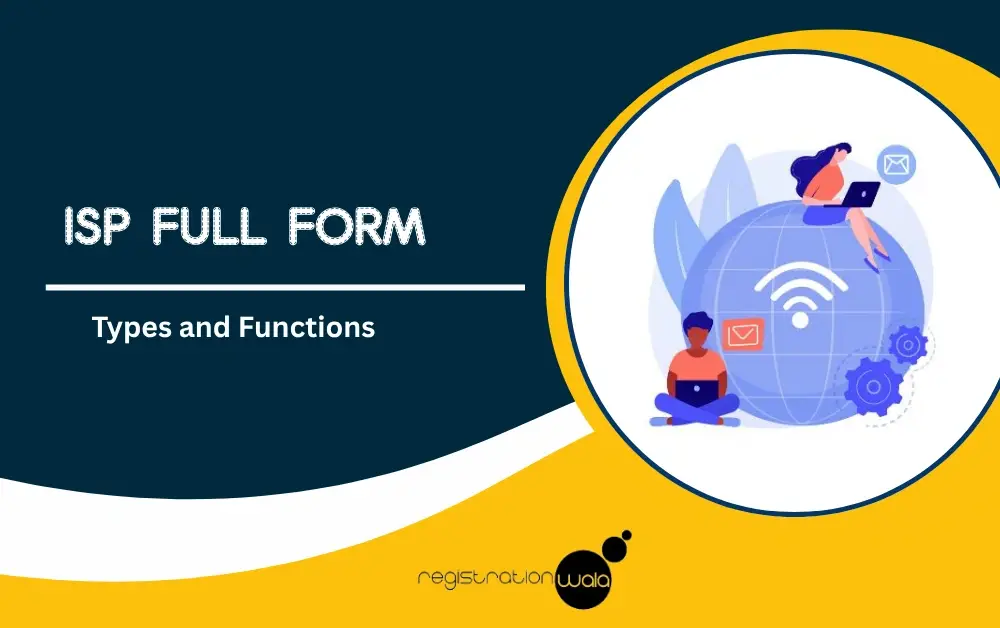
ISP full form is Internet Service Provider. As the name suggests, an internet service provider is a company that provides internet services to individuals, households and businesses.
In this blog post, we shall discuss ISP in detail, and explain its types and functions. We shall also explain the role of DoT and TRAI in regulating the ISPs in India.
ISP full form is Internet Service Provider. In India, an ISP is a business entity authorized by the Department of Telecommunications (DoT) to provide internet services to individuals, households, enterprises and various organizations across the nation. The ISPs play an essential role in the telecom sector as they deliver critical connectivity including broadband, Wi-Fi, leased lines and internet telephony by using technologies like fiber optics, wireless and satellite networks.
Without DoT authorization, a business cannot function as an ISP. Interestingly, only a company registered under the Companies Act, 2013 can become an ISP in India. Individuals, LLPs, sole proprietorships and partnership firms are ineligible. Some of the leading ISPs in India are Reliance Jio, Bharti Airtel, ACT Fibernet, BSNL, Tata Play, Fiber, Excitel and Hathway.
Types of ISPs in India
There are different types of ISPs in India. They are explained below:
-
Fiber-Optic ISPs: These ISPs provide internet through fiber-optic cables. They offer very fast internet speeds and a stable connection with fewer disruptions even when the weather condition is bad.
-
Mobile & Fixed Wireless Access (FWA) ISPs: These ISPs provide internet like all ISPs but they do it without cables. Instead, they use mobile network signals to connect users to the internet. This includes mobile internet on smartphones and wireless broadband connections for homes.
-
Cable & DSL ISPs: To provide internet to users, the cable and DSL ISPs use older types of wires. DSL works through telephone lines. Cable internet works through TV cables.
-
Satellite ISPs: These are advanced ISPs that provide internet with the help of satellites. They are mainly used in remote/rural areas where installing internet cables is quite difficult.
-
Leased Line ISPs: These ISPs provide a dedicated internet connection having symmetrical upload and download speed. These connections are mainly used by businesses and large organizations as they require reliable internet service for their operations.
Functions of ISP
The main functions of ISP are as follows:
-
One of the main functions of an ISP is to connect subscribers devices to the internet. It uses technologies like fiber-optic cables, broadband, DSL, 5G and satellite networks to provide internet access.
-
Another important function of an ISP is to manage the flow of data between subscribers' devices and the websites or applications they access. This function of the ISP ensures smooth as well as efficient communication over the internet.
-
Another key function of ISPs is to assign unique IP addresses to networks. These addresses help websites and online systems identify devices and deliver data to the correct destination.
-
They provide basic cybersecurity features, including firewall protection, DDoS attack prevention and spam or malware filtering so as to improve online security.
-
ISPs assist with internet-related problems. They do this by troubleshooting connectivity issues, maintaining network infrastructure and helping customers manage their service plans.
-
Many ISPs also offer additional services to their customers like web hosting, domain registration, bundled television and telephone packages to name a few.
Role of DoT & TRAI in Regulating ISPs in India
In India, the Department of Telecommunications (DoT) and the Telecom Regulatory Authority of India (TRAI) are responsible for regulating the ISPs in India. The DoT is responsible for granting ISP licenses to allow companies to provide internet services to the customers. These licenses are generally valid for 20 years and must be renewed after that period to continue operating. The DoT is responsible for granting license renewal as well.
It is up to the DoT to decide who can offer internet services. It is also responsible for setting the rules the ISPs must follow. The Department also monitors whether ISPs comply with the terms of their licenses. In addition, it ensures that ISPs follow security requirements, protect national interests and maintain the necessary records while providing internet services to the customers.
The role of Telecom Regulatory Authority of India (TRAI) is different from that of DoT. TRAI basically regulates how ISPs provide services to their customers. The Authority sets standards for internet quality like speed and network performance. The Authority also ensures that ISPs clearly show their plans and prices so that customers can make informed choices.
It protects consumer rights by promoting transparent billing and proper complaint handling. In addition, the Authority supports net neutrality. This means ISPs cannot unfairly block/slow down online content. It also advises the government on policies pertaining to internet and broadband services.
Apply for ISP License
Conclusion
ISP full form is Internet Service Provider. It refers to a company that provides the internet to its customers. There are different types of ISPs like fiber-optic ISPs, Mobile & Fixed Wireless Access (FWA) ISPs, Cable & DSL ISPs, Satellite ISPs and Leased Line ISPs. In India, the ISPs are regulated by two primary bodies, i.e., DoT and TRAI. The DoT acts as the licensing authority and policy enforcer for the ISPs. On the other hand, TRAI acts as the independent regulator to ensure fair pricing, quality of service and consumer protection.
If you want to start an ISP business in India, get in touch with our ISP consultants at Registrationwala for assistance.
Frequently Asked Questions (FAQs)
Q1. What is ISP full form in computer and internet?
A. ISP full form in internet and computer is Internet Service Provider.
Q2. What is ISP full form in Hindi?
A. ISP full form in Hindi is इंटरनेट सेवा प्रदाता.
Q3. What does an ISP do?
A. An ISP provides internet services to individuals, households and businesses.
Q4. Which authority do I need to register with if I want to start an ISP business?
A. You need to register with the Department of Telecommunications (DoT) if you want to start an ISP business.
Q5. Can an individual applicant obtain DoT authorization to become an ISP?
A. No. An individual applicant cannot obtain the DoT authorization to become an ISP. The applicant must be a company registered under the Companies Act, 2013.
Q6. What are the examples of ISPs in India?
A. The examples of ISPs in India are Reliance Jio, Bharti Airtel, ACT Fibernet, BSNL, Tata Play Fiber, Excitel and Hathway. All of them are some of the most leading ISPs in the country.
Q7. Who regulates ISPs in India?
A. In India, ISPs are regulated by the Department of Telecommunications (DoT) and the Telecom Regulatory Authority of India (TRAI).