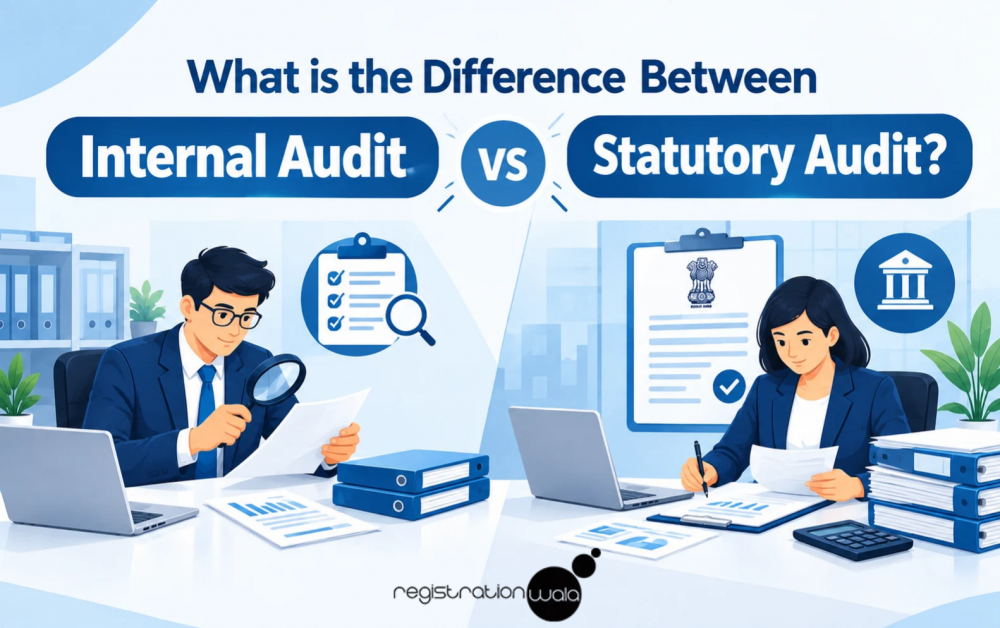
For companies across the world, the audits play an indispensable role. They help companies to maintain their financial records properly, meet regulatory/legal requirements and gain confidence of stakeholders. There are different types of audits and each one of them serves a different purpose. Among them, internal audit and statutory audit are two of most prominent types. An internal audit is conducted with purpose of improving controls as well as efficiency of business. It is conducted by internal audit staff, an outsourced professional firm or a co-sourced team having both employees and external specialists.
A statutory audit, on other hand, is conducted with purpose of verifying financial accuracy. It is conducted by independent external auditors, which means that the company’s employees do not conduct it. Now, you know the basic difference between internal audit and statutory audit. But there are many more differences between them that you should know, especially if you are planning to register a company in India in the near future.
Internal Audit vs Statutory Audit: Key Differences (Table)
In the table below, we have given the main differences between internal audit and statutory audit. Once you go through all the differences, you will understand how exactly these two types of audit differ from each other:
| Base |
Internal Audit |
Statutory Audit |
| Definition |
Internal audit is an audit conducted by a company to identify problems and fix them, improve daily business operations and strengthen internal controls. |
Statutory audit is an audit conducted by an independent external auditor to examine the financial records of a company and confirm whether the financial statements give a true and fair view of financial position of company. |
| Who Conducts It? |
Internal audit team, external professional firm or a co-sourced team comprising company employees and external specialists. |
Independent external auditor who is a practicising CA or a firm of CAs eligible to conduct statutory audits. |
| Auditor’s Qualification |
Individuals conducting the internal audits may or may not be chartered accountant (CA).
Non-chartered accountants, like cost accountants or other professionals, may also conduct these audits if approved by the board of directors of the company. |
Only practising CAs and CA firms can conduct statutory audits. |
| Requirement under Law |
An internal audit is usually optional for most companies. However, for certain companies, it is mandatory.
This includes every listed company on stock exchanges as well as unlisted public companies having paid-up share capital of Rs. 50 crore or more, turnover of Rs. 200 crore or more, outstanding loans or borrowings from banks or public financial institutions exceeding Rs. 100 crore, or outstanding deposits of Rs. 25 crore or more.
For private companies, internal audit becomes a mandatory compliance requirement if they have turnover of Rs. 200 crore or more or outstanding loans or borrowings from banks or public financial institutions exceeding Rs. 100 crore. |
For each and every company incorporated under the Companies Act, conducting a statutory audit is a mandatory compliance requirement.
This holds true regardless of whether the company is private or public, listed or unlisted, small or large, profit-making or loss-making or has zero revenue. |
| Frequency of Audit |
Ongoing, monthly, quarterly or half-yearly. |
Once in every financial year. |
What is Internal Audit?
Internal audit is an audit conducted by a company for its management and board of directors. This audit allows the company to identify problems and fix them, improve daily operations, make business more efficient and strengthen internal controls. The aim of the internal audit is to find out problems that may affect company’s business and come up with ways to improve them. An internal audit may be conducted by the company’s own internal audit team without the engagement of an external party. It may also be conducted by an outside professional firm or by a team of company employees and external professionals working together.
Internal audit helps management and the board of directors run the organization in a much better way. It also checks whether employees are sticking to the company policies, industry rules and prevailing laws. It also checks systems and controls so as to protect company assets, keep data and records accurate and reduce the risk of errors and fraud. In this way, internal audit helps a company identify all its weaknesses, improve its processes, reduce risks and make business operations much more efficient as well as effective.
What is Statutory Audit?
Statutory audit is an audit conducted by an independent external auditor appointed by the shareholders or members of a company. Each and every company registered under the Companies Act, 2013, is required to undergo this type of audit once in a financial year. This is regardless of whether the company is a private limited or public company, small or big, making profit, loss or having zero revenue. Simply put, every company covered under the Act is required to undergo a statutory audit.
The statutory audit is conducted to check financial records of a company and confirm whether the financial statements give real picture of financial position of company. One more thing is that the independent external auditor has to be an independent Chartered Accountant (CA) in practice or a firm of CAs eligible to conduct the audit under the Act. The resulting audit report based on the statutory audit must be presented to the shareholders at Annual General Meeting.
Also Read: Certificate of Incorporation vs Commencement
To Sum Up
After going through this blog post, we hope you are now able to clearly understand the difference between statutory audit and internal audit. While statutory audits are mandatory for every company incorporated under provisions of Companies Act, 2013, internal audits are mandatory only for certain prescribed companies. Both these audits serve different purposes but both are extremely important for maintaining proper financial management, internal controls and corporate governance. If you need help with company registration or post incorporation compliance requirements, you can get in touch with our experts at Registrationwala.
Frequently Asked Questions (FAQs)
Q1. Can company employees conduct a statutory audit?
A. No. Company employees cannot conduct a statutory audit. This audit is conducted by independent external auditors who are not a part of company.
Q2. Are all companies registered under the Companies Act, 2013, required to conduct statutory audits?
A. Yes. All the companies registered under the provisions of the Companies Act, 2013, must mandatorily conduct statutory audits, regardless of their annual turnover, profit, size, etc. Even loss-making companies and companies with zero-revenue need to conduct such audits.
Q3. How often do companies need to conduct statutory audits?
A. Companies need to conduct statutory audits once every financial year.
Q4. Can a statutory audit be conducted after holding the annual general meeting?
A. No. A statutory audit needs to be conducted prior to holding the annual general meeting.
Q5. What is the difference between statutory audits and internal audits?
A. Statutory audits are conducted to examine the financial records of a company and confirm the financial statements give a true picture of the company’s financial standing. Internal audits are totally different from them. They are conducted to identify problems/challenges in a company and fix/solve them, improve business performance, internal controls and come up with ways to grow business.
Q6. Are statutory audits mandatory for one person companies?
A. Yes. Statutory audits are mandatory for all the companies in India, including the one person companies.
Q7. Can non-chartered accountants conduct internal audits for companies?
A. Yes. The non-chartered accountants can conduct internal audits for the companies. The internal auditors may be cost accountants or any other professionals deemed qualified by board of directors.
Q8. Can non-chartered accountants conduct statutory audits for companies?
A. No. Only practising CAs and CA firms can conduct statutory audits for companies.
Disclaimer:- This article is meant for general informational purposes only and should not be construed as legal, accounting or professional advice. Applicability of audit may vary depending on facts and circumstances of company and relevant laws.
-
Published: September 28, 2026
61 Views