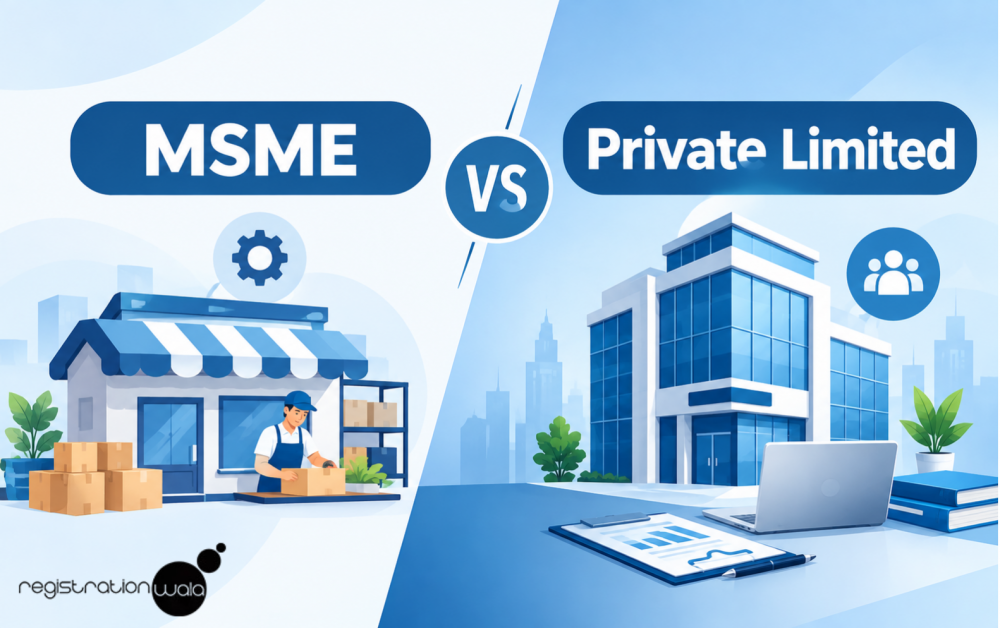
MSME stands for Micro, Small and Medium Enterprises and is governed by Micro, Small and Medium Enterprises Development Act, 2006. It is a classification given to a business based on its size and certain government criteria. A Private Limited Company, on the other hand, is a legal business structure registered under Companies Act, 2013. So, the easiest way to understand the difference is that MSME tells us what size category a business falls into while a Private Limited Company tells us how the business is legally structured. A business can even be a Private Limited Company and also be registered as an MSME if it meets MSME criteria.
This is the basic difference between the two. However, there are several other differences pertaining to their registration, taxation and more. To understand the difference between MSME and a Private Limited Company in detail, we recommend that you check out this blog post.
Difference between MSME and Private Limited Company
The key differences between the MSMEs and Private Limited Companies are highlighted in table below:-
| Parameter |
MSME |
Private Limited Company |
| Definition |
MSME full form is Micro, Small and Medium Enterprises. It is a size-based classification for businesses and is determined by their investment and annual turnover. |
A Private Limited Company is a business structure that is privately owned by its shareholders and provides limited liability protection, meaning the liability of the shareholders is generally limited to amount unpaid on shares they hold. |
| Legislation |
The primary act governing MSMEs is the Micro, Small and Medium Enterprises Development Act, 2006. |
The primary act governing the Private Ltd Companies is the Companies Act, 2013. |
| Eligibility Requirements |
For MSME registration, the business entity must meet investment (Plant/Machinery/Equipment) and annual turnover criteria. In present scenario, a Micro enterprise has investment up to Rs. 2.5 crore and turnover up to Rs. 10 crore while a Small enterprise has investment up to Rs. 25 crore and turnover up to Rs. 100 crore.
A Medium enterprise has investment up to Rs. 125 crore and turnover up to Rs. 500 crore.
The requirement of directors and shareholders in an MSME is as per structure of entity. |
For pvt ltd company formation, there is a minimum requirement of two shareholders and two directors.
The name chosen for the company must be unique.
Additionally, the company must also have a registered office address. |
| Registration |
The MSME registration process is done online via Udyam Registration Portal using an Aadhaar card. There is no govt. fee that needs to be paid during this process.
After successful registration, the entity receives Udyam registration certificate. |
The private ltd company registration process is done via MCA portal. In this process, SPICe+ form is to be filed along with necessary documents and prescribed govt. Fee.
After successful registration, the entity receives a Certificate of Incorporation. |
| Taxation |
The taxation of an MSME totally depends on its structure, i.e., whether it is a Pvt Ltd Company, sole proprietorship, partnership, LLP, etc. |
A pvt ltd is taxed as a domestic company as per corporate tax rates under Income Tax Act. |
| Public Listing of Shares |
Shares of an MSME registered as a Public Limited Company can be publicly listed via Small and Medium Enterprise platforms on major stock exchanges. |
Shares of a Private Ltd Company are not freely available for trading by the general public unlike those of a Public Ltd Company. |
| Protection Against Delayed Payments |
Under MSMED Act, 2006, eligible micro and small enterprises are protected against delayed payments from buyers. |
Pvt companies do not get this specific delayed-payment protection merely because they are incorporated under Companies Act, 2013. However, a pvt company that qualifies as a micro or small enterprise can avail applicable protection under MSMED Act. |
What is an MSME?
MSME, which is an abbreviation for Micro, Small and Medium Enterprises, refers to a classification given to businesses based on their investment and annual turnover. The classification of MSME is based on criteria laid down by Government of India. For a Micro Enterprise, the investment must be up to Rs. 2.5 crore and the annual turnover must be up to Rs. 10 crore. In case of a Small Enterprise, the investment must be up to Rs. 25 crore and the annual turnover must be up to Rs. 100 crore.
Finally, for a Medium Enterprise, the investment must be up to Rs. 125 crore and annual turnover must be up to Rs. 500 crore. MSME registration involves an online application through Udyam Registration portal, after which the Udyam Registration Certificate gets issued to entity. This certificate serves as official proof of MSME registration and can be used to avail government benefits and schemes exclusively available to MSMEs in the country.
Salient Features of an MSME
Let’s understand main features of an MSME:-
-
MSME is a classification for micro, small and medium enterprises under the MSMED Act.
-
MSME registration is an online process that needs to be completed via Udyam portal.
-
Udyam registration certificate, which serves as official proof of MSME registration, allows a business to apply for various govt. benefits and schemes exclusively meant for MSMEs.
-
MSMEs usually require less initial capital and setup costs than large factories.
-
The MSMEs form the backbone of the Indian economy. They create employment and help to raise the GDP of the country.
-
An MSME does not have a separate limit on shareholders or directors because MSME is just a classification based on the enterprise's investment and turnover and not a business structure.
What is a Pvt Ltd Company?
A Private Limited Company in India means a privately held company incorporated under Companies Act, 2013 with a minimum of two shareholders and two directors. It provides limited liability to its shareholders, which is generally limited to amount unpaid on shares held by them.
It is one of the most popular business structures not only in India but also in many countries around the world. In India, there is no minimum capital requirement to incorporate a Private Limited Company.
Salient Features of a Private Limited Company
The main features of a pvt ltd company are given below:-
-
A pvt ltd co is a type of company incorporated under Companies Act, 2013.
-
It is regarded as a legal entity that is separate from its shareholders. Therefore, it can own assets, sue or be sued in its own name.
-
To incorporate such a company, a minimum of two shareholders and two directors are required. The same person can be the shareholder and director.
-
The shares of a private ltd co cannot be publicly traded.
-
A pvt ltd can have a maximum of 200 shareholders. Also, it has a standard limit of 15 directors.
-
A private limited company can also register as an MSME. Therefore, an entity can have both the status of a private ltd company and an MSME registration.
Conclusion
After going through this blog post, we’re sure that it is now clear that MSME and Pvt Ltd Company are entirely different concepts. While MSME is a classification for micro, small and medium enterprises, a private limited company is a type of business structure, just like other structures such as a One Person Company or a Public Limited Company. An entity can be an MSME-registered entity and a Private Limited Company at the same time.
Whether you need MSME registration, Private Limited Company registration, or even both, Registrationwala consultants can provide you with 360-degree support throughout the process.
Frequently Asked Questions (FAQs)
Q1. Can a company be both an MSME and a private limited company?
A. Yes. A company can be both an MSME and a private ltd company.
Q2. What is the name of the certificate issued after registering an enterprise as an MSME?
A. The official name of the certificate is Udyam Registration Certificate. It is issued to an enterprise after completing MSME registration process via Udyam Registration portal.
Q3. Can a private limited company’s shares be publicly traded on a stock exchange?
A. No. A private ltd company’s shares cannot be publicly traded on a stock exchange. Only shares of a public limited company that is listed on a stock exchange can be publicly traded. So, if you want to publicly trade shares of a pvt ltd company, the company must first be converted into a public ltd company. After that, the company can apply to list its shares on a stock exchange by following prescribed process.
Q4. What certificate does a business receive after it is registered as a Private Limited Company?
A. Once a business is successfully registered as a Private Ltd Company with Registrar of Companies, it receives a certificate known as Certificate of Incorporation.
-
Published: September 24, 2026
73 Views