Preface: This post was originally published in 2022 and has been updated on July 15, 2025, to provide you with the most current and accurate information.
A Private Limited Company is a privately-held business entity owned by its shareholders. The ownership percentage and corresponding rights of these shareholders are determined by the number of shares held by them. In this blog post, we will shed a light on the various types of shares that exist in a pvt ltd company.
So, if you are planning to start a private limited company in the near future, going through this post will help you understand the different types of shares your company can provide to all the members.
Types of Shares in Pvt Ltd Company
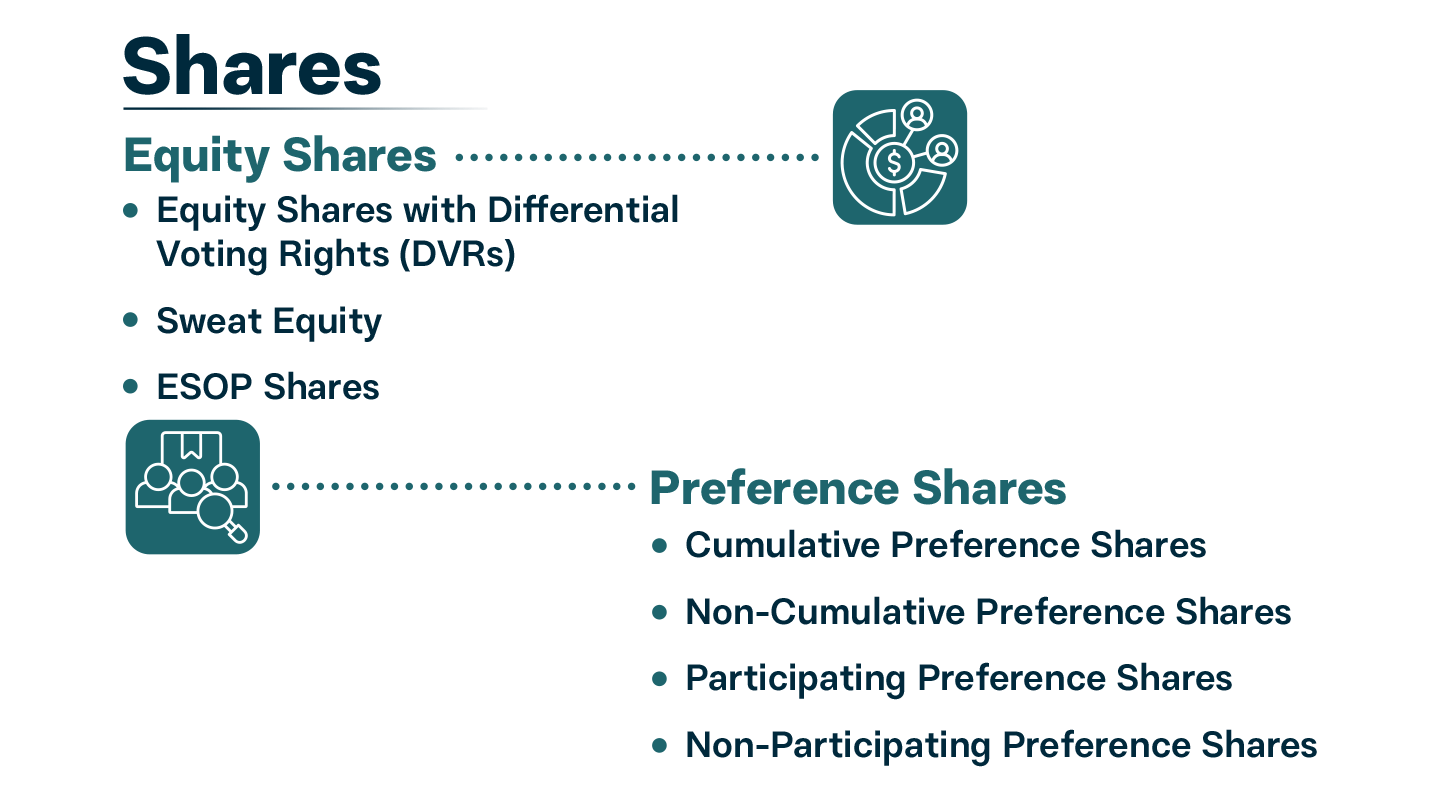
There are two major types of shares in a private ltd company: (i) Equity Shares, and (ii) Preference Stocks. They are further categorized into different types of shares.
1. Equity Shares
In a pvt ltd co, the equity shares are regarded as the most common shares. According to the Indian company law, all shares except the preference stocks are regarded as equity stocks.
Each shareholder holding equity stocks is treated equally. This means each shareholder with such shares is entitled to the same rights and benefits on a per-share basis. However, equity shareholders do not enjoy any special advantages for dividend distribution or capital repayment.
The equity stocks are inherently riskier compared to preference stocks because equity shareholders are last in line for dividend payouts and asset distribution at the time of liquidation.
Equity shares are further classified into various types of shares, including:
(a) Equity Shares with Differential Voting Rights (DVRs)
Equity shares with DVRs are among the special private limited company share types. Individuals having equity shares with DVR are either given superior (more voting rights) or inferior (fewer voting rights) voting power compared to regular shares.
Equity shareholders with DVRs are often their company’s Founders and/or CEOs. Such shareholders have a high degree of control of the daily affairs of the company. Now, you must ask: Why are they special? It’s because only a few companies are known to issue such shares. For example, Google and FaceBook have such shares.
In India, the companies can issue equity shares with DVRs under Section 43 (2) of the Companies Act 2013 read with the Companies (Share Capital and Debentures) Rules 2014.
(b) Sweat Equity
Sweat equity is issued to deserving employees who have been with the company for more than one year. It is issued to the hardworking employees at absolutely no cost.
This means the employees do not have to pay anything in return for receiving such shares. Issuing sweat equity shares is a way for a company to reward its employees for the commitment, knowledge and skills they have contributed.
(c) ESOP Shares
ESOP stands for Employee Stock Options Plan. It is a plan that allows employees to buy shares of the company who employed them. This plan is used by both small and large businesses. It leverages the employees to work in a mutually beneficial manner.
When the employees have an actual stake in the company, they are more motivated to not only fulfill their duties towards the company, but also to contribute towards the company's growth and development. Similar to sweat equity, employees are not required to pay money to own company’s stocks under the ESOP scheme.
2. Preference Shares
These shares are given to the preferred shareholders of the company. They are the ones who get paid first. To get the proper meaning into perspective: If the company goes through liquidation, the holders of preference-shares are paid earlier than the equity holders.
Furthermore, the preference shares’ shareholders are entitled to a fixed dividend. That said, such members don’t have voting rights within a company. This means the shareholders holding preference stocks do not participate in the decision-making processes of the company like electing the board of directors or approving key corporate actions.
The preference stocks are further classified into several types of shares, including:
(a) Cumulative Preference Shares
Cumulative preference shares are a sub-category of preference stocks. In these shares, dividend arrears are cumulative in nature and are paid before any dividend payout to equity shareholders.
These shares guarantee that any unpaid dividends from past years will accumulate and be paid out to preference shareholders before any dividends are distributed to common shareholders in future years.
(b) Non-Cumulative Preference Shares
These are the kinds of shares where the dividend is paid solely from the net profits of the past year. If due to lack of profits, the dividends are not paid in a particular year, they are generally not carried forward and cannot be claimed in subsequent years.
The dividend on preference stocks will expire if the company does not pay it during the fiscal year. Preference stocks are presumed to be cumulative until specifically stated to be non-cumulative.
(c) Participating Preference Shares
Holders of participating preference stocks are allowed to participate in the balance of profits with equity shareholders. Such holders are entitled to receive a fixed rate of dividend on shareholding.
In addition to this, they are also eligible to receive a portion of the company's assets following the liquidation.
(d) Non-Participating Preference Shares
These shares are solely subject to a predetermined or fixed rate of dividend. This means, shareholders with non-participating preference shares cannot participate in surplus earnings.
The preference stocks are usually considered to be non-participating by default unless the company’s MoA and AoA’s provisions state otherwise.
Conclusion
A private limited company can offer two types of shares to its shareholders, i.e., equity shares and preference shares. While equity shares offer voting rights, preference shares offer preferential rights to shareholders. Both these types of shares are further categorized into sub-categories. In case of equity shares, sub-categories include sweat equity, ESOP and equity shares with differential voting rights. Preference shares’ sub-categories include cumulative preference shares, non-cumulative preference shares, participating preference shares and non-participating preference shares.
Want to start a private limited company in India or need assistance in fulfilling post-compliance requirements? Feel free to get in touch with our consultants at Registrationwala. We would be happy to assist you through our comprehensive support and guidance.
Frequently Asked Questions (FAQs)
Q1. Can a private limited company issue equity stocks?
A. Yes, a private limited company can issue equity stocks to its shareholders.
Q2. Can a pvt ltd co offer shares to the general public via IPO launch?
A. No, a pvt ltd co cannot offer shares to the general public via IPO launch. Only public ltd companies are allowed to launch IPO and offer shares to the general public.
Q3. What is the difference between preference share and equity share?
A. On one hand, preference share provides preferential rights to the shareholders. On the other hand, equity share provides voting rights to the shareholders. This is the basic difference between them.
Q4. Which shareholders are given priority at the time of dividend distribution?
A. Preference shareholders are given preference/priority at the time of dividend distribution. They receive dividends before the equity shareholders do.
Q5. What advantage do equity shareholders have over preference shareholders?
A. Equity shareholders have voting rights and can participate in business management and decision-making processes for the company. However, preference shareholders do not have any voting rights.