Intellectual property rights (IPR) are the rights conferred on creators for the creations of their minds. These rights can be granted for innovations, inventions, literary and artistic works, musical recordings, names, images, symbols, logos, to name a few. IPRs provide an exclusive right to authors or inventors over the use of their works for a certain time period. The most popular types of intellectual property rights are trademark, copyright and patent. All of them serve distinct purposes.
The trademark is meant for protecting brand names, logos, symbols and marks used in business/trade. Trademark registration isn’t mandatory by law but necessary to protect against infringement. Copyright is meant for protecting literary, artistic and musical works. It is granted upon creation of the work and therefore, copyright registration is not mandatory. However, the registration is still advisable as it acts as prima facie evidence of ownership.
Patent is meant for protecting inventions and new technological innovations. Like trademark and copyright, registering a patent is not mandatory by law to own an invention but recommended to secure legal rights that protect others from replicating your invention. In this blog post, we will look at the main differences between trademark vs patent vs copyright in a detailed manner.
What is Trademark?
A trademark can be defined as any unique name, word, slogan, symbol or design that can be used to distinguish the source of one good from others in the market. The owner can enjoy the exclusive benefits of usage and distribution over their mark by getting the trademark registration in India. In order to secure trademark registration, the mark chosen must be distinctive and not generic.
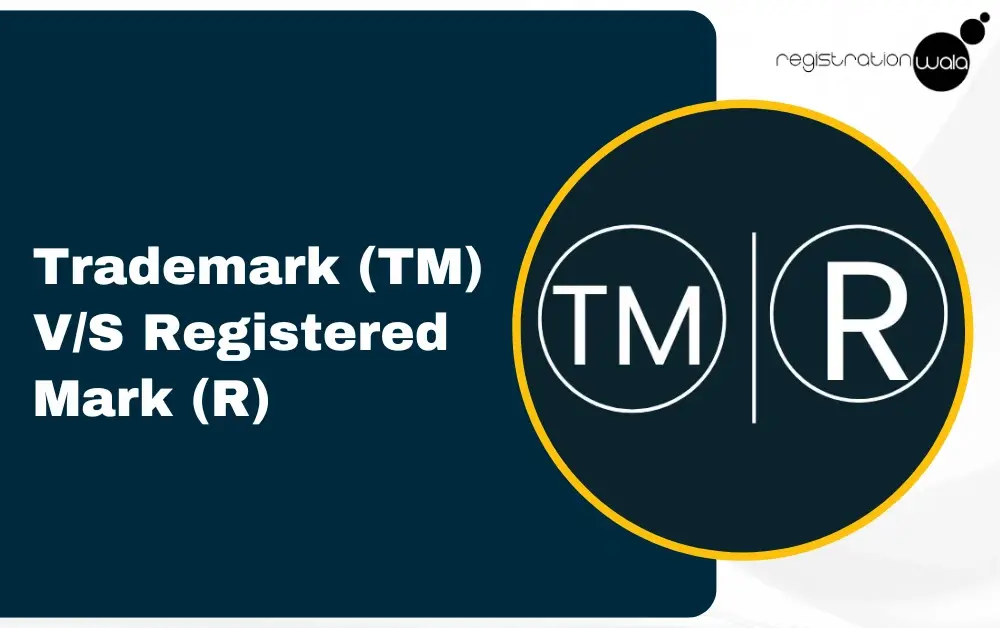
The trademark registration, once obtained, is valid as long as the mark is renewed in a timely manner. However, the period of 10 years renewal must be obtained. There are multiple benefits that come with trademark registration in India. One main benefit of trademark registration is that the owner gets the exclusive rights over their mark after that. Moreover, after trademark registration, they can put the ® symbol with your marks that improve the credibility of your business.
What is Copyright?
Copyright is the kind of IPR that protects the original works of authorship, such as books, articles, songs, photographs, sculptures, choreography, sound recordings, motion pictures and creative works. In order to get the copyright, the work used must be original and creative. Moreover, the work should be capable of being fixed in a tangible medium. The validity of the copyright is the author's lifetime plus 60 years after their death.
With copyright registration in India, the owner gets the exclusive rights to reproduce, make derivative works, distribute and make public performances and display the copyrighted works. Further, the owner can place the © symbol on their work, which serves as legal evidence and public notice of ownership. Moreover, they can sue any person who tries to use their work without the authorization.
What is Patent?
Patent is the unique IPR right that is granted to the valuable inventions, such as novel processes, machines, manufactures, compositions, etc. In order to be registered under the patent the invention must be new, useful and most importantly the non-obvious.
After getting the patent registration in India, the inventor gets the exclusive right to prevent others from making, using, selling or importing the protected invention. The patent registration is valid for the total period of 20 years. After this period, it cannot be renewed. Instead, it enters the public domain for free use.
Trademark vs Copyright vs Patent: Key Differences
In the table below, we have explained the difference between trademark, copyright and patent with examples. :-
|
Parameter
|
Trademark
|
Copyright
|
Patent
|
|
Definition
|
A trademark is a legal right that identifies a unique name, word, slogan, symbol or design used to distinguish the source of one good from others in the market.
|
A copyright is a legal right that protects the original works, such as books, articles, songs, photographs, sculptures, choreography, sound recordings, motion pictures and creative works.
|
A patent is a legal right that is granted to the valuable inventions, such as novel processes, machines, manufactures, compositions, etc.
|
|
Validity
|
A trademark initially remains valid for a period of 10 years. The registration can be maintained indefinitely through periodic renewals.
|
Copyright remains valid for the author's lifetime + 60 years after their demise. It cannot be renewed.
|
A patent remains valid for a period of 20 years. After this period, it is not possible to renew the patent registration. The patent then falls into public domain and can be freely used by others.
|
|
Examples
|
Some of the famous examples of trademark registration are the registered brand names like Apple, Maggi, Puma and the musical notation of the ICICI bank, etc.
|
Famous writers like Chetan Bhagat and singers and composers like A. R. Rahman hold copyright over their works and require a licensing agreement or charge fee for granting usage rights.
|
Examples of patents include Alexander Graham Bell’s patent for the telephone and Thomas Edison’s patent for the electric light bulb.
|
|
Registration Fee
|
Trademark registration fee for online filing is Rs. 9,000 for large corporations. For registered MSMEs, the online filing fee is Rs. 4,500.
|
Copyright registration fee ranges from Rs. 500 to Rs. 5000, depending on the type of work.
|
Patent registration fee ranges from Rs. 1600 to Rs. 8,000, depending on the type of entity.
|
|
Renewal Fee
|
When the renewal is filed online within six months before expiry, the renewal fee is Rs. 9,000 per class. Extra charges apply for filing after the expiry date.
|
Cannot be renewed. So, no renewal fee is applicable. There is no annual maintenance fee either.
|
Cannot be renewed after 20 years. So, there is no renewal fee. However, there is an annual maintenance fee during the 20-year period to keep the patent alive. The fee needs to be paid from 3rd year onwards.
|
Conclusion
There is a clear distinction between the three types of IPR on the basis of the kind of work they protect. For instance, a trademark can be obtained for the logo of the business while the copyright is used to protect its creative and artistic aspects of original works of authorship. Meanwhile, patents are designed to protect inventions and innovations to ensure exclusivity for the inventor. Understanding the differences between various IPRs is necessary as it allows creators and businesses to decide the appropriate form of protection for their intellectual property.
-
Published: August 23, 2018
8006 Views