Preface: This post was originally published in 2022 and has been updated on February 19, 2026, to provide you with the most current and accurate information.
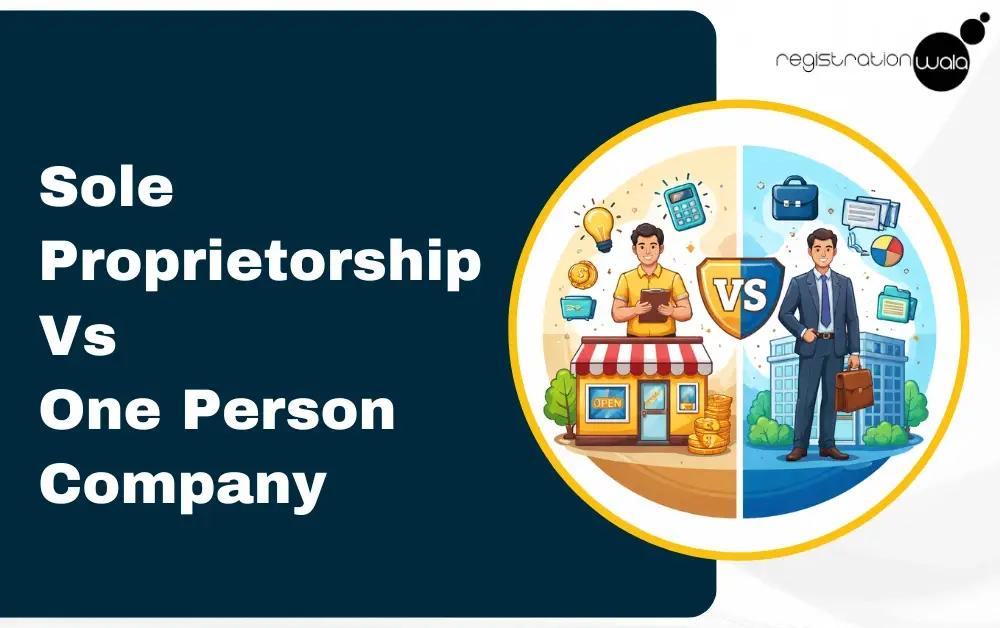
Many people tend to mix up a Sole Proprietorship and a One Person Company (OPC). Both types of businesses are owned by a single individual. However, while a sole proprietorship is an unregistered form of business, an OPC is a registered business structure. A proprietorship is the oldest form of business in India, whereas an OPC is a relatively new concept introduced by the Companies Act, 2013.
If you’re confused about the difference between Sole Proprietorship and One Person Company, going through this blog post will be helpful. Here, we will explain the key distinctions between these two business structures.
What is Sole Proprietorship?
A sole proprietorship, also known as a proprietorship firm, is a traditional form of business. It is the oldest, simplest and most common type of business structure not only in India but also globally. To set up this business, the legal formalities are minimal.
No formal business registration process is required to set up a proprietorship. Under this type of business, only a single owner known as the proprietor runs the whole show independently. The owner and the entity are not treated as separate legal entities. This results in personal unlimited liability for the debts of the business.
To pay off the debts of the business, the personal assets of the proprietor can be seized, including their car and house. With that being said, the proprietor gets to keep all the profits generated by the proprietorship firm.
The proprietorship is taxed as the proprietor's personal income. As compared to the registered business models, it is generally challenging for a proprietorship to receive funds.
What is One Person Company?
A One Person Company, abbreviated as OPC, is a relatively new form of business in India compared to a proprietorship, private limited company, limited liability partnership and other traditional business structures. It was introduced under the Companies Act, 2013. Prior to this, under the Companies Act, 1956, there was no provision for the incorporation of a One Person Company in India.
The concept of an OPC was introduced to enable individual entrepreneurs and professionals such as doctors, aviation consultants, IT professionals, etc., to operate under a corporate structure with single ownership. The primary advantage of registering as an OPC is that it provides a separate legal identity to the business, which a proprietorship does not offer. Before the introduction of the OPC concept, individuals commonly opted for a proprietorship as their business structure.
However, a proprietorship has several limitations like unlimited liability of the owner, lack of a separate legal entity and limited access to external funding. An OPC addresses many of these concerns by offering limited liability protection and a distinct legal status.
There is a misconception about the OPC registration is that there can be only one director in the company but the fact is OPC can have a maximum of 15 directors. Also, the OPC’s sole shareholder (owner) can also be its sole director. This can help to save up business expenses.
Sole Proprietorship vs One Person Company: Table of Difference
The difference between sole proprietorship vs OPC can be understood with the help of the table provided below:
|
Difference
|
Sole Proprietorship
|
One Person Company
|
|
Definition
|
It is an unregistered form of business owned by a single individual known as the proprietor.
|
It is a registered form of business owned by a single individual known as the shareholder.
|
|
Liability
|
In a proprietorship, there is unlimited liability to the owner for business debts.
|
The owner’s liability is limited to the unpaid amount on the shares held by them.
|
|
Registration
|
No formal business registration is required.
|
Registration under the Companies Act, 2013, with the Ministry of Corporate Affairs (MCA) is mandatory.
|
|
Legal Entity
|
It is not a separate legal entity from its owner. Therefore, the proprietorship and proprietor are treated as the same in the eyes of law and also for tax purposes.
|
An OPC is a separate legal entity from its owner. This means, an OPC is treated as separate as its owner in the eyes of law. It is also taxed separately.
|
|
No. of Directors Required
|
No director needs to be appointed for a proprietorship.
|
At least one director is required to be appointed for an OPC. The maximum no. of directors appointed for an OPC is 15 directors.
|
|
Continuity
|
It ends with the owner.
|
It continues with the nominee.
|
|
Taxation
|
The proprietorship’s profits are taxed as the proprietor's personal income as per individual income tax slabs.
|
The OPC is taxed as a distinct legal entity separate from its owner.
|

Conclusion
A sole proprietorship is the oldest form of business and is owned by a single individual. On the other hand, an OPC is a relatively new form of business that is also owned by a single individual. While a proprietorship does not require formal business registration, registration is mandatory for a One Person Company. If you need assistance in setting up an OPC, you can connect with our OPC registration consultants at Registrationwala.
Frequently Asked Questions (FAQs)
Q1. Which is the oldest form of business?
A. The oldest form of business is sole proprietorship.
Q2. Is it cheaper to set up a proprietorship firm compared to an OPC?
A. Yes, it is usually cheaper to set up a proprietorship compared to an OPC. A proprietorship does not require any formal business registration and has to fulfill minimal legal formalities.
Q3. When was the concept of OPC introduced in India?
A. The concept of OPC was introduced in India for the first time when the Companies Act, 2013, came into force on 1 April 2014.
Q4. How is a proprietorship’s business income taxed?
A. It is taxed as the personal income of the proprietor as per the individual income tax slabs.
Q5. Can a proprietorship be converted into an OPC?
A. Yes, a proprietorship can be converted into an OPC. For this, registering with the Ministry of Corporate Affairs (MCA) as per the provisions of the Companies Act, 2013, is necessary.
-
Published: February 19, 2026
6383 Views