Last Updated on March 25, 2026
According to Mordor Intelligence, India’s Battery Market size is estimated at USD 7.20 billion in 2024. By the year 2029, it is anticipated to reach USD 15.65 billion, growing at a 16.80% CAGR during the 2024-2029 forecast period.
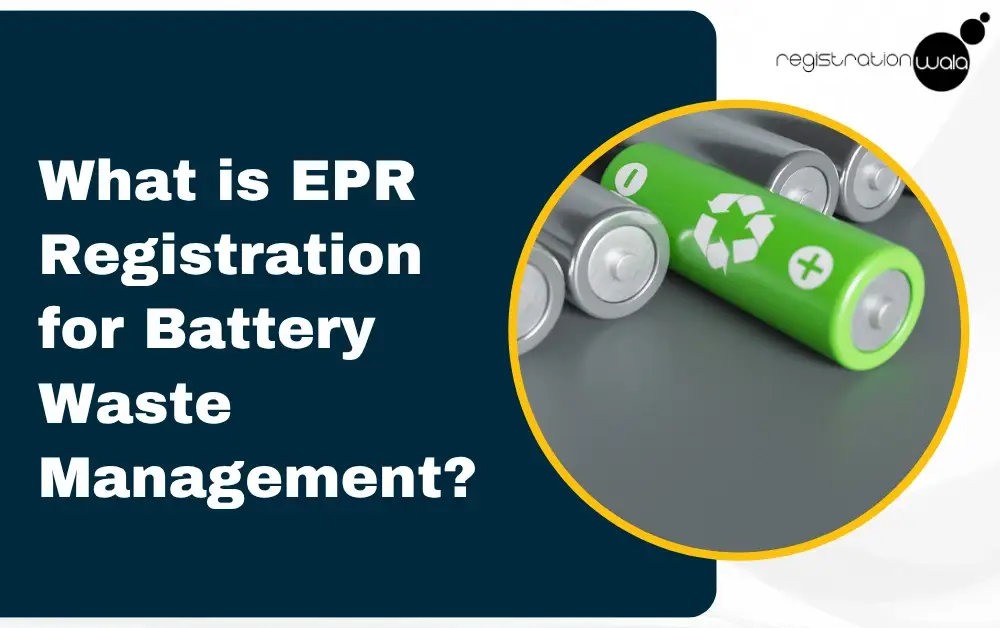
As the demand for the batteries has been rising, it has become necessary to manage the battery wastes so that the environment is not harmed. This is why, just 2 years back, the Government of India had decided to come up with rules and regulations for the management of battery waste.
On 22nd August 2022, the Ministry of Environment Forest and Climate Change notified the Battery Waste Management (BWM) Rules. According to these rules, every producer (person or an entity) involved in manufacturing of batteries has to get registered with the Central Pollution Control Board (CPCB).
What are the Battery Waste Management (BWM) Rules?
The Battery Waste Management Rules, 2022, are applicable to all kinds of batteries regardless of their shape, volume, weight, use, chemical and material composition. These rules put the obligation of Extended Producer Responsibility on the Producers (manufacturers and importers) of batteries they introduce in the market. Accordingly, the Producer has to meet the collection and recycling targets to ensure the attainment of EPR obligations.
According to the Rules, producers and manufacturers of batteries are required to register themselves with CPCB using the online centralized portal of CPCB. The registration has to be done as Producer in Form 1(A). The certificate of registration will be issued in Form 1(B).
If there are any changes to the information contained in the EPR Registration, the producer has to inform the CPCB about it. For the renewal of EPR Registration, an application must be filed using Form 1(A) before 60 days of its expiry. The Producers/Manufacturers must file Annual Returns by June 30 of the following year for the intervening registration period. If all due annual reports are not filed, the application for renewal will not be processed.
The producers of batteries are required to obtain EPR certificates from recyclers according to the quantity of waste batteries recycled by the recyclers and use such certificates to meet their targets related to EPR. The battery waste shall be sent for recycling or refurbishing and shall not be sent for landfilling or incineration, according to BWM Rules.
What are the Different Types of Batteries that require EPR Registration?
The EPR registration is applicable to all kinds of batteries. We have mentioned below some of the different types of batteries:
- Lithium battery
- Lead acid battery
- Alkaline batteries
- Nickel metal hydride
- Nickel-cadmium
- Zinc carbon
- 9V Batteries
- Flow battery
- Solid State
- Backup Battery
- Battery capacity
- LiPo Battery
- Electric battery
- AA Batteries
- Amaron battery
- Button
- Coin batteries
- Zinc
- Graphene battery
- LFP battery
- Lithium cobalt oxide
- Lithium nickel cobalt Aluminum oxide
- Lithium titanate
- Micromax Battery
What are the Specific Conditions for EPR Registration?
The EPR-registered producers/manufacturers are required to comply with certain conditions such as:
- The producers or manufacturers of batteries cannot carry any business without obtaining EPR registration through CPCB’s online centralized portal.
- The producers or manufacturers shall not deal with any entity that is not registered through CPCB’s online portal to meet EPR targets.
- If it is found or determined that any producer or manufacturer registered with CPCB has provided false information or has intentionally concealed information or there is any irregularity or deviation from the conditions stipulated while obtaining the EPR registration under the Battery Waste Management Rules, 2022, then such an entity’s registration will be revoked for 1 year after giving an opportunity to be heard.
- The producers or manufacturers of batteries are required to fulfill year-wise/ category-wise EPR Target as specified in the BWM, Rules, 2022 under Schedule II.
- The provisions of the Battery Waste Management Rules, 2022 are required to be complied with by the producers and manufacturers. If they fail to comply with these rules, necessary action as deemed fit shall be taken against them.
What are the Grounds for the Cancellation of EPR Registration?
The producers and manufacturers who have obtained EPR registration can get their registration canceled if they do not comply with the BWM Rules, 2022. The following reasons can lead to the cancellation of EPR Registration:
- If the documents provided by the producers or manufacturers are found to be false, the EPR registration is liable to be canceled or suspended at any stage.
- If the producers or manufacturers fail to comply with the EPR obligations as per Schedule II, the Central Pollution Control Board can suspend or cancel EPR registration.
- In case of violation of the Battery Waste Management Rules, 2022 by the registered entity, the Central Pollution Control Board can suspend or cancel the EPR registration of the producer and may also impose environmental compensation.
- The producers or manufacturers will be provided with an opportunity to be heard within 15 days from the date of issuance of notice, prior to considering the case for cancellation/suspension of Registration by CPCB.
- The Appellate Authority for this case will be the Joint Secretary of the officer equivalent in the Ministry of Environment, Forest and Climate Change.
Schedule I of the Battery Waste Management Rules
Schedule I of the Battery Waste Management Rules, 2022, states the prohibitions and labeling requirements for the batteries.
1. Prohibitions on the battery’s heavy metal content
- Batteries containing mercury up to 0.0005% (5 ppm) by weight may only be allowed till 2025.
- Batteries containing cadmium up to 0.002% (2000 ppm) by weight may be permitted.
- Exception for button zinc silver oxide batteries having a mercury content < 2% and button zinc air battery with a mercury content <2% by weight.
- The portable batteries used in emergency and alarm systems, and medical equipment are exempt from the prohibitions.
2. Labeling requirements
- Producers must ensure that all batteries or battery packs are properly labeled as per the standards prescribed by the Bureau of India Standards (BIS).
- All the requisite labels and symbols shall be printed visibly, indelibly and legibly on the batteries or battery packs.
- No individual shall place the batteries or battery pack on the market without marking them with the “crossed out wheeled bin symbol”. This symbol must cover at least 3% of the area of the battery or battery pack’s largest side, up to a maximum size 5 cm x 5 cm.
 (1) (1).png)
- In case of cylindrical cells, the crossed out wheeled bin symbol is required to cover at least 1.5% of the battery or battery pack’s surface area, with a maximum size of 5 cm x 5 cm.
- If the battery or battery pack’s size is such that the symbol would be smaller than 0.5 cm x 0.5 cm, the battery or battery pack doesn’t need to be marked but a crossed out wheeled bin symbol measuring at 1 cm x 1 cm has to be printed on the packaging.
- Batteries which contain mercury, cadmium or lead must be marked with their respective chemical symbols to indicate their contents and the potential environmental impacts they may have.
SCHEDULE II of the Battery Waste Management Rules
Schedule II of the Battery Waste Management Rules, 2022, states the targets for extended producer responsibility.
Targets for Extended Producer Responsibility
- If a new producer introduces a battery in the market in the subsequent years after the publication of BWM Rules, 2022, the EPR targets shall be applicable for various kinds of battery based on their average battery life.
- EPR targets include collection targets and a 100% recycling/refurbishment target of the collected batteries for each respective year.
- Recycling of waste batteries involves the recycling of battery materials like lead, nickel, cobalt, plastics, rubber, glass, lithium and so on.
- The EPR targets for the producers are specific to the battery’s kind (viz. Lead acid, Nickel, Cadmium, Zinc-based, Li-on, etc.) within each type of battery - portable, industrial, electric vehicle, automotive battery.
- Producers are required to fulfill their EPR obligations through EPR certificates issued by recyclers or refurbishers.
- In case of the unavailability of EPR certificates with recyclers or refurbishers, the producers are responsible for both collection and recycling efforts.
General Terms and Conditions for Registered Entities
The entities that are registered with the CPCB are required to comply with the provisions of the Environmental (Protection) Act, 1986 and the rules made thereunder. If there are any changes in the approved EPR form, the same shall be informed to the CPCB in a timely manner.
Conclusion
The producers of all kinds of batteries regardless of their shape, chemical composition, volume, weight and use are required to apply for the grant of EPR registration on the CPCB’s official portal. The battery producers or manufacturers in India are required to fulfill their EPR obligations by ensuring that the waste batteries are recycled through certified recyclers to meet the assigned EPR targets mentioned in the Battery Waste Management Rules, 2022.
If you want to obtain EPR Registration for Battery Waste Management in a simple and stress-free manner, get in touch with Registrationwala’s EPR consultants.
Frequently Asked Questions (FAQs)
Q1. What is EPR Registration for Battery Waste?
A. EPR (Extended Producer Responsibility) Registration is a mandatory approval for battery producers and importers in India. It ensures they collect, recycle, and safely manage battery waste.
Q2. Who needs EPR Registration?
A. Any business involved in manufacturing, importing, or selling batteries must register with the Central Pollution Control Board (CPCB).
Q3. Which batteries are covered under EPR?
A. EPR applies to all types of batteries, including lithium-ion, lead-acid, alkaline, nickel-cadmium, EV batteries, and more.
Q4. Can EPR Registration be canceled?
A. Yes, it can be canceled if false information is provided, rules are violated, or EPR targets are not met.
Q5. Is recycling mandatory under EPR?
A. Yes, battery waste must be recycled or refurbished. Landfilling and burning are not allowed.
Q6. Do I need to renew EPR Registration?
A. Yes, you must apply for renewal at least 60 days before expiry.
Q7. How can Registrationwala help?
A. Registrationwala provides expert assistance to help you get EPR Registration quickly and hassle-free.
Also Read: Extended Producer Responsibility Registration for Plastic Waste