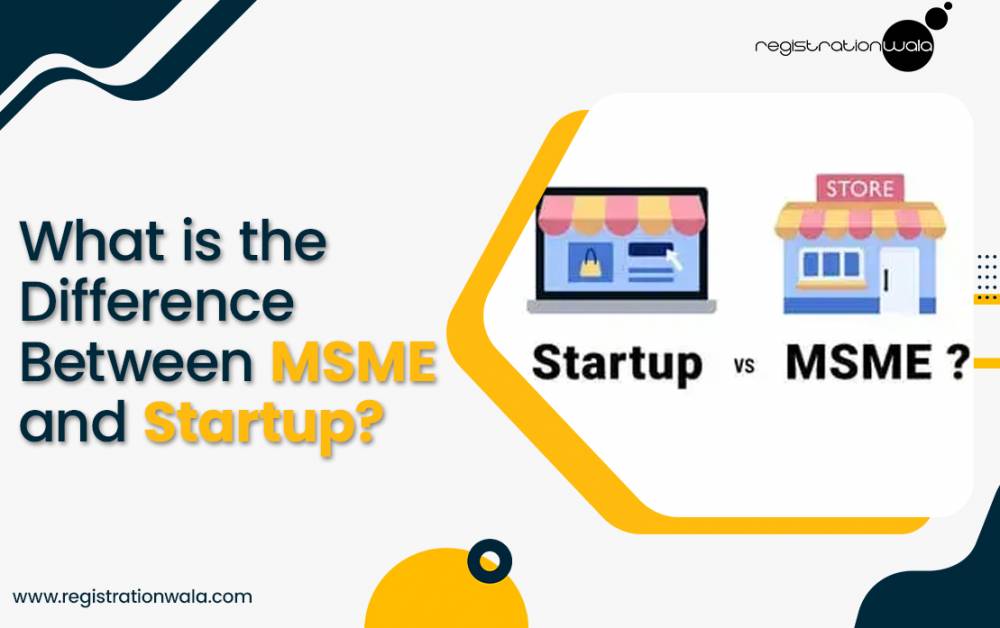
Many people use the terms MSME and Startup interchangeably. However, their definitions and advantages are worlds apart. An MSME (Micro, Small and Medium Enterprise) is a business that is classified on the basis of its investment and annual turnover. Taking a different path, a Startup is a newly established business that is usually focused on innovation, scalability or solving a market problem in a never-seen-before way. An MSME can apply for Udyam Registration while an eligible Startup can apply for DPIIT Startup Recognition a.k.a Startup Registration. Both MSMEs and Startups support business growth, create employment and encourage entrepreneurship. Because of this, they are important pillars of our nation’s economy.
Understanding the difference between MSME and Startup can help business owners choose the right registration and benefits for their business. To make this easier, Dushyant Sharma, a professional with experience in startup incorporation and business registrations, has prepared this article explaining the key differences between MSME vs Startup in simple language.
Table of Comparison: MSME vs Startup
The table below explains the difference between MSME and Startup across various parameters:
| Parameters |
MSME |
Startup |
| Meaning |
MSMEs are small businesses that are classified on the basis of their investment and annual turnover |
Startups are newly established businesses that focus on innovation, growth and solving problems in a new way |
| Nature |
MSMEs are classified based on investment and turnover |
Startups are generally ventures that are innovation-driven as well as growth-oriented |
| People Strength |
An MSME can be and often is managed by a single person or a team, depending on the nature of the business |
Startups are usually run by people from different fields such as marketing, finance, operations and product development |
| Fund Raising |
MSMEs generally rely on loans from banks and NBFCs for business expansion |
Startups often raise funds from angel investors and venture capitalists in exchange for equity |
| Business Objective |
The objective is to build a sustainable business with stable growth |
The objective is to scale quickly and bring innovative solutions to the market |
| Risk Factor |
MSMEs usually follow established business models and have a lower risk profile |
Startups generally involve higher risk because they experiment with new ideas and business models |
| Technology |
Generally speaking, MSMEs tend to use existing technologies to run their operations |
It is often the case that Startups use innovation and technology to develop new products, services or business models |
What is MSME?
The MSME stands for Micro, Small and Medium Enterprises. The classification of these three enterprises was most recently revised in April 2025 and applies to all. Below is a composite criteria for investment in plant & machinery/equipment and annual turnover.
-
Micro Enterprises: Investment not exceeding Rs. 2.5 crores and Annual Turnover not exceeding Rs. 10 crores.
-
Small Enterprises: Investment not exceeding Rs. 25 crores and Annual Turnover not exceeding Rs. 100 crores.
-
Medium Enterprises: Investment not exceeding Rs. 125 crores and Annual Turnover not exceeding Rs. 500 crores.
In the last five decades, the MSME has emerged a lot and helped in the industrialisation of rural and backward areas. The contribution of the MSME sector is over 30% of the country’s total GDP. Millions of jobs have been created across different industries and regions thanks to MSMEs.
What are the Advantages of MSME?
The advantages of MSME are as follows:
-
Subsidy on Patent Registration: To protect unique ideas and innovations, an MSME entity can file a patent application. MSMEs can avail a 50% subsidy on the application fee, which encourages them to invest more in research and development. It also helps them protect their work from competitors.
-
Free ISO Certification: To build trust and faith among customers, obtaining an ISO certification is important. However, the cost of ISO certification is generally high, but Udyam-registered MSMEs can obtain it free of cost. This helps them improve product quality and as a result, they can become more competitive in the market.
-
Timely Payment by Buyers: A lot of buyers tend to make delayed payments to businesses. This is true for MSME businesses too. The delay affects their cash flow as well as their financial stability. Payments to MSMEs must be made within 45 days as per the MSME Development Act, 2006. In case of delays in payment the MSMEs can file complaints against buyers using Samadhan portal. This initiative helps MSMEs improve their financial stability.
What is Startup?
A startup is a newly set up business. It is expected to bring a new product or service to the market to fill a gap, solve existing problems and provide a unique solution. Usually, startups aim for rapid growth because of their innovative ideas and venture capitalists or angel investors support them as they recognize the potential of a strong idea.
The government also provides various benefits to startups through different schemes, one of which is Startup India Scheme. It was launched by PM Shri Narendra Modi to support eligible startups with benefits like certain tax exemptions, easier compliance, IPR fees rebates and much more.
What are the Advantages of Startups?
The advantages of startups can be understood with help of the following points:
-
Creative and Unique Ideas: Startups are built upon innovative ideas that have the potential to transform existing market practices and business methods greatly. They often bring new and different perspectives to solving prevailing problems. They are also more open to taking risks. This gives rise to innovation and helps break prevailing business norms.
-
Agile and Flexible Nature: Startups are typically small ventures having a very limited no. of people and can adapt quickly to changing market conditions and trends. Implementing changes for such ventures is not so difficult because decision-making is concentrated among just a few people.
-
High Growth & Low Cost: Startups tend to have a unique product or service and have the potential for swift growth when they understand target market and use appropriate strategies and marketing to reach an ideal audience. This high growth potential also attracts investors who seek strong returns on their investments. In initial years, startups manage their operations strategically. They often rely on cloud based services, advanced technologies and efficient tools and resources. This helps them allocate funds in a rather cost effective manner and at the same time, it allows them to focus on their core business activities.
The Takeaway
After going through this blog, we hope you have understood the difference between Startup and MSME clearly. Startups focus on rapid growth and, for that purpose, take risks to scale their business, whereas MSMEs focus on stability and sustainability. Now you know which registration your business may require: MSME or Startup Registration. Reach out to Registrationwala consultants to assist you in obtaining the registration as per your requirements.
Frequently Asked Questions (FAQs)
Q1. What does MSME stand for?
A. MSME stands for Micro, Small and Medium Enterprises.
Q2. Can an MSME be a startup?
A. Yes, an MSME can be a startup and it is also possible for a Startup to be an MSME. A business can qualify as both of them provided it meets startup eligibility criteria and also satisfies MSME prescribed turnover and investment limits for an MSME.
Q3. Can a sole proprietorship be a startup?
A. A sole proprietorship can be considered a Startup in general sense as long as it is a newly established and growth oriented business with something innovative (whether product or service). However, a sole proprietorship startup cannot be a DPIIT-recognized startup at any given time as DPIIT recognition for startups is only available to certain eligible entities like pvt ltd companies, LLPs, OPCs and registered partnership firms.
Q4. Can a sole proprietorship be MSME?
A. Yes, a sole proprietorship can be MSME provided that it satisfies MSME criteria set by government.
Q5. How to choose between Startup and MSME?
A. For this, you should take into consideration factors like business nature, scale, plans regarding growth and eligibility criteria. In some cases, instead of having to choose one of the two, a business can actually qualify as both.
-
Published: November 25, 2023
11902 Views