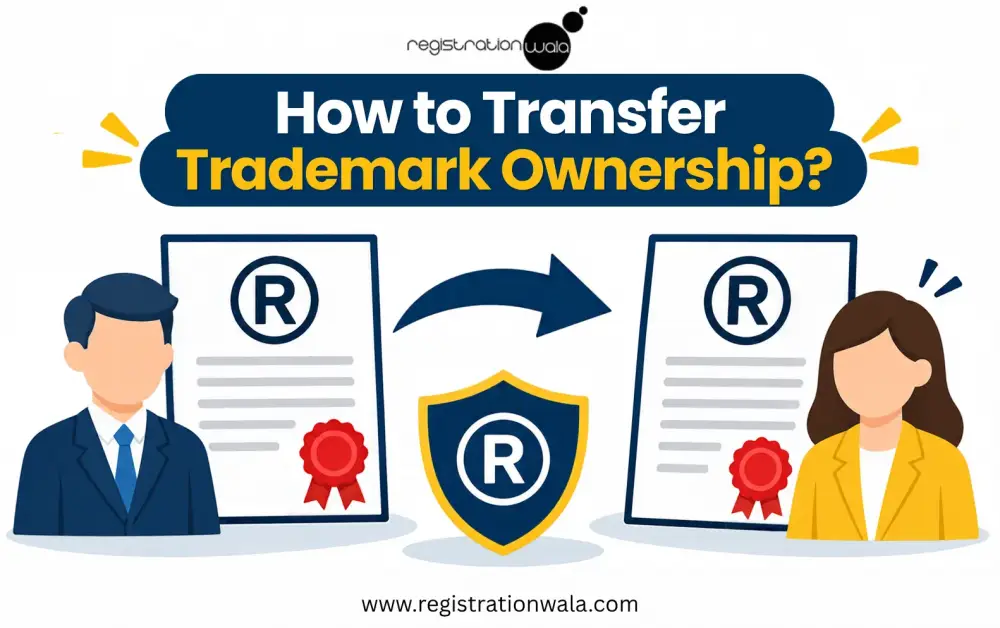
When an entity successfully registers their trademark, they officially become its owner. As the owner, they have legal rights over the registered mark’s exclusive use, licensing and protection of the mark against infringement. It is common for a trademark owner to transfer their ownership to another entity due to reasons like corporate restructuring, sale of a brand, mergers and acquisitions, etc.
The process of transferring trademark ownership from one entity to another is known as trademark transfer. In this blog post, we shall explain to our readers how the trademark transfer process works.
What is Trademark Transfer?
Trademark transfer, also known as trademark ownership transfer and trademark assignment, refers to a formal process through which the original trademark owner (the assignor) transfers their trademark ownership and associated legal rights to a new owner (the assignee). The most crucial document involved in this whole process is the trademark assignment agreement.
This legal document details all the important terms and conditions for the transfer of trademark. It lets assignor smoothly hand over the reputation and exclusive rights they have built. It allows assignee to step into their shoes and take the brand forward with legal authority as well as responsibility.
Legal Provisions Governing Transfer of Trademarks
In India, the TM transfer process is governed by Chapter V (Sections 37 to 45) of Trade Marks Act, 1999.
|
Section under Chapter V
|
Description
|
|
Section 37
|
This Section states the power to assign a trademark
|
|
Section 38
|
This Section specifies the trademark assignability and transmissibility rules
|
|
Section 39 - 42
|
These Sections specify the restrictions on assignment
|
|
Section 45
|
This Section outlines the manner for registration of assignments and transmissions.
|
Types of Trademark Transfer
There are two different types of trademark assignment/transfer, i.e., complete transfer and partial transfer. Below, we’ve explained both of them.
1. Complete Transfer
Complete transfer is also known as complete assignment. In this, the trademark ownership and its exclusive rights are completely transferred to the new owner. This means that all rights, title and interest in trademark across all of the registered goods and services get transferred to the new owner upon the completion of transfer process. Once the complete assignment is done, the original owner gives up all ownership permanently and therefore, cannot use the mark anymore.
2. Partial Transfer
Partial transfer is also known as partial assignment. In this, the trademark ownership and its exclusive rights are not transferred fully. Instead, only a portion of the ownership and rights are transferred and only for specific goods or services. This results in both the original owner and the new recipient splitting the ownership and rights of the trademark.
Common Reasons for Transfer of Trademark
The transfer of trademark ownership could be due to any of the following reasons:
|
Reason for Trademark Transfer
|
Description
|
|
1. Corporate Restructuring
|
One of the most common reasons for trademark ownership transfer is corporate restructuring. At the time of an internal reorganization, such as during conversion of sole proprietorship into a company or moving assets between holding company and subsidiary company, the trademark ownership may get transferred with the new corporate structure.
|
|
2. Sale of Brand/Business
|
Another reason for transfer of TM ownership is at the time of sale of the brand/business. When a business owner sells their brand or business, they often transfer their intellectual property rights during the process to the new owner. This includes trademark rights as well. It allows the new owner to ensure brand/business continuity.
|
|
3. Sale of Trademark Only, not Other Assets
|
A business may decide to sell one or more of its trademarks separately from other assets it possesses. In such a case, it transfers ownership to another entity while continuing rest of its business operations.
|
|
4. Mergers and Acquisitions
|
When two companies merge or one takes over another, the acquirer or the resulting entity will generally take on the existing trademarks in order to bring the brand rights and market presence of the two companies together under one roof.
|
|
5. Trademark Owner’s Demise
|
In case of the unfortunate demise of the trademark owner, the trademark ownership may need to be transferred to an heir/legal representative during the estate settlement process.
|
|
6. Court Order
|
If a legal dispute arises over who owns a trademark, a court may issue an order to transfer trademark to comply with a judgment/settlement.
|
|
7. Division of Business
|
When a business division takes place, the trademarks may have to be split among new entities/divisions in accordance with their operations as well as brand usage.
|
Documents Required for Transfer of Trademark
The following documents are required for trademark transfer in India:
-
Duly Filled Trademark Transfer Application Form (Form TM-P)
-
Copy of the Original Trademark Registration Certificate
-
Trademark Transfer Agreement (a.k.a. Transfer Assignment Agreement)
-
Power of Attorney, if a Trademark Agent is hired for filing Form TM-P on the Assignee’s behalf
-
NOC of Original Trademark Owner/Assignor confirming that they have no issues with the transfer.
-
Declaration Affidavit by Assignee asserting the acquisition of the trademark and their willingness to adhere to legal usage of the mark.
-
Proof of Identity of Assignee, such as PAN or Passport.
-
Proof of Address of Assignee, such as Aadhaar Card or Latest Utility Bills.
What is the Trademark Transfer Process in India?
The trademark ownership transfer process in India generally involves the following steps:
Step 1: First, the trademark assignment deed needs to be drafted and executed properly through legal assistance. The deed must clearly outline what is being transferred, i.e., whether only a select few goods and services are being transferred or all of them, and whether goodwill goes with it. Then, both the parties, that is to say the Assignor and Assignee, must sign the deed.
Step 2: The deed must then be properly stamped. While doing so, it is necessary to pay the stamp duty, as per the applicable state laws. It must be noted that an unstamped or inadequately stamped deed is not legally admissible and cannot be used for official purposes.
Step 3: Collect all the supporting documents for the trademark transfer, including original TM registration certificate’s copy, NOC, address and identity proofs of Assignee, Power of Attorney, etc.
Step 4: The prescribed form for recording Trademark Ownership Transfer Form TM-P must be filed with the Trade Marks Registry along with the prescribed application filing fee. The e-filing fee for this form is Rs. 9,000/per mark while the physical filing fee is Rs. 10,000/per mark.
Step 5: Complete the advertisement requirement, if deemed necessary. If the trademark is assigned without goodwill, then an application must be made to Registrar for directions to advertise the assignment u/s 42 of the Trade Marks Act, and then the assignment must be published accordingly before the transfer can be registered.
Step 6: Respond promptly to any queries or objections raised by the Registrar. Resolving these clarifications quickly is essential as the Assignee will not be officially recognized as the new owner until the Registrar updates the register.
Need assistance in trademark registration, licensing or transfer? Connect with Registrationwala for complete support.
Frequently Asked Questions (FAQs)
Q1. Which is the prescribed form for recording the transfer of a registered trademark’s ownership to another entity?
A. Form TM-P is the prescribed form under Trade Marks Rules, 2017 for recording the transfer of a registered trademark to another entity.
Q2. What is the government fee for filing Form TM-P?
A. The government fee for e-filing Form TM-P is Rs. 9,000/per mark. The government fee for offline filing is Rs. 10,000/per mark.
Q3. What is the trademark assignment agreement?
A. Trademark assignment, also known as trademark transfer agreement, is a legally binding document that states all the important terms and conditions relevant to the transfer of a trademark.
Q4. How is a complete assignment different from partial assignment?
A. In a complete assignment, the trademark assignor completely transfers ownership of the trademark and its exclusive rights to the trademark assignee for all goods and services. However, in a partial assignment, the assignor transfers ownership and rights only for specific goods and services.
-
Published: November 24, 2026
49 Views