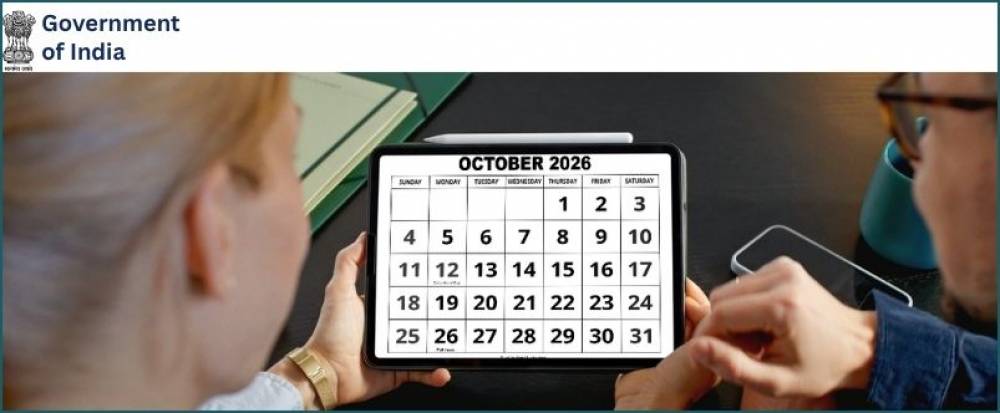
From 1 October 2026, several rules relating to banking, payment and finance will change, such as revision in free ATM transaction limits for certain SBI salary account holders, changes in NPS charges and mandatory aadhaar authentication for LPG subsidy among others. In this news article, we shed light on the major changes set to take effect from 1 October 2026 and keep our readers informed.
List of 5 Major Changes w.e.f. 1 October
Below, we have listed a total of 5 major changes that will become effective from October 2026.
|
Change
|
Details
|
|
1. SBI ATM Free Transaction Rules
|
Free other-bank ATM transactions to reduce from prevailing 10 transactions/per month to 5 transactions/per month.
|
|
2. Disclosure & Updation of Bulk FD Rates
|
Starting from 1 October, banks shall have a requirement to disclose bulk deposit rates well in advance and update them on a daily basis.
|
|
3. UPI MDR
|
MDR shall become applicable to select merchant UPI transactions exceeding Rs. 2,000. However, this change will take effect from 15 October, not 1 October.
|
|
4. NPS Charges
|
NPS subscribers registering through PoPs shall pay Rs. 200 as a one-time onboarding fee w.e.f. 1 Oct.
|
|
5. LPG Subsidy Aadhaar Authentication
|
Biometric Aadhaar Authentication will become a mandatory requirement for subsidised LPG refills from 1 October onwards.
|
1. Change in SBI ATM Transaction Rules
The State Bank of India, abbreviated as SBI, has updated the policy regarding the number of free monthly transactions for salary package account holders who use their SBI debit cards at ATMs and Automated Deposit cum Withdrawal Machines of other banks. These changes are going to take effect soon, i.e., from 1 October. For all SBI salary package account variants, the number of free transactions at other banks' ATMs will be reduced from 10 to 5 per month at all centres. This is half of what is currently being offered.
This limit of 5 transactions shall take into account both financial as well as non-financial transactions. So, ensuring transactions are done wisely is absolutely necessary. It is important to note that for Basic Savings Bank Deposit accounts, customers will still be able to make four cash withdrawals per month for free. After that, each additional transaction will attract a charge of Rs. 15 + GST. To clarify, all digital transactions will remain free without any restrictions of any manner whatsoever.
2. Revision in Bulk Deposit Interest Rate Rules
India’s central bank Reserve Bank of India is revising the manner in which commercial banks determine and disclose their interest rates on bulk fixed deposits. The revised rules shall take effect from 1 October 2026. Under central bank’s revised framework, banks will be required to disclose their bulk deposit rates ahead of time.
What’s more, they will be required to offer same interest rates for bulk deposits that are similar in nature. With that being said, they can differentiate rates on the basis of the Liquidity Coverage Ratio treatment applicable to deposits.
3. UPI MDR on Specified Merchant Payments
Another major change that will take place in October, specifically from the 15th of the month, is regarding UPI transactions made by merchants. Such payments will attract a Merchant Discount Rate (MDR) on select transactions. This rate will be applicable to specific merchant transactions that cross Rs. 2,000 threshold. Payments of up to Rs 2,000 and transactions falling under the zero-MDR framework for small traders will remain free. Consequently, approximately 96% of all person-to-merchant (P2M) transactions will be unaffected. The MDR will vary by merchant. The applicable rate will depend on industry or category in which merchant operates.
A Public Interest Litigation was filed before Supreme Court that seeked to overturn government’s decision to allow MDR on UPI merchant payments above Rs 2,000. The petitioner argued that this levy was introduced without any adequate statutory safeguards, transparency or consultation from the public. Despite this, Supreme Court chose not to stay Centre’s decision to impose the 0.4% MDR on specified UPI P2M transactions over Rs 2,000 with the government clarifying that it is neither a tax nor a fee.
4. Revision in NPS Charges
India’s pension sector regulatory Pension Fund Regulatory and Development Authority has announced charges that Points of Presence (PoPs) can collect from subscribers participating in National Pension System (NPS) as well as NPS Lite. These revised charges will take effect on 1 October.
Under new fee structure, subscribers registering through PoPs will attract a one time onboarding charge of Rs 200 for each Permanent Retirement Account Number they obtain. Please note that this Rs 200 fee will not be deducted as a single amount from the account of the NPS subscriber.
5. Mandatory Aadhaar Authentication for LPG
Domestic LPG consumers need to complete their biometric Aadhaar authentication before 1st October 2026. If they fail to do so, they will not be able to refill LPG at the regulated selling price with subsidy. To clarify, the LPG supply will not be stopped and consumers will not lose their connection even in case of failure to complete the authentication. It’s just that unauthenticated users will need to pay the full market price for refills.
Upon completion of authentication, refill booking at regulated selling price along with the government subsidy will be enabled. It is advised that all domestic LPG consumers complete their authentication as soon as possible if they want to continue getting the benefit of subsidised refills from 1st October onwards.
Source: MSN
Comments
No comments yet.
Leave a Comment