If you have ever invested in stock market or kept an eye on IPOs, you have probably come across the term “Draft Red Herring Prospectus (DRHP)”. It is one of the most important documents in IPO process as it gives a detailed picture of the company. It covers the company’s major aspects like its business operations, financial performance, promoters, potential risks and proposed use of funds raised through IPO.
The DRHP is prepared with assistance of a merchant banker and then submitted to Securities and Exchange Board of India (SEBI)/Stock Exchange for review. It is a mandatory step that a company must complete before moving ahead with its IPO. So, how does a company prepare and file a DRHP with SEBI? In this blog post, we'll break down the process step by step.
What is a Draft Red Herring Prospectus?
A Draft Red Herring Prospectus (DRHP) is an initial offer document prepared by a company proposing to raise funds through an Initial Public Offering (IPO). For a Main Board IPO, the DRHP is filed with SEBI. A copy of the document is also filed with the stock exchange(s) where the company proposes to list. However, for an SME IPO, the DRHP is filed with the Stock Exchange instead. The company prepares and files the DRHP with the assistance of its appointed merchant banker(s). This document contains key information about the company, its business, financials, risks and the proposed IPO.
You can think of DRHP document as a detailed introduction to the company for potential retail and institutional investors. It gives them a clear picture of how the business exactly works, its financial standing, its promoters and management, major risks involved and how the company plans to use funds raised through IPO.
To put it in a nutshell, the DRHP gives investors a chance to understand the company before its shares are offered to public. For instance, if a growing tech startup plans to launch an IPO, it would first need to prepare its DRHP and then submit it to SEBI for review through a merchant banker before moving ahead with the public issue.
How to Submit a DRHP to SEBI?
Although the DRHP is just a ‘draft’ document, filing it is a fairly time-consuming process. It takes several months to file this document with SEBI. Once filed, the company can move closer towards the final IPO preparations. Below, we have explained all the major steps involved in filing a DRHP with SEBI:-

Step 1:- Appointing Merchant Bankers & Other Intermediaries
The first step that a company needs to complete is to appoint a merchant banker to oversee the IPO and due diligence process. For a fixed-price issue, a standard lead manager with SEBI merchant registration can be appointed.
However, for a book-built issue, a book running lead manager with SEBI merchant banker registration must be appointed. The company must also appoint other key intermediaries like legal counsel, statutory auditor, registrar to the issue, bankers to the issue, etc.
For assistance in appointing the key intermediaries, get in touch with our IPO consultants at Registrationwala.
Step 2:- Completing Due Diligence
In this step, the company undergoes detailed checks. These checks cover the company’s financials, legal matters, business operations and compliance with regulatory requirements. This process involves reviewing financial statements, ongoing litigation, material contracts, promoter holdings, related party transactions, employee stock ownership plans (ESOPs) and other records considered necessary.
Step 3:- Drafting the DRHP Document
The DRHP contains important details of the company planning to go public through an IPO. This document contains the company’s financial performance, promoters, risks, use of IPO proceeds, litigation and other material matters. While drafting this document, consistency is extremely important. Information provided in one section of the document shouldn’t contradict information in other sections. In case of any such gaps, SEBI may raise queries/seek clarification.
Step 4:- Filing the DRHP with SEBI
As mentioned earlier, for a Mainboard IPO, the DRHP needs to filed with SEBI and the relevant stock exchange. For an SME IPO, this document needs to be filed with the relevant stock exchange’s SME platform. Once filed, the DRHP is made available to the public for a minimum period of 21 days.
Step 5:- Responding to SEBI Queries
The DRHP is reviewed by SEBI. If necessary, SEBI may ask questions or request additional information. In response, the company and its advisors must provide explanations, supporting documents or updated disclosures. The number of review rounds will vary based on the complexity and quality of the filing.
Step 6:- Filing the UDRHP and Moving to the RHP
Once the company receives an Observation Letter from SEBI, it incorporates all the necessary changes and then files the Updated Draft Red Herring Prospectus (UDRHP). The updated document is made available for public review for at least 21 days. After this period, the company moves closer to finalizing the IPO price band and then files the Red Herring Prospectus (RHP) with ROC before the IPO opens.
For a smooth DRHP process, strong due diligence, accurate disclosures, consistency across various sections of the DRHP document and timely responses to queries raised by SEBI are extremely important.
How the DRHP Differs from the Documents That Follow
In the IPO documentation process, the DRHP is only the starting point. As the company approaches its public issue, this document is updated and ultimately replaced by more final versions.
| Document |
Where It Is Filed or Made Available |
What It Covers |
| Draft Red Herring Prospectus (DRHP) |
DRHP is filed with SEBI for Mainboard IPOs.
However, for the SME IPOs, it is filed via SME platform of the stock exchange. |
It gives detailed information about the company. However, it does not mention the IPO final price, debut date and allotment date. |
| Updated Draft Red Herring Prospectus (UDRHP) |
This document is made available to the public. |
The UDRHP includes changes and observations arising from SEBI’s review. It is kept open for public comments for a period of at least 21 days. |
| Red Herring Prospectus (RHP) |
It is filed with ROC at least 3 working days prior to opening of issue. |
It contains updated information about the IPO incl. details such as price band, issue size and issue timetable. |
| Final Prospectus |
This document is filed with the ROC, with a copy submitted to SEBI for a Mainboard IPO. For an SME IPO, it is filed with the ROC and relevant Stock Exchange. |
It presents final details of issue like confirmed issue price and total funds to be raised. |
In summary, the DRHP only provides investors with the first detailed look at the company. The subsequent documents gradually furnish information necessary to understand IPO’s final terms and conditions.
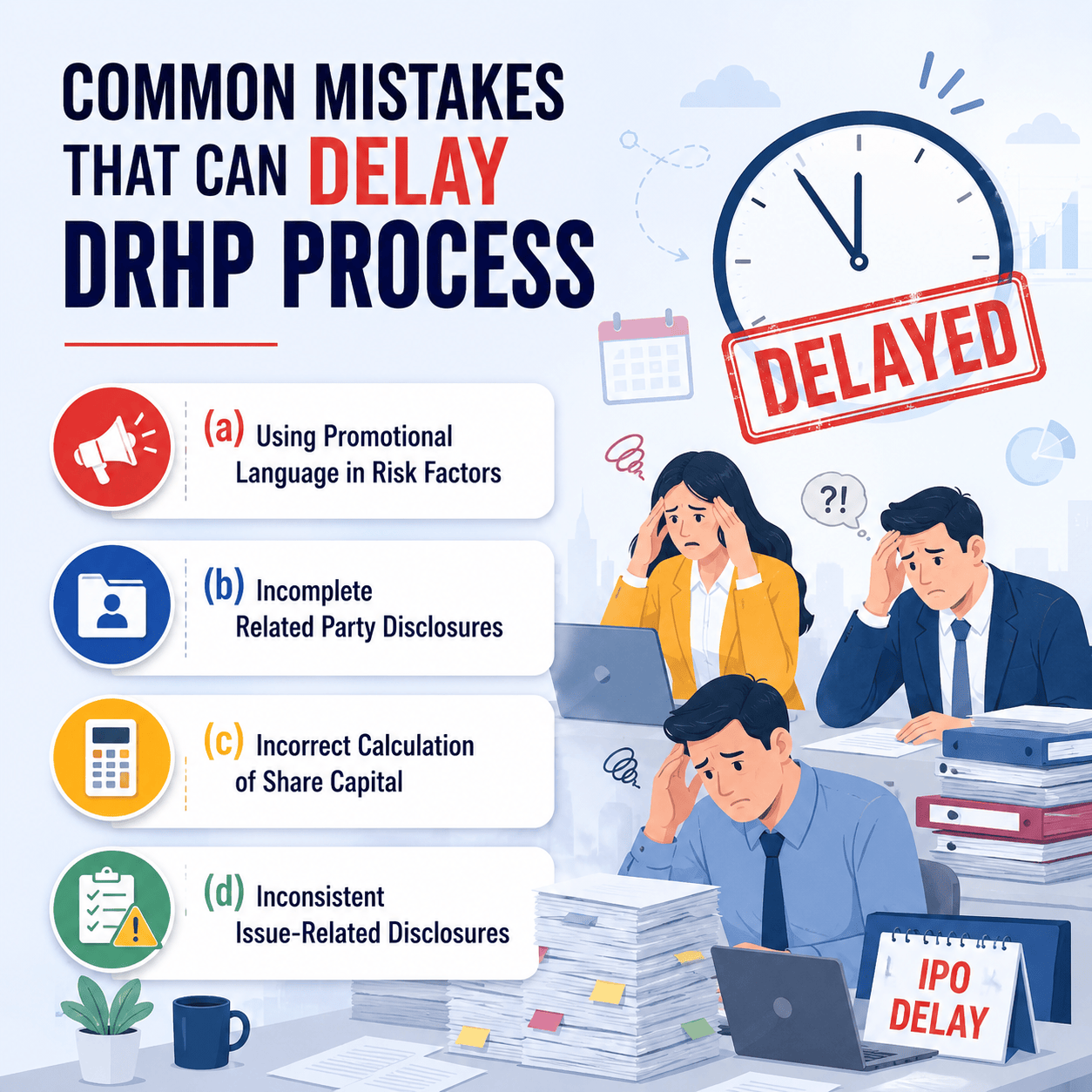
Common Mistakes That Can Delay DRHP Process
Preparing a DRHP involves more than just compiling the necessary information. The presentation of that information and its alignment across various sections is equally important.
Even minor inconsistencies can prompt additional questions from the market watchdog and delay the IPO process. Below, we have explained some of the most common mistakes that cause delays in DRHP process.
(a) Using Promotional Language in Risk Factors
One of the most common mistakes that cause a delay in DRHP approval is bringing the language used in investor presentations directly into the document. In a pitch desk, terms like “best manufacturer”, “undisputed market leader”, “strong customer relationships” or “significant market presence’ may work pretty well for convincing the potential investors. However, in a regulatory document like DRHP, these terms need to be used very carefully.
The risk factors must be factual and must be capable of being supported by evidence. This information must also align with the disclosures made in other sections of DRHP. Any statements that appear promotional or lack proper substantiation may lead to additional questions from SEBI during review process.
(b) Incomplete Related Party Disclosures
Another common mistake is incomplete or inaccurate disclosure of related party transactions. Companies may overlook transactions with entities controlled by promoters or other related parties, particularly when such transactions are routine, small in value or conducted at arm’s length.
All the related party transactions need to be properly identified, reviewed and disclosed as required. Any gaps/inconsistencies in these disclosures may lead to additional queries from SEBI during the DRHP review process and delay the overall IPO process.
(c) Incorrect Calculation of Share Capital
Another frequent mistake is making errors while restructuring the share capital of the company before the IPO. This may include wrong calculations while issuing bonus shares or transferring amounts from free reserves or securities premium to paid up share capital.
Such errors can lead to inconsistencies in the company’s financial statements and may necessitate corrections or new resolutions, leading to additional queries and delays in the DRHP approval process.
(d) Inconsistent Issue-Related Disclosures
Errors in the objects of the issue, use of proceeds, ESOP or SAR disclosures can raise questions during the DRHP review. Discrepancies in the cap table, shareholding pattern and Minimum Promoter Contribution calculations may require corrections and can cause delay in approval process.
Spotting the aforementioned problems can be really difficult when each section of DRHP is reviewed separately. Such problems generally become evident only when the entire draft document is checked across all the sections and the underlying details are cross-checked line by line.
Also Read: What is a Book Running Lead Manager?
Final Thoughts
A company must prepare and file a DRHP document by appointing a merchant bank. For a mainboard IPO, the document must be filed with SEBI. However, for an SME IPO, the document must be filed with concerned Stock Exchange through the SME Platform. The company should ensure that all disclosures are accurate, complete and consistent before the document is filed. Having a well-prepared DRHP can help a company reduce regulatory queries and avoid unnecessary delays in IPO process.
Need assistance in preparing or filing a DRHP with SEBI? Get in touch with our IPO consultants at Registrationwala. We can guide you through all the requirements and also assist you in connecting with SEBI-authorised intermediaries for the IPO process.
Avail IPO Consulting Service!
Frequently Asked Questions (FAQs)
Q1. Can a company file DRHP with SEBI for Mainboard IPO without appointing a merchant banker?
A. No. A company cannot file a DRHP directly with SEBI for Mainboard IPO. Therefore, appointing a merchant banker is necessary.
Q2. Where does a company need to file a DRHP for an SME IPO?
A. The company needs to file the DRHP for an SME IPO with the concerned Stock Exchange through the SME Platform. The documents need to be filed with the assistance of an appointed merchant banker.
Q3. For how many days is the UDRHP made publicly available?
A. To invite comments and feedback from the public, the UDRHP is made publicly available for a minimum of 21 days.
Q4. Does DRHP need to be submitted with SEBI for an SME IPO?
A. No. For an SME IPO, the DRHP needs to be submitted with the concerned Stock Exchange via the SME Platform, not SEBI.
Q5. What is the difference between Mainboard IPO and SME IPO?
A. The main difference between them lies in the size and paid-up capital of the company. In case of a Mainboard IPO, the post-issue paid-up capital must be at least Rs. 10 crore along with a minimum equity capitalisation of Rs. 25 crore. In the case of an SME IPO, the post-issue paid-up capital must not exceed Rs. 25 crore.
-
Published: October 09, 2026
46 Views