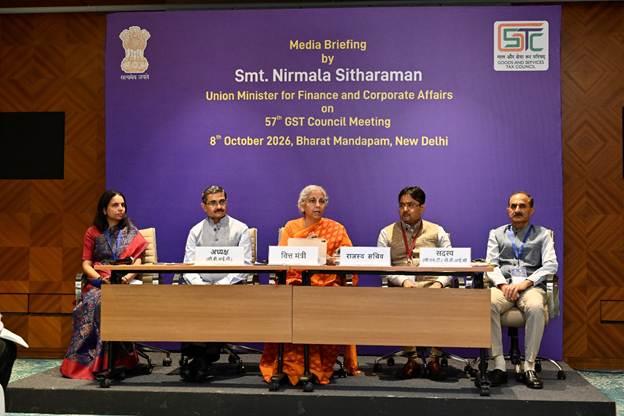
On 8 October 2026, the GST Council convened its 57th meeting at Bharat Mandapam in New Delhi. This meeting was chaired by Union Finance and Corporate Affairs Minister Smt. Nirmala Sitharaman. During the meeting, several important recommendations were made. In the meeting, the GST Council addressed process reforms pertaining to GST registration, returns, adjudication, etc.
They also provided clarifications concerning the applicability of GST on the supply of certain goods and services. Moreover, other measures aimed at facilitating trade and streamlining compliance within the GST framework were also proposed in meeting. In this article, we will discuss the key recommendations made during the recently held 57th GST Council meeting.
Why was 57th Meeting of GST Council Convened?
Every few months, the GST Council holds meetings to discuss important issues and provide recommendations to deal with them. The GST Council’s 57th meeting was held to discuss various recommendations related to GST registration, cancellation of registration, GST returns, dispute resolution and IPR among others.
Ultimately, the recommendations are intended to make GST compliance simpler, improve transparency in the GST system, reduce compliance burden faced by taxpayers, minimize litigation and promote ease of doing business by establishing taxpayer-friendly GST framework.
Who Attended 57th Meeting of GST Council?
The participants included the following government officials:
-
Chief Ministers of Delhi, Goa, Haryana, Jammu & Kashmir, Karnataka, Kerala, Maharashtra, and Meghalaya;
-
Deputy Chief Ministers of Manipur and Telangana;
-
Finance Ministers and Senior members of States/Union Territories with Legislative Assembly, Secretary, Department of Revenue;
-
Chairman and Members of Central Board of Indirect Taxes & Customs
-
Senior officials of the Ministry of Finance.
GST Council’s 57th Meeting: List of Recommendations
We have provided a list of some of the major recommendations from the 57th meeting of the GST Council below, as notified by the Press Information Bureau (PIB). Please keep in mind that these recommendations are not legally binding for the time being. They will take effect only through official notifications, circulars and amendments to the CGST and IGST Acts.
(a) Clear Filing/Processing Guidelines for Streamlining Registration Process
Following the recommendations made by the GST Council in its 56th meeting, the portal is now granting automatic registrations without officer intervention under Rule 14A of the CGST Rules, 2017, for applicants who do not intend to pass on Input Tax Credit (ITC) exceeding Rs. 2.5 lakh per month.
To improve the processing of registration applications in other cases, the GST Council made the following recommendations during its 57th meeting:-
|
S. No.
|
Recommendations
|
|
1.
|
Issuing a well-detailed circular that specifies the documents and information required for GST registration along with a list of frequently asked questions (FAQs) to simplify filing as well as processing of GST registration applications.
|
|
2.
|
Amending the registration application in FORM GST REG-01 to include drop-down boxes for the selection of prescribed documents/information. This would ensure clarity for both the taxpayer and the tax officer regarding required submissions.
|
|
3.
|
Improving the official GST portal to provide a user-friendly interface for filing registration applications, complete with clear navigational paths, drop-down lists, tool tips and contextual guidance so as to facilitate accurate submission of GST applications.
|
The aforesaid measures aim to reduce number of rejections and queries related to registration applications, which often arise from lack of correct information and details. If they are implemented, they are anticipated to expedite processing of applications by tax officers.
(b) Rationalization of Procedure for Amendments in GST Registration
The GST Council has recommended amending Rule 19 of the CGST Rules, 2017. This amendment would allow for automatic acceptance of changes to all GST registration details on GST portal, with the exception of those relating to Principal Place of Business (PPoB).
Additionally, for taxpayers registered under Rule 14A of CGST Rules, 2017 (the automatic route), all amendments, including those concerning PPoB, would be automatically accepted on portal.
If this recommendation gets implemented, it is expected to provide easy and almost real-time updates of GST registration information on the portal in these cases. It would eliminate the need for interaction with tax officers.
(c) Rationalization of GST Registration Cancellation Process
During the meeting, the GST Council recommended amending the CGST Act, 2017 and the CGST Rules, 2017, so as to make the GST registration cancellation process simpler. The recommendations would be implemented in two distinct phases explained below:-
Phase 1:- As per recommendations, the system will automatically accept GST registration cancellation application (FORM GST REG-16) filed by the taxpayer, once all the pending returns are filed and all the dues are paid, in the cases given below:
-
The taxpayer has not passed on Input Tax Credit (ITC) exceeding Rs. 2.5 lakh in any month since GST registration.
-
The taxpayer has passed on ITC exceeding Rs. 2.5 lakh in a month but has filed the final return using FORM GSTR-10 within prescribed time period.
Phase 2:- Once all pending returns are filed and all dues are cleared, all applications for GST registration cancellation would be automatically accepted by system. FORM GST REG-16 would be amended so that FORM GSTR-10 details could be provided directly within the said application itself.
(d) Simplified Registration Mechanism on ECO Platform
To provide a simplified GST registration mechanism for small sellers on Electronic Commerce Operators (ECO) platform, the GST Council gave an in-principal approval in its 56th meeting. In its 57th meeting, the Council recommended that there be an insertion of Rule 14B in the CGST Rules, 2017, in continuation of the same. This rule aims to establish a straightforward mechanism for the registration of small suppliers who make supplies of goods through e-commerce operators in states and Union Territories (UTs) where they do not have a physical presence.
It would be applicable to those suppliers intending to pass on Input Tax Credit (ITC) of no more than Rs. 2.5 lakh per month (excluding stock transfers between distinct persons). These small suppliers could declare the warehouse of an ECO in that state or UT as their Principal Place of Business (PPoB). Under this rule, registration would be granted automatically by the system provided certain conditions are met.
This measure would allow small sellers to expand their businesses to other states through e-commerce platforms without the need to establish a physical presence in each and every state. It would greatly enhance ease of doing business.
(e) Minimization of Mismatches and Reduction of Notices
To streamline GST return filing process, certain measures have been recommended by GST Council. These measures would minimize mismatches in liability and input tax credit in the returns. Now, let’s take a look at what these recommendations are:-
|
S. No.
|
Recommendations
|
|
1.
|
Changes in FORM GSTR-1/1A/IFF to allow for better reconciliation of the information furnished in these forms with the information reported in the return in FORM GSTR-3B.
|
|
2.
|
Insertion of Rule 86D in the CGST Rules, 2017 to provide for a facility called “Electronic Statement of tax paid on Reverse charge basis and input tax credit claimed” on the portal and help the taxpayers to correctly report tax liability and ITC on supplies liable to RCM in returns.
|
|
3.
|
Insertion of Sub-rule (1A) in Rule 61 of CGST Rules, 2017 to establish a mechanism for accurately reporting and rectifying tax liabilities in the return. It would ensure that the liabilities reported in FORM GSTR-3B align with those provided in FORM GSTR-1, FORM GSTR-1A and the Invoice Furnishing Facility (IFF).
|
|
4.
|
Changes in FORM GST DRC-03 for declaration of details of the underlying invoice for which payment has been done.
|
|
5.
|
Insertion of Sub-rule (6A) in Rule 60. This new provision would introduce the Invoice Management System and allow recipients to accept, reject or keep a document related to inward supply pending on the portal. This mechanism aims to generate ITC statement in FORM GSTR-2B, subject to specific conditions, including permissible time frame for keeping a credit note pending within the System.
|
|
6.
|
Insertion of Rule 86C in the CGST Rules, 2017 to introduce the “Electronic Credit Reversal and Reclaim Statement” feature on the GST portal. It would assist taxpayers in accurately reporting ITC that has been reversed and reclaimed in FORM GSTR-3B.
|
|
7.
|
Inclusion of sub-rule (1B) under rule 61 of CGST Rules to introduce a mechanism of correct reporting and correction/rectification of ITC in return. This would ensure that the ITC availed in the return in FORM GSTR-3B is in line with the ITC details made available in FORM GSTR-2B.
|
|
8.
|
Release of a circular to clarify the correct and proper manner of reporting ITC and any reversals in FORM GSTR-3B.
|
The Council recommended that the provisions for an alternate mechanism to amend liability and ITC in GST returns be implemented starting with the return of April 2027. It is anticipated that these measures will greatly reduce mismatches in liability and ITC in returns. This will not only help to decrease the number of demand notices and system-generated intimations due to such mismatches but it will also enhance the integrity of ITC across supply chain and ultimately benefit taxpayers.
In addition to the above, the Council suggested that the proposed revised mechanism should be made available to public for time-bound consultation. The Union Finance Minister has been authorized to approve any necessary changes or modifications based on feedback received from stakeholders.
(f) Reduction in Max. Penalty u/s 125 of CGST Act, 2017
The Council recommended an amendment to provisos of section 107(6) and section 112(8) of CGST Act, 2017. This amendment proposes an upper limit of Rs. 40 crore (Rs. 20 crore under CGST and Rs. 20 crore under SGST/UTGST) for pre-deposit required when filing an appeal before Appellate Authority/Appellate Tribunal in cases where order involves only a penalty and no demand for tax. This change aims to ease the financial burden on taxpayers and facilitate their access to appellate remedies in such situations.
(g) Refund of Accumulated ITC
The Council recommended amending clause (ii) of proviso to section 54(3) of CGST Act, 2017 and CGST Rules, 2017. This amendment would enable refund of accumulated ITC on account of capital goods in case of refund pertaining to zero-rate supplies and of accumulated ITC on account of input services and capital goods in case of refund pertaining to inverted duty structure. The Council has also recommended that refunds for accumulated ITC on input services related to the inverted duty structure to be applicable only for ITC availed on/after 1 November 2026.
Regarding refunds of ITC on capital goods associated with zero-rated supplies and inverted duty structure, the Council gave a proposal that these refunds should be spread over a period of 60 months. This would apply to ITC availed on capital goods on or after 1 April 2027. These proposed changes aim to ease working capital constraints for taxpayers and eliminate blockage of ITC related to input services and capital goods in such scenarios.
(h) Rationalization of Blocked ITC
The Council has recommended amending section 17(5) of the CGST Act, 2017. The recommendation is aimed at removing restrictions on the availing of Input Tax Credit (ITC) for certain supplies.
This includes outdoor catering services, health and life insurance, telecom towers, pipelines laid outside factory premises, free samples and goods that have been destroyed/written off due to expiry as required by law. Implementing these changes will help reduce cascading effect of taxes and allow for a smoother flow of ITC throughout supply chain.
(i) Reforms for Exports/Zero Rating of Supplies of Goods/Services
The GST Council recommended the removal of sub-clause (v) from clause (6) of section 2 of the IGST Act, 2017. This change would eliminate the requirement that both the supplier and recipient of services must not be establishments of a distinct person, as stated in Explanation 1 to section 8 of the IGST Act, 2017.
This revision would allow for refunds for Indian service providers regarding services supplied to or through their foreign offices or branches. It would help to promote the export of services from India. The Council also recommended issuance of a circular to clarify various issues concerning receipt of payments in either foreign exchange or Indian Rupees, which will be acceptable for export of goods and services.
It also recommended removal of clause (a) from section 13(3) of the IGST Act, 2017. This would mean that place of supply for services, when goods are made physically available by the recipient to the supplier, would be determined based on default provision u/s 13(2) of the IGST Act, 2017, that is, according to location of recipient of those services. This recommendation would enhance access to export-related benefits under GST for Indian service providers serving foreign clients.
(j) Rationalization of Provisions for Arrest and Prosecution
The Council has recommended omitting section 69 of the CGST Act, 2017, for complete withdrawal of arrest powers under GST. In addition, the Council has also recommended the below-mentioned measures to further strengthen a progressive and trust-based GST regime:-
|
S. No.
|
Recommendations
|
|
1.
|
Increase in monetary prosecution threshold from Rs. 1 crore to Rs. 5 crore.
|
|
2.
|
The omission of clause (i) of section 132(1) of the CGST Act, 2017, deletion of the phrase "evades tax" in clause (e) and the removal of the words "or in any other manner deals with" in clause (h) of the same section.
|
|
3.
|
Amendment to clause (c) of section 132(1) of the CGST Act, 2017, to specifically address only the offense of fraudulent availment of ITC without the receipt of goods or services or without an invoice or bill.
|
|
4.
|
Rationalization of punishment amount for various offences u/s 132 of CGST Act, 2017.
|
(k) Treatment of Transfer of Title in IPR
The Council recommended to amend Schedule II of CGST Act, 2017. The amendment would establish that the transfer of title in Intellectual Property Rights (IPR), whether temporary or permanent, would be uniformly classified as a supply of services. This proposed change aims to make GST compliance simpler and facilitate smoother cross-border transactions involving IPR.
(l) Taxpayer’s Opportunity of Being Heard
Another key recommendation by the Council is to amend rule 86A of the CGST Rules, 2017. The amendment would provide the taxpayer with a mechanism for filing an objection against blocking of any amount in electronic credit ledger and to avail a personal hearing before the officer makes a decision on such objection.
(m) Relief Extension for Small Taxpayers on Late Fees
The Council has also recommended to waive off late fee imposed on delayed filing of return u/s 39(1) of the CGST Act for taxpayers having an annual turnover up to Rs. 5 crore in the preceding financial year provided that the said delayed return is filed by the end of the month in which it was due.
(n) Fund Transfer Pricing Mechanism in Banks
The GST Council recommended clarifying that the notional amount regarded as “interest” in the books of accounts for the activity of notional transfer of funds between the branches of the banks by the head office as part of Funds Transfer Pricing transactions falls under the definition of “interest” given in the Notification No. 12/2017-Central Tax (Rate).
Need assistance with GST registration or have post-registration compliance requirements to fulfill? Get in touch with our GST consultants at Registrationwala for availing our specialized guidance and support.
Get Free GST Consultation
-
Published: October 10, 2026
52 Views