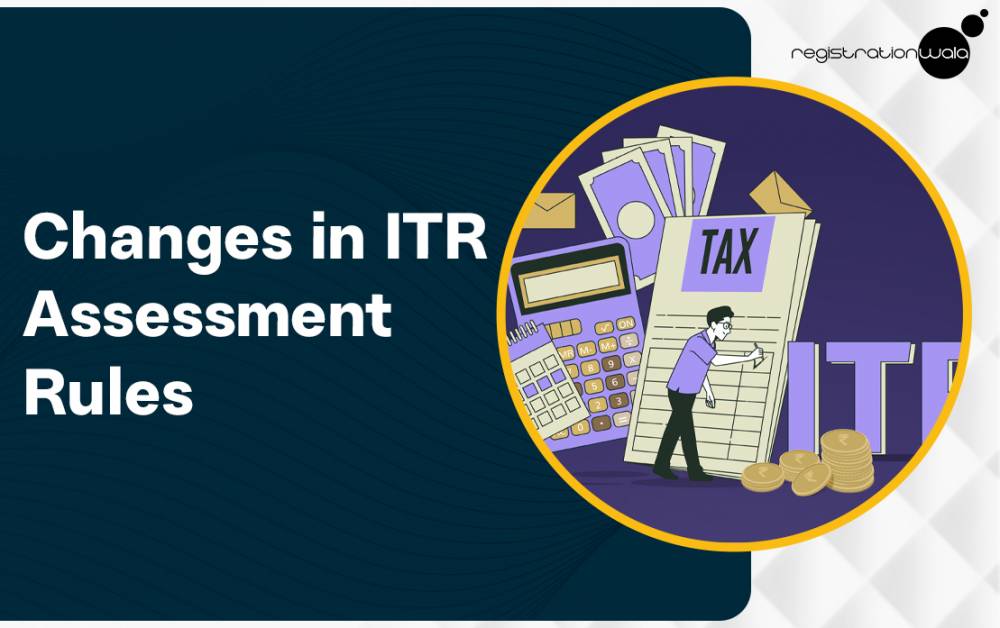
On 1 April 2026, the Income Tax Act 2025, came into effect and replaced the six decade old Income Tax Act 1961. With the introduction of the new Act in Indian tax system, the ITR (Income Tax Return) assessment framework has been streamlined and modernized so as to improve compliance.
The key changes in the framework include requirement of reassessment notices to be issued only by JAO, validity of assessments despite minor DIN errors, strict timelines for assessments and streamlined block assessments limited to relevant years. In this blog post, we shall discuss these key changes to ITR assessment rules in a detailed manner.
What is Income Tax Assessment?
Income Tax Assessment meaning can be defined as the process of checking and reviewing the ITR filing to verify income, deductions and tax liability of the taxpayer. There are different types of tax assessment like Summary Assessment, Scrutiny Assessment, Best Judgment Assessment and Reassessment. Earlier, the tax assessment process in India relied quite heavily on manual intervention as well as direct interaction between taxpayers and concerned tax authorities.
However, in line with the government’s e-governance initiatives, the tax system in the country has gradually shifted towards a more digitized framework to make things much easier for the government as well as the taxpayers. To facilitate the transition to digitization, the Central Board of Direct Taxes (CBDT) has been vested with the authority to devise and notify schemes for electronic assessment of total income/loss under the Income Tax Act.
In exercise of this power, the CBDT introduced the e-Assessment Scheme, 2019, which was later renamed as the Faceless Assessment Scheme, 2019, with a strategic focus on enhancement of efficiency, transparency and accountability in tax administration.
List of Key Changes in Income Tax Assessment Rules
India implemented significant changes to income tax assessment rules under the new Income Tax Act, 2025 w.e.f. 1 April 2026. Every taxpayer should know about them. According to the Economic Times and Business Standard, these changes include the following :-
1. JAO’s Role in Issuing Reassessment Notice:- Tax reassessment means the process by which the Income Tax Dept reopens a previously completed assessment to find income that should have been taxed but was not. The reassessment structure has undergone an amendment in order to clarify the role of Jurisdictional Assessment Officer (JAO) and National Faceless Assessment Centre (NaFAC). Now, the notices for escaping assessment u/s 280 and 281 of the IT Act 2025 are only valid if they are issued by JAO.
This rule overrides the previous mandates for faceless issuance of notices by NaFAC. It confirms that initiating reassessment is exclusively JAO’s jurisdictional responsibility while the actual reassessment must be conducted facelessly by NaFAC.
2. Validity of DIN despite Minor Errors:- Here, DIN stands for Document Identification Number, which is a unique computer generated alphanumeric code mandated by tax authorities. The treatment of DIN has been clarified under the amended framework.
Now, the assessment remains valid despite minor mistakes, defects or omissions at the time of DIN quotation as long as the communication is linked or referenced to a system-generated DIN in any manner.
3. Completion of Assessment Timeline:- For completion of assessment, reassessments and recomputations, the law continues to prescribe a strict timeline u/s 286 of the Income-tax Act, 2025 (corresponding to Sections 153 and 153B of the 1961 Act). However, an important clarification has been introduced that the general time limit is applicable only up to the issuance of draft assessment order u/s 275 of Income-Tax Act 2025 (Section 144C of IT Act, 1961) in eligible cases.
After issuance of draft order, subsequent steps like taxpayer response, dispute resolution panel (DRP) proceedings and final order, will strictly adhere to the timelines u/s 275 of the Income-Tax Act, 2025 (corresponding to Section 144C of the 1961 Act). To settle the pending disputes, this rule is made retrospective from April 1, 2009 for Section 153 and from October 1, 2009 for Section 153B under Income-Tax Act 1961, w.e.f. April 1, 2026 under IT Act 2025.
4. Block Assessment:- Block assessment is a tax assessment procedure that is initiated when suspicious raises for undisclosed/hidden income/assets. The block assessments for “other persons” has been rationalized by limiting the assessment period to specific years of found undisclosed income.
Moreover, the time limit for completion of these assessments has been extended from 12 months to 18 months, applicable from Tax Year 2026-27 (for the searches initiated after 1 April 2026). The starting point for the 18 month period is now date of search/requisition.
Conclusion
From 1 April, 2026, the Indian tax system has introduced several major changes to improve transparency, accountability and integrity of the tax administration. If you need assistance in ITR filing or in ensuring compliance with tax regulations, you can get in touch with our tax consultants at Registrationwala.
Frequently Asked Questions (FAQs)
Q1. What is Income Tax Assessment?
A. It refers to the process where the Income Tax Department assesses the ITR of a taxpayer to verify their income, deductions and tax liability.
Q2. What is Tax Recomputation?
A. It refers to the process where the Income-Tax Department or the taxpayer recalculates a taxpayer's total income and tax liability for a previous assessment year.
Q3. What is JAO full form in income tax?
A. JAO full form in income tax is Jurisdictional Assessment Officer. It refers to an official who is assigned by the Income-Tax Dept to manage tax affairs and assessments.
Q4. What is NaFAC full form in income tax?
A. NaFAC full form in income tax is National Faceless Assessment Centre. It refers to a central body under the Income-Tax Dept. It is responsible for managing the Faceless Assessment Scheme and also the Faceless Appeal Scheme so as to reduce corruption as well as bribery.
Q5. What is Tax Reassessment?
A. It refers to the process of reassessing a previously completed assessment of a taxpayer’s income when there is a valid reason to believe that some income has escaped assessment.
Disclaimer :- This blog post is purely meant for educational purposes. While we have made every effort to provide our readers with accurate as well as complete information in this post, we cannot guarantee its full accuracy or completeness. Therefore, we suggest the readers verify with the official sources (i.e., Economic Times and Business Standard) before making any decisions. Information in this content should not be interpreted as professional, tax, academic, business, financial or legal advice at all.
-
Published: April 18, 2026
649 Views