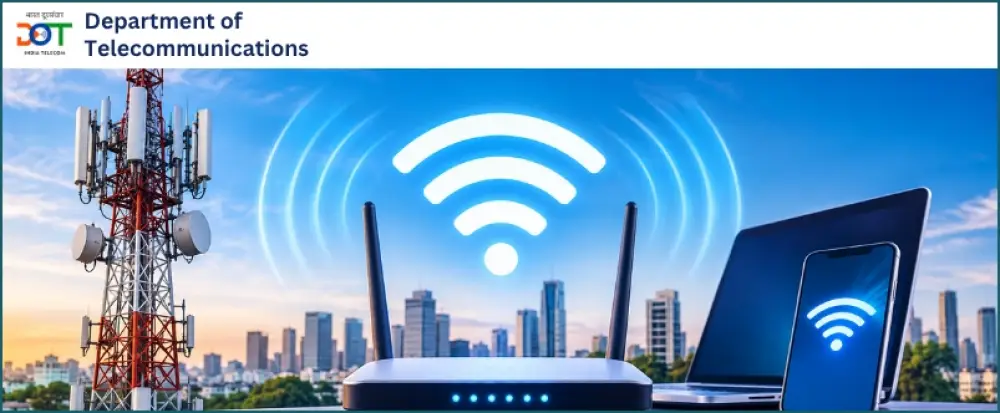
Telecom operators Reliance Jio, Bharti Airtel and Vodafone Idea have urged Department of Telecommunications (DoT) to permit high-power outdoor use of lower end of 6 GHz Wi-Fi band. These telcos argue that this change could help them to expand high-speed broadband access in areas where deploying fiber tends to be challenging or costly for the moment.
This request was made through Cellular Operators Association of India (COAI), which represents all of these telcos. The appeal comes amid concerns raised by Indian Space Research Organisation (ISRO) regarding potential interference that stronger outdoor Wi-Fi signals could cause to existing satellite operations.
Earlier this year, India opened the lower portion of 6 GHz band for license-free, low-power indoor use and very low power outdoor use so as to support next-generation Wi-Fi devices and enhance home broadband speeds.
The key issue now is whether government will allow for higher power outdoor transmissions, which operators believe would improve coverage without high costs associated with extending fiber networks. As of Tuesday evening, queries emailed to the DoT had not received a response by press time.
Case for Higher Power
Higher transmission power enables signals to travel longer distances, penetrate walls and other obstacles in a much more effective manner. They help to maintain stable connections even over larger areas. The government established an expert committee chaired by professors from IIT Madras to evaluate the proposal. This committee included representatives from telecom operators and ISRO.
The COAI had stated the committee recommended allowing for standard power outdoor use at 36 dBm in 5925–6425 MHz band. The industry body emphasized that this recommendation should be implemented on an immediate basis without any further delay in the process.
Director General of COAI, Mr. S.P. Kocchar, stated that, “India's broadband sector has progressed significantly, yet last-mile connectivity gaps persist particularly in rural, semi-urban, and difficult-to-reach areas due to Right-of-Way (RoW) challenges, limited fibre availability and high deployment costs.” He further stated that, “the Expert Committee's recommendation to permit Standard Power (36 dBm) outdoor use of the lower 6 GHz delicensed band (5925–6425 MHz) remains a practical and cost-effective solution to this challenge — one that is yet to be operationalised through the necessary regulatory notification.”
Mr. Kochhar further said, “Fixed Wireless Access and Point-to-Multi-Point deployments at Standard Power are suited for last-mile broadband delivery where fibre penetration is absent, economically unviable or physically impractical. Enabling outdoor Standard Power operations ensures this 500 MHz of valuable delicensed spectrum is fully harnessed in [service] of national objectives and can be utilized by all service providers.” He added, “Enabling these operations will ensure that India's delicensed spectrum serves not just indoor enterprise and [consumer] Wi-Fi but becomes a genuine engine of rural broadband penetration and digital inclusion.”
In July, Mint reported that DoT was facing a dilemma regarding approval of high-power usage for the band. ISRO had cautioned that high-power outdoor Wi-Fi transmissions could interfere with satellite operations. Reliance Jio has been advocating for government to permit higher-power outdoor use to enhance its home broadband services utilizing unlicensed-band radio (UBR).
These services operate on spectrum without requiring operators to pay any licensing fees or auction prices. In the month of November last year, Bharti Airtel announced that it was conducting experiments and trials with UBR so as to evaluate its potential for expansion into areas facing limited fiber coverage.
The Roadblock
The government will permit high-power use only if it can be guaranteed that existing users will not experience interference and that a solution to the issue is available. While operators contend that limiting the band to low-power indoor use would prevent much of its potential from being utilized, some experts have cautioned that allowing commercial services to operate at high power on license-free spectrum could compromise its intended purpose.
Independent telecom analyst Mr. Parag Kar warns that if telecom operators or commercial broadband providers begin using delicensed spectrum at high power levels, they could dominate that frequency band. This would diminish its usefulness for regular Wi-Fi users, households, businesses and smaller users. Kar, therefore, advises that high-power commercial broadband services or UBR-type offerings should preferably utilize licensed spectrum where interference management and accountability are more effectively regulated.
Earlier this year, India joined 96 other countries in allowing license-free use of lower portion of the 6 GHz band. This spectrum is essential for supporting high-speed Wi-Fi as well as certain devices such as Sony PlayStation 5 Pro, Apple's augmented and virtual reality devices and Meta Ray-Ban smart glasses.
Source:- MSN
Comments
No comments yet.
Leave a Comment