The Solid Waste Management Rules 2026 were formally notified by the Ministry of Environment, Forest and Climate Change on 28 January 2026. These rules were notified under the Environment (Protection) Act 1986. They came into full effect on 1 April 2026.
The Solid Waste Management Rules 2026 focus on efficient waste segregation and management. In this blog post, we shall discuss these rules in detail. We shall outline some of the key terms defined under these rules and also mention the key features of the rules.
Key Terms: Solid Waste Management Rules 2026
In the Solid Waste Management Rules 2026, many important terms are clearly defined, including the following terms:-
-
Biodegradable waste:- In the SWM rules 2026, biodegradable waste refers to any organic material that microorganisms can degrade into simpler stable compounds.
-
Brand owner:- Under the new rules, a brand owner is described as an individual or company selling any commodity under a registered brand label.
-
Combustible waste:- It means waste that is not biodegradable, recyclable, reusable or hazardous and has a minimum calorific value exceeding 1500 kcal/kg and does not include chlorinated materials.
-
Dry waste:- It means waste that is not wet waste, sanitary waste, special care waste. It includes recyclable waste and non-recyclable waste.
-
Horticultural waste:- It means plants-based waste from parks, gardens, traffic islands, road medians, etc. including grass and wood clippings, weeds, pruning, branches, twigs, wood chipping, straw or dead leaves, and tree trimmings, which cannot be accommodated in the daily collection system for wet waste.
-
Registered Environment Auditor:- It means Environment Auditor as defined under the Environment Audit Rules, 2025, as amended from time to time.
-
Sanitary waste:- Under solid waste management swm rules 2026, sanitary waste refers to waste comprising used diapers, sanitary towels/napkins, incontinence sheets and other similar wastes.
-
Special care waste:- It includes discarded paint drums, pesticide cans or containers or bottles, compact fluorescent lamp or bulbs, tube lights, expired medicines, broken mercury thermometers, waste batteries, used/waste needles and syringes and contaminated gauge, or any other waste notified by CPCB from time to time, generated at the household level.
-
Wet Waste:- Under SWM Rules 2026, wet waste refers to organic waste like kitchen waste, food waste, vegetable waste, meat waste, fruits waste, flower waste and such similar waste and biodegradable waste.
-
Bulk waste generator:- It means any entity that satisfies at least one of these conditions:
-
It has a building with a floor area of 20,000 square metres or more; or
-
It uses 40,000 litres of water per day; or
-
It produces 100 kilograms of solid waste per day.
Key Features of the SWM Rules 2026
The key features and provisions of SWM Rules of 2026 are as follows:-
-
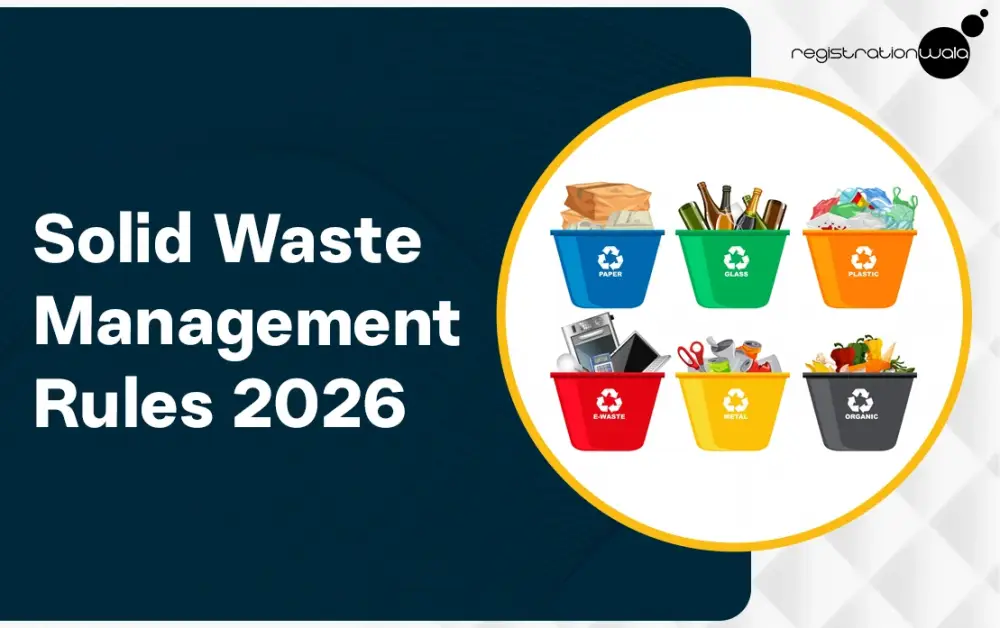
Under the rules, four-stream segregation of solid waste at source has become mandatory. As a result, waste is required to be segregated in wet waste, dry waste, sanitary waste and special care waste.
-
The new rules introduce the Extended Bulk Waste Generator Responsibility (EBWGR) framework. Under this framework, the bulk waste generators are accountable for the solid waste they have generated.
-
They are required to process wet waste on-site as far as possible. Where on-site processing is not attainable, they must obtain an EBWGR certificate. This framework seeks to improve waste management practices as the bulk waste generators account for around 30% of total solid waste generation.
-
Under the new rules, only non-usable, non-recyclable, non-biodegradable dry waste, non-combustible, non-energy recoverable dry waste, non-reactive inert waste, pre-processing rejects and residues from waste processing facilities, and residual waste can be disposed of in sanitary landfill. Wet waste and waste from building/demolishing activities cannot be disposed of in these landfills.
-
The State Government/Union Territories are responsible for identification of locations to create sanitary landfills on a regional and cluster basis. The local governments must carefully choose the qualified organizations for constructing, maintaining and operating such landfills.
-
All operators must register on a common online system, submit reports every quarter or year and run the landfills according to the CPCB guidelines.
-
To discourage poor waste management, higher charges are applied to unsegregated waste as well as recyclable and energy recoverable waste that is sent to landfills. These charges must be kept in a separate account. They must be used only for waste processing and infrastructure development.
-
All existing dump sites must be geographically mapped as well as assessed by October 2026. Local authorities must carry out biomining and bioremediation of legacy waste within a fixed timeline and submit quarterly progress reports via centralized portal.
Conclusion
The Solid Waste Management (SWM) Rules, 2026, replaced the Solid Waste Management Rules, 2016 on 1 April 2026. The new rules are aimed at modernizing waste handling via four-stream segregation of solid waste at source, which includes wet waste, dry waste, sanitary waste and special care waste. They have introduced a centralized digital portal to track waste streams nationwide. These rules are a major step towards solid waste management. They are anticipated to reduce landfill use, improve recycling and promote a circular economy.
If you need assistance in EPR registration or in ensuring EPR compliance, get in touch with our experts at Registrationwala.
Frequently Asked Questions (FAQs)
Q1. When did the SWM Rules 2026 come into effect?
A. The SWM Rules 2026 came into effect on 1 April 2026.
Q2. What is the full form of SWM Rules?
A. The SWM Rules full form is Solid Waste Management Rules.
Q3. What is ‘four stream segregation of solid waste at source’ under SWM 2026?
A. Four-stream segregation of solid waste at source is a mandatory process for all waste generations in India. Under this process, the waste is required to be segregated in wet waste, dry waste, sanitary waste and special care waste.
Q4. What is the EBWGR framework under the SWM 2026?
A. EBWGR full form is Extended Bulk Waste Generator Responsibility. It is a framework that makes large waste generators like housing societies, commercial complexes and institutions accountable for their waste.
Q5. Which rules did the SWM Rules of 2026 replace?
A. The Solid Waste Management Rules of 2026 replaced the Solid Waste Management Rules of 2016. The new rules became effective from 1 April 2026.
Q6. What are the examples of wet waste?
A. The examples of wet waste are organic waste like kitchen waste, food waste, vegetable waste, meat waste, fruits waste, flower waste and such similar waste and biodegradable waste.
Q7. Is wet waste biodegradable?
A. Yes, it is biodegradable. It consists of organic materials that naturally decompose into simple organic compounds by microorganisms.
Q8. Who is a bulk waste generator?
A. “bulk waste generator” means any entity that meets at least one of the following conditions:- (i) It has a building with a floor area of 20,000 square metres or more, (ii) It uses 40,000 litres of water daily or (iii) It produces 100 kilograms of solid waste daily.
Disclaimer :- This blog post is purely meant for educational purposes. While we have made every effort to provide our readers with accurate as well as complete information in this post, we cannot guarantee its full accuracy or completeness. Therefore, we suggest the readers verify with the official sources before making any decisions. Information in this content should not be interpreted as professional, academic, business, financial or legal advice at all.
-
Published: April 22, 2026
1554 Views