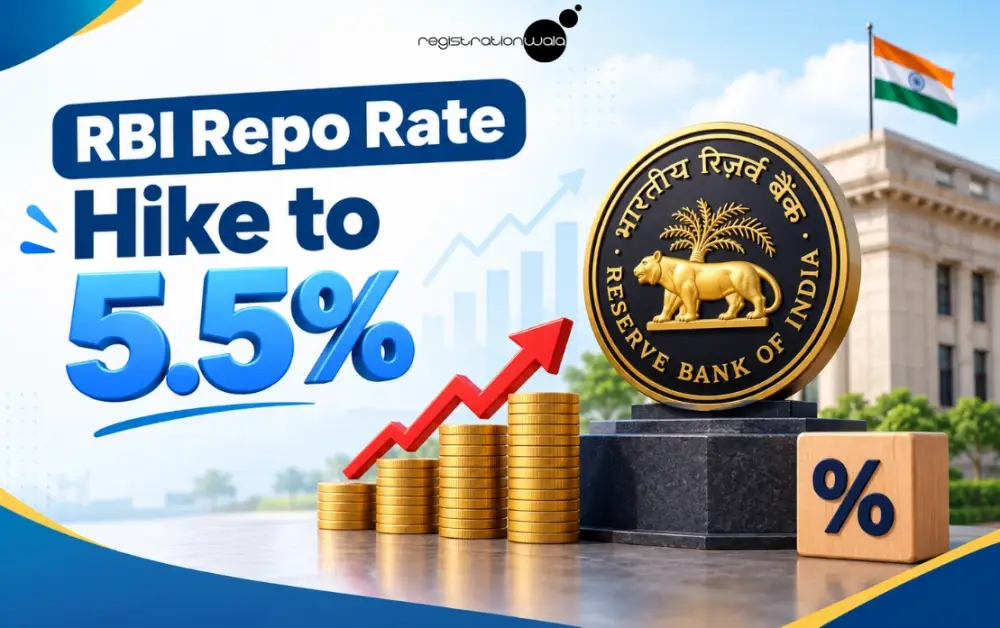
One of the most discussed topics in the banking and finance industry right now is the RBI’s decision to hike the repo rate. The Monetary Policy Committee (MPC), a statutory six-member body of the central bank, unanimously increased the repo rate by 25 basis points, from 5.25% to 5.50%. Headed by RBI Governor Sanjay Malhotra, the MPC announced the decision on 7 October 2026 with immediate effect.
This marks the RBI’s first rate hike since February 2023. In this blog post, we shall discuss why the RBI decided to raise the repo rate after 44 months and how the higher cost of capital affects MSME and business loans in FY27.
What is RBI Repo Rate?
RBI repo rate refers to the interest rate at which the central bank lends short-term money to commercial banks against government securities as collateral. When this rate increases, borrowing becomes more expensive for the banks.
So, to protect their profit margins, the banks raise their interest rates on retail and corporate loans for consumers and businesses, respectively. When the repo rate becomes lower, it results in cheaper borrowing and encourages consumption and investment.
RBI Repo Rates Trends in the Last Decade: Complete Date-Wise List
Here is a list of the RBI repo rate trends in the last ten years:-
|
Effective Date
|
Repo Rate (in %)
|
Change (Net Basis Points)
|
|
5 April 2016
|
6.50%
|
-0.25% (decrease from 29 September 2015, when the effective repo rate was 6.75%)
|
|
4 October 2016
|
6.25%
|
-0.25%
|
|
2 August 2017
|
6.00%
|
-0.25%
|
|
6 June 2018
|
6.25%
|
+0.25%
|
|
1 August 2018
|
6.50%
|
+0.25%
|
|
7 February 2019
|
6.25%
|
-0.25%
|
|
4 April 2019
|
6.00%
|
-0.25%
|
|
6 June 2019
|
5.75%
|
-0.25%
|
|
7 August 2019
|
5.40%
|
-0.35%
|
|
4 October 2019
|
5.15%
|
-0.25%
|
|
27 March 2020
|
4.40%
|
-0.75%
|
|
22 May 2020
|
4.00%
|
-0.40%
|
|
6 August 2020
|
4.00%
|
0.00%
|
|
9 October 2020
|
4.00%
|
0.00%
|
|
4 May 2022
|
4.40%
|
+0.40%
|
|
8 June 2022
|
4.90%
|
+0.50%
|
|
5 August 2022
|
5.40%
|
+0.50%
|
|
30 September 2022
|
5.90%
|
+0.50%
|
|
7 December 2022
|
6.25%
|
+0.35%
|
|
8 February 2023
|
6.50%
|
+0.25%
|
|
8 June 2023
|
6.50%
|
0.00%
|
|
9 October 2024
|
6.50%
|
0.00%
|
|
6 December 2024
|
6.50%
|
0.00%
|
|
7 February 2025
|
6.25%
|
-0.25%
|
|
9 April 2025
|
6.00%
|
-0.25%
|
|
6 June 2025
|
5.50%
|
-0.50%
|
|
6 August 2025
|
5.50%
|
0.00%
|
|
1 October 2025
|
5.50%
|
0.00%
|
|
5 December 2025
|
5.25%
|
-0.25%
|
|
6 February 2026
|
5.25%
|
0.00%
|
|
8 April 2026
|
5.25%
|
0.00%
|
|
5 June 2026
|
5.25%
|
0.00%
|
|
5 August 2026
|
5.25%
|
0.00%
|
|
7 October 2026
|
5.50%
|
+0.25%
|
Why Did RBI Raise Repo Rate?
The recent decision for RBI repo rate 5.5% has sparked questions regarding the rationale behind this hike after nearly four years. Well, the primary concern is the rising inflation outlook in India. This increase can be attributed in part to significantly higher crude oil prices driven by ongoing war in the Middle East and Strait of Hormuz blockade.
Since India relies heavily on imported crude oil. Therefore, continued spikes in oil prices can lead to higher costs for transportation, manufacturing and logistics across the entire economy. Food inflation also presents a risk. Weather-related disruptions and decreased agricultural yields can cause food prices to rise while geopolitical tensions may create volatility in energy and commodity prices.
On a positive note, India's economy has performed better than the expectations of many economists. The RBI's decision to raise its growth forecast for FY27 to 7.1% indicates that policymakers believe there is enough underlying strength in demand and economic activity to implement tighter monetary policy without risking a major slowdown in growth. This aspect makes the decision noteworthy: the RBI is now becoming more concerned about inflation even as its confidence in economic growth continues to strengthen.
How RBI Repo Rate Hike Affects MSME & Business Loans?
With the recent hike in repo rate by RBI, the bank customers must now pay higher interest rates for MSME and business loans that are linked directly to external benchmarks like the External Benchmark Lending Rates (EBLR) and Repo-Linked Lending Rates (RLLR).
From 8 October 2026 onwards, major lenders like Indian Overseas Bank, Bank of Baroda, Punjab National Bank, Tamilnad Mercantile Bank, etc., revised their repo-linked lending rates upwards by 0.25%. Therefore, for the MSMEs and businesses, the liquidity has been tightened and borrowing has become more expensive now.
RBI Calibrated Tightening Impact on Small Business Borrowing
By hiking the repo rate, the RBI changed its monetary policy stance from neutral to calibrated tightening. Here, calibrated tightening means that rate cuts are not in the central bank’s consideration in the near term. In the future, the rate will either increase further or pause, depending on how growth and inflation evolve in the country. Now, let’s understand the impact of RBI’s calibrated tightening on small business borrowing.
Small businesses and MSMEs often operate with limited capital, which means they frequently need to take out loans from banks to meet their funding needs. The shift to calibrated tightening directly raises the cost of credit for such businesses, tightens their working capital and signals that cheap or reduced borrowing options are not going to be available anytime soon.
In a country where small businesses and MSMEs are regarded as the backbone of the economy, rising borrowing costs can negatively affect their growth and day-to-day operations.
RLLR/EBLR Rate Revisions By Banks After RBI Repo Rate Hike
Shortly after the RBI repo rate witnessed a hike, several lenders adjusted their External Benchmark Lending Rates (EBLR) and Repo-Linked Lending Rates (RLLR) for MSME & business loans. The table below provides the revisions by leading banks after the RBI rate hike announcement:
|
S. No.
|
Name of Bank
|
Previous Rate (in %)
|
Revised Repo-Linked Rate (EBLR/RLLR) (in %)
|
Net Basis Points Increase
|
|
1.
|
Bank of India
|
8.10%
|
8.35%
|
+25 bps
|
|
2.
|
Punjab National Bank
|
8.10%
|
8.35%
|
+25 bps
|
|
3.
|
Indian Overseas Bank
|
8.10%
|
8.35%
|
+25 bps
|
|
4.
|
Indian Bank
|
7.95%
|
8.20%
|
+25 bps
|
|
5
|
Bank of Baroda
|
7.90%
|
8.15%
|
+25 bps
|
|
6.
|
Karur Vysya Bank
|
8.55%
|
8.80%
|
+25 bps
|
|
7.
|
Tamilnad Mercantile Bank
|
8.25%
|
8.50%
|
+25 bps
|
Here are the Key Takeaways….
-
The revised repo rate currently stands at 5.50%, which is a 0.25% increase from the earlier 5.25% rate.
-
Calibrated tightening is a monetary policy approach currently being adopted by the RBI. This approach aims to control inflation as well as maintain economic stability.
-
Due to the shift in stance to calibrated tightening, a decrease in the repo rate anytime in the near future is off the table for the RBI.
-
Higher interest rates have increased borrowing costs for individuals, small businesses and MSMEs. They have made loans more expensive.
-
Due to higher borrowing costs, small businesses and MSMEs may now find it more difficult to manage their working capital and meet their funding needs.
-
Banks might become more cautious while approving loans for small businesses and MSMEs.
-
While calibrated tightening can be useful for curbing inflation, it may slow down borrowing and business expansion.
-
The overall impact hinges on the duration of the tighter monetary policy and the responses of businesses and banks to evolving economic conditions and inflation.
Frequently Asked Questions (FAQs)
Q1. What is the RBI rate hike impact on business loans?
A. The interest rates for the business loans linked to the repo rate have increased due to the hike by the RBI.
Q2. Has there be an increase in cost of capital for MSMEs FY27?
A. Yes. The cost of capital for MSMEs FY27 are experiencing an increase due to a 25-basis-point hike in RBI repo rate to 5.50%. The decision to increase the rate was taken by the MPC on 7 October with immediate effect.
Q3. What is the working capital loan interest rate after repo rate hike?
A. There is no single fixed interest rate for working capital loans as rates vary across businesses. However, loans linked to external benchmarks such as the repo rate (EBLR/RLLR) are facing an increase in interest rate by 0.25 percentage points.
Q4. Fixed vs floating rate business loans post RBI rate hike: Which one is better for the borrowers?
A. After the RBI’s 0.25 percentage point rate hike, businesses with floating-rate loans linked to the repo rate are facing higher borrowing costs. They now have to pay higher EMIs or face extended loan tenures. However, those with fixed-rate loans continue to benefit from predictable EMIs.
Q5. Is there an increase in the interest rates for the external benchmark lending rate EBLR business loans?
A. Yes. After the RBI’s repo rate hike from 5.25% to 5.50%, there has been a increase in the interest rates for the external benchmark lending rate (EBLR) business loans.
Q6. Will RBI cut down the repo rate anytime soon?
A. No. The RBI has shifted its stance to calibrated tightening. This meas that the repo rate will either increase or be paused, depending on inflation and economic conditions. Lowering the repo rate is currently not under consideration.
Q7. Will my FD interest increase after the hike in repo rate by RBI?
A. No. Your FD will continue to provide the same, fixed interest rate till it reaches maturity. The recent hike in repo rate by RBI does not affect the rate of your current FD.
Q8. What is Calibrated Tightening?
A. It is a monetary policy approach currently followed by the RBI to control inflation. It means that interest rate cuts are not being considered in the near future and future decisions are limited to either raising rates or keeping them unchanged. However, there is no expectation of rate cuts anytime soon.
Q9. What are External Benchmark Lending Rates (EBLR) and Repo-Linked Lending Rates (RLLR)?
A. EBLR is a system in which banks link floating loan interest rates to an external benchmark, such as the RBI Repo Rate or Treasury Bill rate so as to ensure complete transparency in pricing and allow for faster transmission of RBI policy changes. RLLR is a specific type of EBLR directly linked to the RBI Repo Rate, so loan interest rates change whenever the Repo Rate changes.
Q10. What is the Monetary Policy Committee?
A. Monetary Policy Committee is a statutory body operating under the RBI. It consists of 6 members, out of which 3 are RBI members and remaining 3 are government-appointed external experts. This committee is responsible for deciding the repo rates in India.
|
Disclaimer:- The information provided in this write-up is for general informational purposes only. It is based on the developments and analysis by the author. Loan interest rates, borrowing costs and lending terms may vary by bank and borrower, and change in future. Therefore, readers should confirm latest rates as well as applicable terms directly with their respective lenders.
|
-
Published: October 13, 2026
109 Views