On 13 January 2026, the Reserve Bank of India (RBI) notified Foreign Exchange Management (Export and Import of Goods and Services) Regulations, 2026. These regulations, which are a part of FEMA, 1999, came into effect quite recently on 1 October 2026. Under these RBI regulations, filing EDF declaration form with an Authorised Dealer (AD) Bank is mandatory for exporters of goods and services who are required to declare their commercial export transactions.
The RBI has clarified that the EDF filing requirement applies to commercial export transactions only and that it excludes transactions undertaken for personal purposes. If you are wondering how to file EDF declaration with your AD Bank, we recommend you to check out this comprehensive guide!
What is AD Bank?
AD Bank full form is Authorised Dealer Bank. It is officially known as the Authorised Dealer Category-I Bank. It refers to a bank authorised by the Reserve Bank of India (RBI) to deal in foreign exchange and cross-border transactions in accordance with Foreign Exchange Management Act (FEMA), 1999.
Such a bank can handle all permissible current and capital account foreign exchange transactions like trade payments, FDI reporting and outward/inward remittances to name a few. Whether you run an import or export business, opening a bank account with an AD Bank is necessary to ensure compliance with FEMA, RBI regulations and foreign trade policy.
What is the Due Date for Filing EDF with an AD Bank?
Recently, the RBI made filing EDF form mandatory for commercial export transactions. This form is required to be filed with the AD Banks within 30 days from the end of the month in which the invoice was raised
For example, if you raise an invoice on 9 October 2026, then the end of month is 31 October 2026. So, in this case, you will need to file EDF on 30 November 2026, i.e., within 30 days of 31 October 2026.
| S. No. |
Date When the Invoice was Raised |
Month End |
Due Date for Filing EDF with AD bank |
| 1. |
October 2026 (Any Date) |
31 October 2026 |
30 November 2026 |
| 2. |
November 2026 (Any Date) |
30 November 2026 |
30 December 2026 |
| 3. |
December 2026 (Any Date) |
31 December 2026 |
30 January 2027 |
| 4. |
January 2027 (Any Date) |
31 January 2027 |
2 March 2027 |
How to Submit EDF Declaration with AD Bank Online?
To submit an EDF Declaration with your AD-I Bank, you generally need to follow the steps given below. However, the process may vary a bit depending on the specific bank.
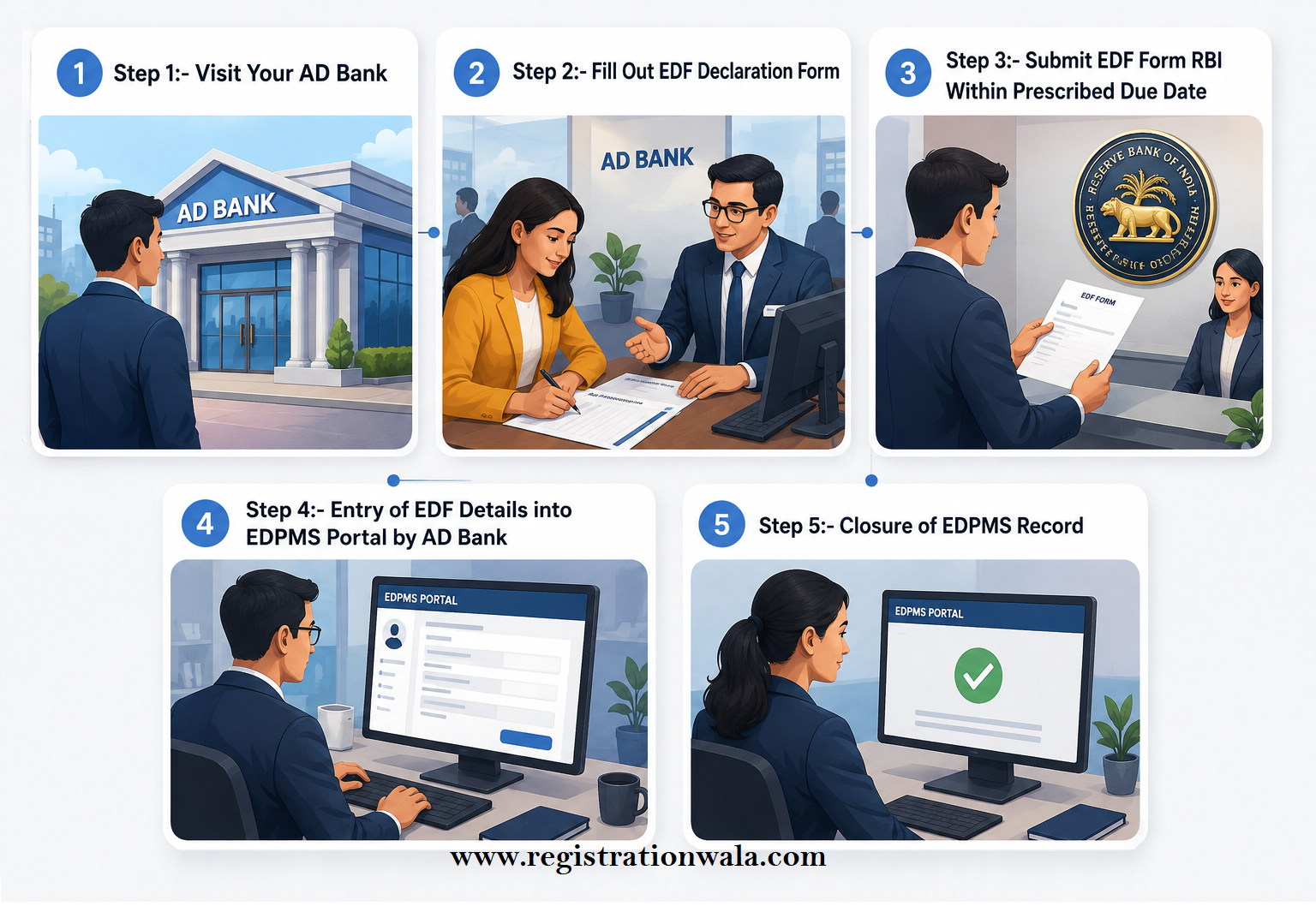
Step 1:- Visit Your AD Bank
As the first step, you need to visit or contact your AD Bank’s nearest branch. You must then ask the bank whether your transactions are eligible for EDF filing. If the bank confirms your eligibility, then you must ask for EDF declaration form’s submission method, format and documents required for EDF form.
Step 2:- Fill Out EDF Declaration Form
Begin filling out EDF with all the necessary details. Important details include Exporters Name and Address, PAN, GSTIN, IEC, Customs Security No., Invoice Number, Invoice Date and AD code among others. Make sure you enter all the required details correctly. Also, attach all the required documents along with the form.
If you feel confused and get stuck while filling out the form’s details, you can ask your AD bank for assistance. Alternatively, you can approach an experienced FEMA consultant for assistance.
Step 3:- Submit EDF Form RBI Within Prescribed Due Date
Once you have filled out RBI form EDF, you need to submit it with your AD Bank using the prescribed method. Make sure to submit this form within the prescribed due date, i.e., within 30 days from the end of the month in which the invoice was raised.
Step 4:- Entry of EDF Details into EDPMS Portal by AD Bank
Once your Authorised Dealer Bank receives your form, it shall upload and log your Export Declaration Form’s details in EDPMS (Export Data Processing and Monitoring System) portal of the Reserve Bank of India. This step usually takes 5 working days to complete.
Step 5:- Closure of EDPMS Record
Once your foreign payment is received, your AD bank will record and reconcile the inward remittance against the logged EDPMS entry. After realisation of the full value, the bank will finally move to close the EDPMS record.
Once all the above-mentioned steps are completed, your EDF filing process will have crossed the finish line. Make sure to fill in all the details correctly and file the form within the prescribed time to avoid unnecessary delays from your end.
To Conclude…
To ensure compliance with FEMA, RBI regulations and foreign direct policy, filing EDF form is necessary for exporters dealing in commercial export transactions. This form needs to be filed with the AD-I Bank. It does not need to be filed directly with the RBI. Once your AD Bank receives your EDF form RBI, it will move ahead to log and enter your EDF details into the EDPMS portal of the RBI.
Need assistance in ensuring compliance with FEMA, RBI guidelines and the foreign direct policy of the Indian government? Get in touch with our consultants at Registrationwala for full-fledged professional assistance.
Frequently Asked Questions (FAQs)
Q1. What are the examples of AD Banks in India?
A. Examples of AD Banks in India include State Bank of India, Punjab National Bank, Bank of India, HDFC Bank, Axis Bank and Kotak Mahindra Bank. All of these banks are authorised by the Central Bank to deal in foreign exchange and cross-border transactions.
Q2. What is the due date for EDF filing?
A. The due date for filing this form is within 30 days from the end of the month in which the invoice was raised.
Q3. Do I need to file EDF directly with the RBI?
A. No. You need to file EDF with an Authorised Dealer Category-I Bank, not directly with the RBI. Once the AD Bank receives your EDF form, it will then log and enter your EDF details into the RBI EDPMS portal.
Q4. What is Authorised Dealer Category-I Bank?
A. It refers to an RBI-authorised commercial bank that handles all the permissible current and capital account foreign exchange transactions like trade payments, FDI reporting and outward/inward remittances.
Q5. Are freelancers exempt from filing EDF?
A. No. EDF form needs to be filed by freelancers operating businesses for offering commercial export services. However, for transactions of personal nature, filing this form is not required.
Q6. Do I need to file EDF for transactions of personal nature?
A. No. RBI has clarified that you do not have to file the EDF form for transactions of a personal nature. This includes transactions like paying for digital apps, online magazines, online tutoring or small software/freelance work (non-commercial export services) done as an individual.
Q7. Are the importers required to file EDF declaration form?
A. No. This form is meant for exporters who need to declare the full export value of their commercial export transactions under FEMA 1999. It is not meant for the importers.
Q8. When did the RBI notify the Foreign Exchange Management (Export and Import of Goods and Services) Regulations, 2026?
A. The RBI notified Foreign Exchange Management (Export and Import of Goods and Services) Regulations, 2026 on 13 January 2026.
Q9. When did the FEMA Export and Import Regulations 2026 come into force?
A. The FEMA Export and Import Regulations 2026 came into effect from 1 October 2026 onwards.
Disclaimer:- This blog post is intended for general informational purposes only. Readers should not rely on it as the sole basis for making any financial, investment or business decisions. As rules and regulations may change over time, we advise our readers to check the official RBI website or consult a qualified RBI consultant for learning about the latest updates.
-
Published: October 12, 2026
121 Views