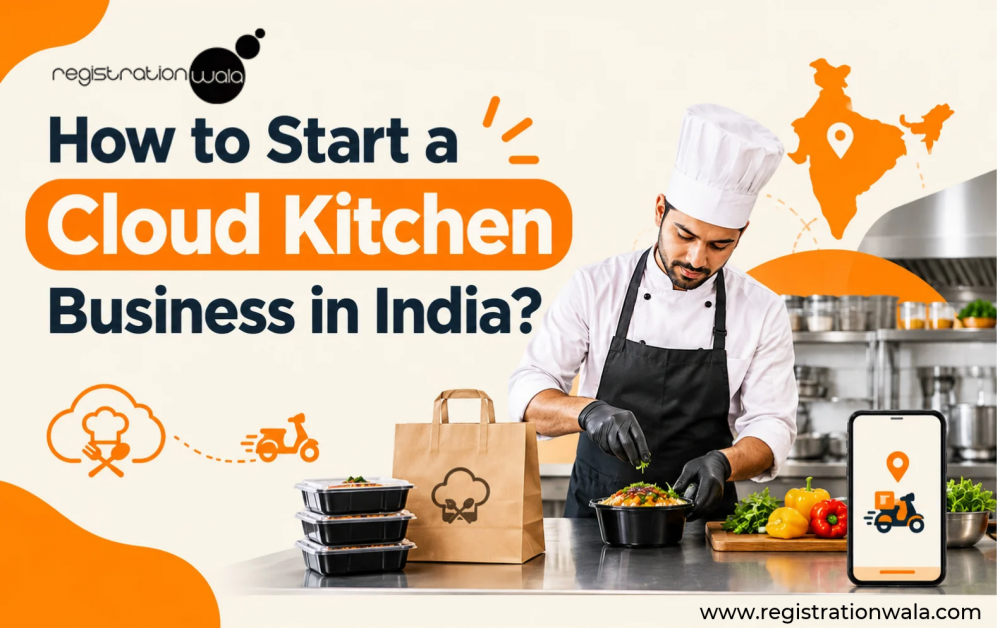
Starting a cloud kitchen is becoming a popular food business idea among those who want to start their own food business but have a very limited budget. Cloud kitchens operate as food businesses that do not have a physical location like traditional restaurants do. Instead, they rely heavily on technology to provide food to customers. Swiggy and Zomato are two of the most popular online food ordering and delivery platforms in India. Many cloud kitchen businesses are registering on these platforms to reach their customers effectively.
These food delivery platforms handle the pickup of food packages from the kitchen and deliver them directly to the customers. Their service is quick, efficient and budget-friendly. That’s why the concept of cloud kitchens is become increasingly trendy among entrepreneurs. If you're considering starting a cloud kitchen business, this article will guide you on how to get started.
What is Cloud Kitchen?
Cloud kitchen meaning can be explained as a space where a food business can operate a business without any pressure of high rent and customer service. It operates on technology and relies heavily on online marketing to grow its customer base. The cloud kitchen is also known as a ghost kitchen or a virtual kitchen.
The Indian cloud kitchen market is valued at approximately USD 1.13 billion to USD 1.3 billion. This value is projected to grow further with time, with estimates indicating it could reach between USD 2.84 billion and USD 4.4 billion by 2030-2032.
How Does Cloud Kitchen Work?
A cloud kitchen serves as a delivery-only restaurant without physical dine-in space for the customers, unlike cafes and restaurants. It prepares food in a commercial kitchen or even home kitchen at times. It relies on online orders through food delivery apps or its own website to earn profits.
List of Top 10 Cloud Kitchens in India
Here is a list of some of the best cloud kitchens in India:-
|
S. No.
|
Name of Cloud Kitchen
|
Year of Establishment
|
Founder
|
|
1.
|
Ghost Kitchens India
|
2019
|
Karan Tanna
|
|
2.
|
Cure Foods
|
2020
|
Ankit Nagori
|
|
3.
|
FreshMenu
|
2014
|
Rashmi Daga
|
|
4.
|
Travelkhana
|
2009
|
Pushpinder Singh
|
|
5.
|
Rebel Foods
|
2010
|
Jaydeep Barman and Kallol Banerjee
|
|
6.
|
Box 8
|
2012
|
Anshul Gupta and Amit Raj
|
|
7.
|
Hoi Food
|
2017
|
Indrajeet Kumar and Pawan Raj Kumar
|
|
8.
|
EatFit
|
2020
|
Ankit Nagori
|
|
9.
|
KaatiZone
|
2004
|
Kiran Nadkarni
|
|
10.
|
WarmOven
|
2019
|
Gautam Balijepalli, Mahesh Mahabaleshwara Madiyala, Sumit Gupta, and Rohankumar Chandrakantha Rao
|
What are the Benefits of Cloud Kitchen?
Digital technology makes the process of selecting a food item and placing an order easy. Individuals who don’t want to step outside their house, hostel or office just to get food often order food items through cloud kitchens using online food delivery apps. Many customers now prefer online options over offline ones.
So, the growth prospects of these businesses in the future are higher, especially when they are located in close proximity to student areas, work hubs, hospitals or any place that sees high traffic. Below are some benefits of cloud kitchens:
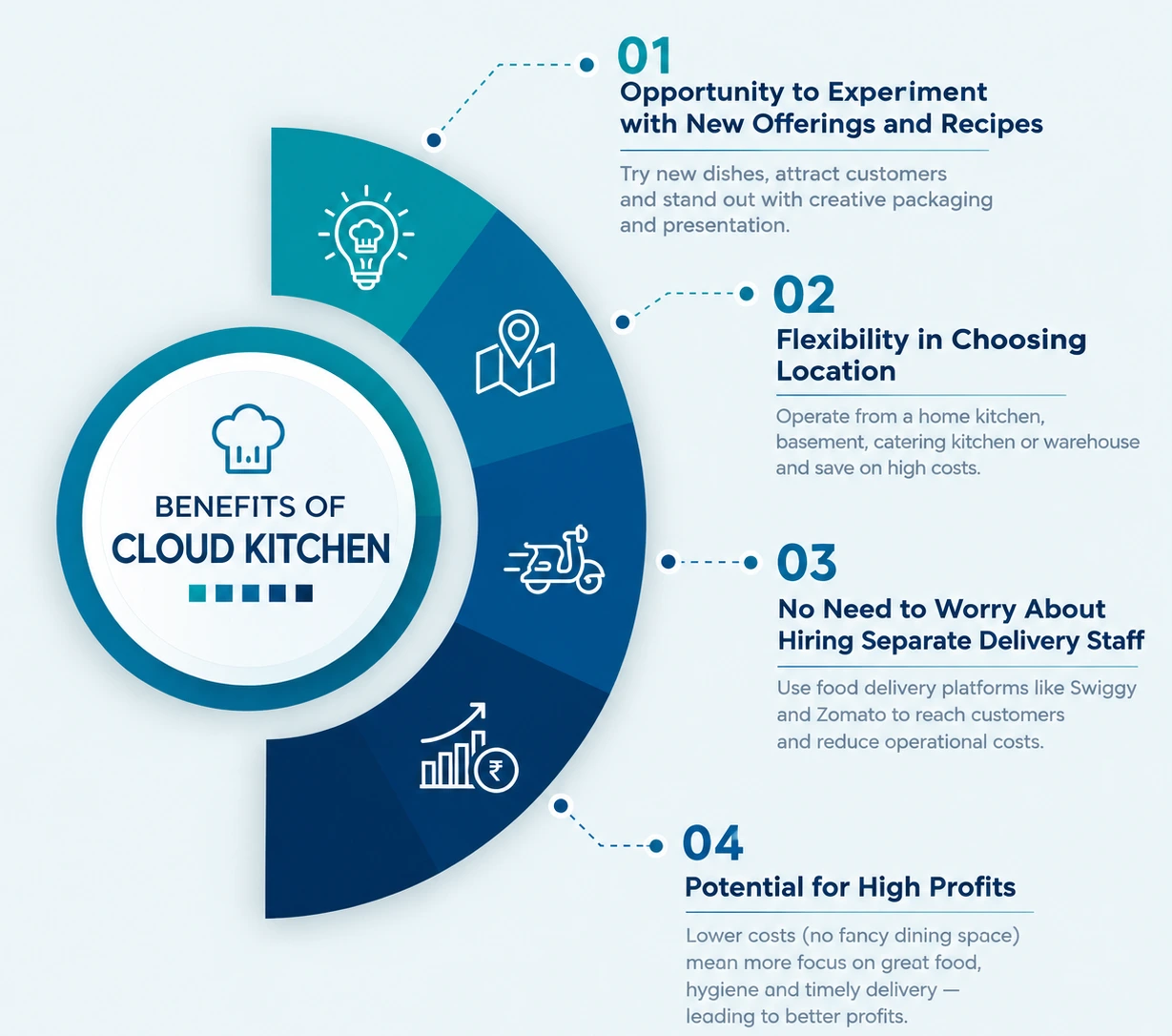
1. Opportunity to Experiment with New Offerings and Recipes
A cloud kitchen allows business owners to experiment with new dishes and recipes without the high costs of running a traditional restaurant. Introducing different food options can attract customers while appealing presentation and creative packaging can make dishes more attractive especially on social media platforms.
For example, Pot Pot is an Indian cloud kitchen business that delivers food in eco-friendly pots, which it claims can be easily recycled and upcycled.
2. Flexibility in Choosing Location
One of the major expenses when starting a food business is associated with choosing the right location for business. Purchasing land or renting a restaurant in a popular location can require a significant investment. In contrast, a cloud kitchen can operate from a suitable space such as a home kitchen, basement, catering kitchen or warehouse.
This flexibility can certainly be helpful for entrepreneurs as it allows them to reduce their initial investment and start a food business even with a very limited budget.
3. No Need to Worry About Hiring Separate Delivery Staff
Cloud kitchens often register on food delivery platforms like Swiggy and Zomato. These platforms help deliver food to customers. Hence, the business owners do not need to hire separate delivery staff. This helps reduce operational costs associated with employing delivery boys and makes it a lot easier to manage the business.
4. Potential for High Profits
Running restaurants can be expensive, especially those set up in premium locations. A lot of money goes into rent, interiors, furniture and maintaining the overall look of place. In a cloud kitchen, these expenses are much lower because there is no need for a fancy dining space.
The main focus is majorly on good food, hygiene and timely delivery for such a business. This helps reduce costs and gives cloud kitchens a better chance of making higher profits.
Requirement of FSSAI License for Cloud Kitchen
The FSSAI license is a legal requirement for all the food businesses in India, be it a restaurant, café, food stall or cloud kitchen. Applying for and securing an FSSAI licence for cloud kitchen ensures that your business complies with the food safety and quality standards set forth by the FSSAI.
By obtaining the FSSAI licence and following the prescribed food safety practices, you can ensure regulatory compliance and help reduce the risk of foodborne illnesses and customer complaints pertaining to food quality.
It is important to note that the FSSAI registration for cloud kitchen must be obtained before commencing business operations, not afterwards. Unless you have this license, you cannot start accepting food orders from customers.
How to Start a Cloud Kitchen in India: Detailed Step-by-Step Procedure
Below, we have detailed the cloud kitchen registration process in India in a simple and easy manner. Once you go through all the mentioned steps, you will have a clear understanding about how to open a cloud kitchen in India:-
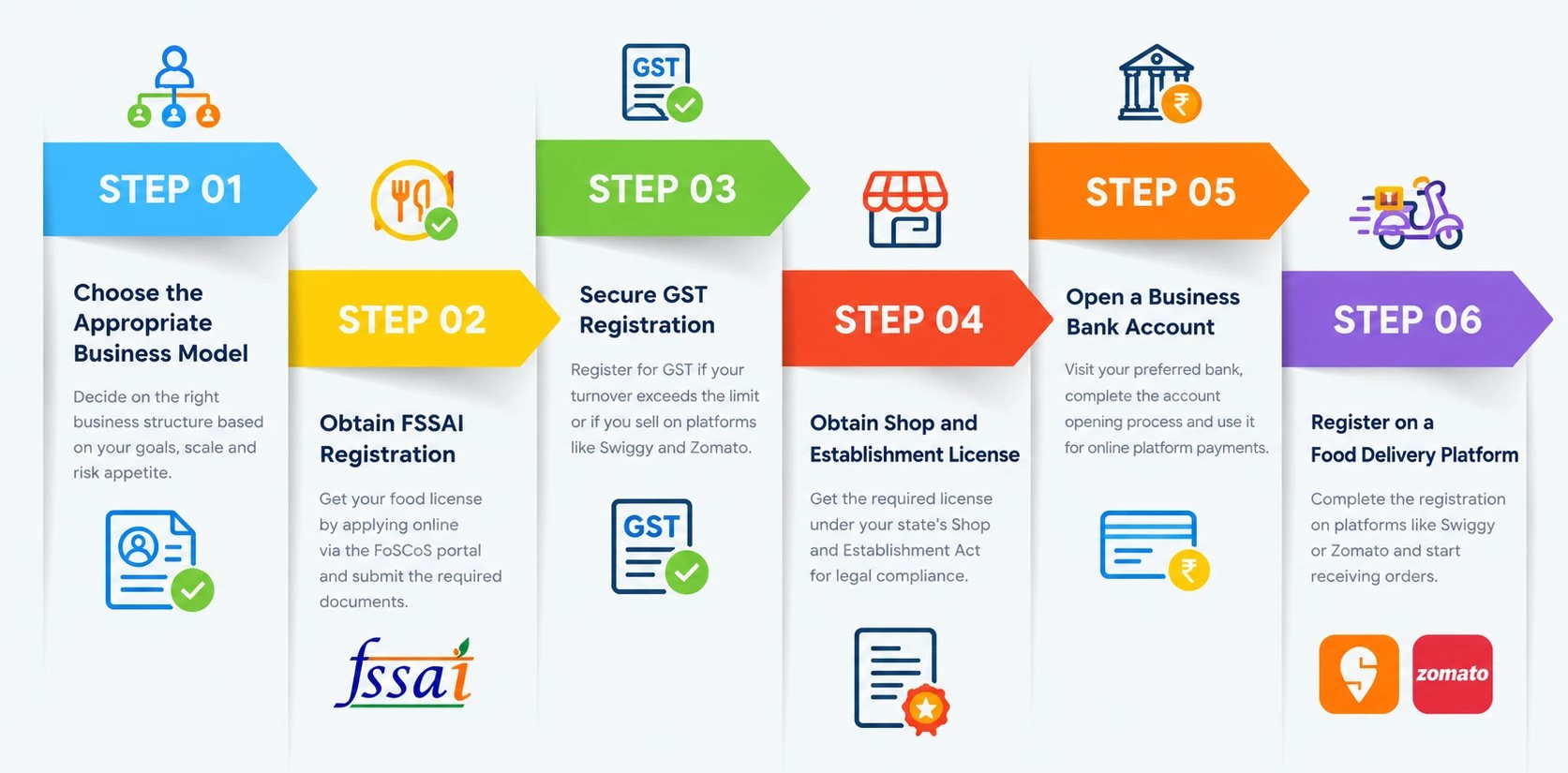
Step 1:- Choose the Appropriate Business Model
Since a cloud kitchen is a business, you need to decide the model for this business. There are a ton of options to choose from based on your needs. If you plan on running the business alone at a small scale, you can opt for sole proprietorship. This business model requires no formal business registration. However, in such a model, the liabilities and debts of the business are unlimited and the proprietor is directly responsible for them.
That said, they get to enjoy all the profits. In case you plan to start the business with one or more individuals without mandatory formal business registration, you can opt for partnership firm model instead. However, in this model too, the liabilities and debts of the business are unlimited and the partners are responsible for them based on the principles of joint and several liability.
In this model, the profits are split between the partners according to the ratio agreed upon. If you want to be the sole business owner but want to enjoy the benefit of limited liability protection, you can go for one person company (OPC) model instead of a sole proprietorship. However, this model requires formal company registration process with RoC. Similarly, if you want to operate the business with other individuals but want to enjoy the limited liability protection benefit, you can go for limited liability partnership business structure instead of a traditional partnership firm (LLP).
LLP requires formal business registration with RoC. Apart from the models explained already, there is another popular business structure known as a private limited company. It is ideal for businesses that plan to expand, raise funds or bring in investors while enjoying limited liability protection.
This structure is also suitable for businesses owned by multiple individuals, including family members, who want to operate under a formal corporate structure. A private limited company also requires formal registration with the RoC, just like LLPs and OPCs.
Step 2:- Obtain FSSAI Registration
FSSAI registration is required by all the food business operators in India. To secure this registration, you need to file an application online via FoSCoS portal. While filing the application, all the required information needs to be filled out correctly. Additionally, all the necessary documents need to be submitted along with the application.
Documents Required for FSSAI Registration
Some of the most crucial documents required during FSSAI application process are listed below:-
-
Authorized person address proof
-
Passport size photo
-
Business name and address
-
FSSAI declaration form
-
Nature of business details
-
Rental Agreement of Business Premises.
-
ID Proof of the Concerned Person (Aadhaar Card / Driving License / Passport / Voter ID)
-
Government Registration Certificates such as GST registration, or company registration (if have any)
-
MoA & AoA or partnership deed copy (in case of a Pvt Ltd. company)
-
Trade license, Shop and Establishment Registration, Panchayath License, Corporation License, Municipality License (any one is compulsory)
-
Other documents required by FSSAI
While filing the FSSAI cloud kitchen license application online, you need to pay the prescribed fee as well. If you need assistance in obtaining the FSSAI food license for cloud kitchen smoothly without any hassle, you can connect with our consultants at Registrationwala.
Step 3:- Secure GST Registration
Obtaining the FSSAI registration is certainly important. However, it’s not the only registration required for a cloud kitchen business. Such a business also requires GST registration if its annual turnover increases Rs. 20 lakhs (or Rs. 10 lakhs in special category states). However, if such a business wants to sell its food through e-commerce platforms like Swiggy and Zomato, it must obtain the GST registration regardless of its annual turnover.
To apply for the registration, the applicant needs to file an online application via the official GST portal. For assistance in the process, you can connect with our GST consultants at Registrationwala.
Step 4:- Obtain Shop and Establishment License
A cloud kitchen business is also required to obtain the Shop and Establishment license to ensure compliance with the local laws. This license is one of the most important licenses required for cloud kitchen. It is issued under the Shop and Establishment Act, which differs from the state to state. So, the exact requirements for obtaining this license vary from one state to another.
In Delhi, the Labour Department, operating under the Government of National Capital Territory of Delhi, issues the shop and establishment license under the Delhi Shops and Establishments Act, 1954. If you need assistance in obtaining this license, you can get in touch with our consultants.
Step 5:- Open a Business Bank Account
The main reason behind opening a cloud kitchen is usually to make money. To receive this money, you need a bank account, preferably a business bank account. For this, visit the branch of a bank of your choice, such as Axis Bank, HDFC Bank SBI or any other bank.
Then, fill out the bank account opening form with necessary details and then submit it at the counter. Once your bank account is successfully opened, you must provide the account details when registering your cloud kitchen on e-commerce platforms like Swiggy or Zomato.
Step 6:- Register on a Food Delivery Platform
The cloud kitchen must register on a food delivery platform like Swiggy, Zomato or other similar platforms. To complete the registration, the required details and documents may vary from one platform to another.
Once registered, the cloud kitchen can start accepting orders, preparing and packaging food. Then, delivery partners will pick up the orders and deliver them to the customers’ doorsteps.
In a Nutshell
Cloud businesses are a relatively new concept compared to many other businesses, and numerous entrepreneurs are opting for them to drive growth and profit. Additionally, the advantages of cloud kitchens over traditional restaurants make it easier for entrepreneurs to establish such businesses and achieve sustainability.
If you're looking for professional assistance in starting a cloud kitchen, you can reach out to our consultants at Registrationwala. We will guide you through the entire process of applying for and obtaining FSSAI license for cloud kitchen.
Frequently Asked Questions (FAQs)
Q1. Can we start cloud kitchen from home in India?
A. Yes, you can start a cloud kitchen from home as long as you comply with all the legal cloud kitchen requirements in India.
Q2. Is cloud kitchen profitable?
A. Yes, a cloud kitchen can be a profitable business venture if you can manage costs, promote your business, offer high quality food and hygiene. Make sure you have a proper game plan before establishing a cloud kitchen.
Q3. Is GST required for cloud kitchen?
A. Yes, a cloud kitchen requires GST registration if its annual turnover exceeds Rs. 20 lakhs (Rs. 10 lakhs in special category states) or if it sells food through Swiggy, Zomato or other e-commerce platforms.
Q4. Can I apply for FSSAI license after commencing food business operations?
A. No. You must apply for this license prior to commencing food business operations.
Q5. What is cloud kitchen license cost?
A. The cost of cloud kitchen license issued by the FSSAI depends on the annual turnover and scale of operations of the business.
Q6. Can we start cloud kitchen without a FSSAI license?
A. No. You cannot start a cloud kitchen without obtaining the FSSAI license. Every food business operator in India requires this license.
Disclaimer:- This article is intended for general information only. It should not be construed as legal, financial or business advice.
-
Published: October 23, 2026
44 Views