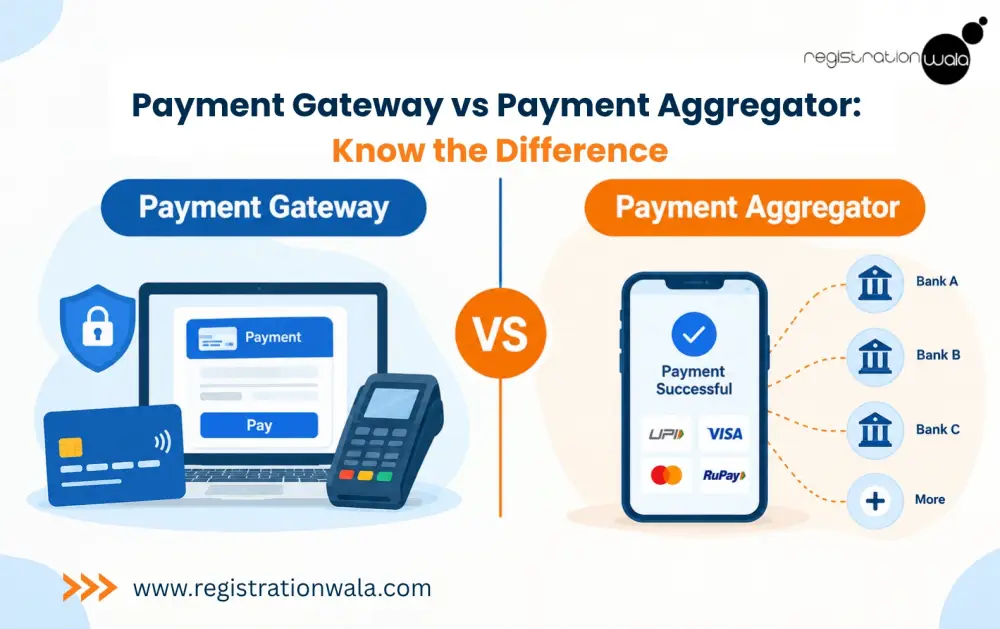
India accounts for around half of world’s real-time digital payment transactions, which highlights the growing importance of digital payments in the country. Behind these transactions, payment gateways and payment aggregators play an important role in making digital payments a possibility. Payment gateway refers to a technology that allows for secure transfer of transaction information between customer, merchant and banks involved in a payment.
A payment aggregator, on the other hand, is a third-party service provider that helps merchants accept payments through different payment methods and manages entire payment process, from collection to settlement of funds.
From this introduction alone, you should have a fair idea of how the payment gateway and aggregator differ from each other. But that’s not all. There are several other differences between them that are worth learning about. In this blog, we will discuss main differences between payment gateway and payment aggregator in detail.
Payment Gateway vs Payment Aggregator: Differences (Table)
The difference between payment gateway and aggregator can be easily understood once you go through the table given below:-
|
Difference
|
Payment Gateway
|
Payment Aggregator
|
|
Definition
|
A Payment Gateway is a secure digital technology that lets merchants accept, authorize and process online transactions.
It allows them to collect payments through credit cards, debit cards, UPI, net banking and digital wallets all through a single integration.
|
Payment Aggregator refers to a third-party service provider that lets merchants accept customer payments easily through digital channels like UPI, credit/debit cards, net banking, e-wallets and EMI options.
The aggregators eliminate the requirement to set up a separate merchant bank account with an acquiring bank.
|
|
Authorisation
|
No specific Reserve Bank of India (RBI) license is required for payment gateways.
However, they must adhere to the Reserve Bank of India’s ‘Guidelines on Managing Risks and Code of Conduct in Outsourcing of Financial Services by banks’ notification.
|
To function as an aggregator, obtaining the payment aggregator license from the RBI is mandatory.
However, banks do not require this license separately as they are already directly regulated by the Central Bank.
|
|
Requirement for Integration
|
Requires separate integration with each payment method/bank.
|
Requires integration with a single service provider only.
|
|
Onboarding Speed
|
The onboarding speed is generally moderate. The process requires bank underwriting.
|
The speed is fast. It usually takes just a few days to complete.
|
|
Examples
|
Popular examples of Payment Gateways in India are:
-
Mastercard Payment Gateway Services (MPGS)
-
HDFC Bank Payment Gateway
-
ICICI Bank Payment Gateway
-
CCAvenue
-
Cybersource
|
Popular examples of Payment Aggregators in India are:
-
PhonePe
-
PayU
-
Cashfree
-
Razorpay
-
BillDesk
|
What is a Payment Gateway?
The meaning of Payment Gateway can be explained as a digital service that securely sends payment information between the customer, merchant and bank. It encrypts and transfers payment details, receives the payment status and sends the result back to the merchant.
Unlike a payment aggregator, a payments gateway usually requires the merchant to have their own merchant account with an acquiring bank. The bank checks the merchant’s business and requires them to complete KYC process before finally approving the account.
This process can take a few days or a few weeks. However, it gives them more control over pricing, settlement times and their relationship with the bank. As their business grows with time, they may also be able to negotiate better rates and settlement terms with the bank.
What is a Payment Aggregator?
The meaning of Payment Aggregator can be explained as a third party service provider that allows multiple merchants to accept payments from customers through a single platform. Instead of setting up a separate merchant account with a bank, which can involve a lot of paperwork and a longer approval process, the merchant can register with an aggregator and start accepting payments within just a few working days in most cases.
In India, PayU, PhonePe and Razorpay work as RBI-authorized payment aggregators. American payments player Stripe provides similar services in many countries. When a customer makes a payment, the money gets collected by the payments aggregator.
After that, the aggregator deducts the applicable fees and the remaining amount gets transferred to the merchant’s bank account. It usually takes one or two working days to complete this whole process, depending on the settlement terms.
To Conclude…
In India, both the payment gateways and payment aggregators are regulated by the Reserve Bank of India (RBI) but their roles are totally different from each other. On one hand, a payment gateway securely transfers payment information between the customer, merchant and bank.
It generally does not handle the funds and does not require securing the RBI authorisation as a payments aggregator. On the other hand, a payments aggregator collects payments on behalf of merchants and then transfers the funds to them upon deduction of applicable fees.
Need help in obtaining a payment aggregator license or ensuring compliance with RBI regulations for payment gateways? Get in touch with our RBI compliance consultants at Registrationwala for assistance!
Free RBI Compliance Consultation
Frequently Asked Questions (FAQs)
Q1. Is Razorpay a payment gateway or payment aggregator?
A. Razorpay acts as both a payment aggregator and a payments gateway at the same time. It holds RBI payment aggregator licence and also provides businesses with required technology to accept and process online payments.
Q2. Who issues the payment aggregator license in India?
A. India’s central bank, the Reserve Bank of India, issues the payment-aggregator license to eligible entities.
Q3. Which is the primary act governing the payments aggregators in India?
A. The primary act governing the payments aggregators in India is the Payment and Settlement Systems Act, 2007.
Q4. Can payment aggregators have their own payment gateways?
A. Yes. The RBI-authorized payment aggregators can and often have their own payment gateways.
Q5. Is GPay an RBI-authorized payments aggregator?
A. Yes. GPay is an RBI-authorized payments aggregator under the Payment and Settlement Systems Act, 2007.
Q6. How many payment aggregators are there in India?
A. In India, there are approx. 50 entities that operate as payment aggregators.
Q7. Do payment gateways collect and settle the funds?
A. No. Unlike payments aggregators, a payment gateway is not responsible for collection or settlement of funds. The latter is merely a digital technology that encrypts, transfers and authorizes payment requests.
Q8. Which company became the first company to receive a payment aggregator license from the RBI?
A. Actually, there were three companies, not one. In July 2022, Pine Labs, Razorpay and American payments player Stripe became the first companies to receive in-principle approval for the RBI aggregator license.
Q9. Can payment gateways and aggregators handle the global transactions online?
A. Yes, of course. Both the payment gateways and aggregator can handle the global transactions online. However, it is important to check with the provider whether they have the required infrastructure and support for such transactions.
Q10. Which was the first payment gateway in India?
A. BillDesk, founded in 2000, is regarded as the first payments gateway in India. It was founded by three individuals, namely, M.N. Srinivasu, Ajay Kaushal and Karthik Ganapathy.
|
Disclaimer:- This blog is for general informational purposes only. It should not be considered legal, financial, investment or business advice. RBI-issued regulations and guidelines may change from time to time. Therefore, our readers are advised to verify the latest updates through official sources before making any decisions based on this information. Alternatively, they may reach out to our professional consultants for assistance.
|
-
Published: October 15, 2026
65 Views