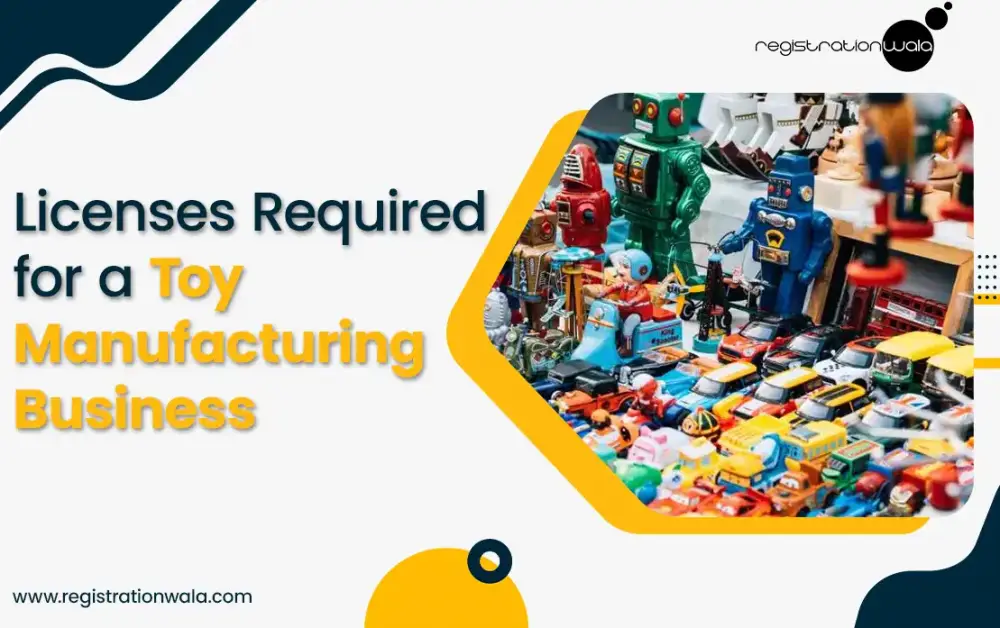
Most of us played with toy cars, dolls, teddy bears and many other toys during our childhood. Today, the toy industry is growing faster than ever because there is a huge demand for different types of toys in the market. The Indian government has been actively promoting “Made in India” products as an alternative to popular Chinese goods. This initiative aims to reduce imports as well as boost exports of Indian made products, including the toys that are manufactured in the country.
If you are planning to start a toy manufacturing company, you should know about the important licenses and registrations required for this particular business. In this blog post, we will discuss them one by one.
Table: Licenses & Registrations for Toy Manufacturing Company
Here is a table that lists the major licenses and registrations that a toy manufacturing company requires:
|
S. No.
|
Name of License / Registration
|
|
1.
|
Business Registration.
|
|
2.
|
BIS Certification for Toys.
|
|
3.
|
GST Registration.
|
|
4.
|
Import-Export Code.
|
|
5.
|
Trademark Registration.
|
|
6.
|
Shop and Establishment License.
|
|
7.
|
Factory License.
|
|
8.
|
EPR License.
|
Licenses and Registrations Required for Toy Manufacturing Business in India in 2026
The licenses and registrations are required for a toy manufacturing business in India are explained below in a detailed manner:
Business Registration
Business registration is one of the most important requirements that must be met to start a toy manufacturing business in India. There are many business structures to choose from for registration like LLP, private limited company and OPC. All these 3 structures provide limited liability protection. LLP is ideal for small businesses or family run/professional ventures where partners want flexibility, limited compliance and shared control.
Pvt ltd co is more appropriate for securing funding as it offers better credibility as well as structured corporate governance. OPC is ideal for a sole entrepreneur who wants full control of business with limited liability. For registering any of these structures, the applicant must file an online application via official MCA portal. After the business is registered, a certificate of incorporation is issued in its name.
Those who want to save up on registration costs can opt for sole proprietorship as a sole entrepreneur or partnership firm for partners. These structures don’t require mandatory registration. But a major drawback is that, in these structures, the liability is unlimited. This means that personal assets can also be at risk in case of business debts. So, individuals must decide the structure very carefully based on their needs, risk appetite and long-term business goals.
BIS Certification for Toys
All toys manufactured or sold in India, including plastic, wooden, soft and electronic toys, must comply with the standards set by the Bureau of Indian Standards. Under the Toys Quality Control Order 2020, BIS certification became mandatory from 1 September 2020. This certification is commonly known as the ISI License for Toys. It is one of the most important toy manufacturing business licenses. It is mandatory for all toys intended for children under the age of 14.
Manufacturers and importers must obtain this license and make sure their toys meet prescribed safety and quality standards before selling them in the Indian market. To apply for BIS certificate toys, the applicant must submit an application online via BIS ManakOnline portal.
GST Registration
GST Registration must be obtained by a toy manufacturing business if its annual turnover exceeds Rs. 40 lakhs in most states (or Rs. 20 lakh in case of special category states). In case of inter-state supply, exports or selling through e-commerce platforms, GST registration may be required by the toy manufacturer regardless of annual turnover of business.
To apply for this registration, the applicant needs to visit the official GST portal and file an application there. It is an entirely online process that does not require physical presence. After successful registration, a GST certificate is issued. This certificate serves as official proof of GST registration.
Import-Export Code
A toy manufacturing company must secure the Import-Export Code registration if it intends to export toys from India to another country. It is also required to import raw materials required for manufacturing toys. To apply for IEC, the applicant needs to visit DGFT portal and then complete the registration process there.
Once issued, the code remains valid for lifetime. Therefore, there is no requirement for renewal. With that being said, IEC details must still be updated every year to maintain its active status.
Trademark Registration
Trademark registration is not mandatory by law. It is an entirely voluntary registration process. However, its voluntary nature does not reduce its importance for a toy manufacturing business in any way. By registering trademark, the business gets exclusive legal rights over its brand name/logo/identity. In case of infringement/misuse by an unauthorized party, the Trademark Registration Certificate acts as strong ownership evidence.
In order to apply for trademark registration, the proposed mark should be unique as well as distinctive. It should not be identical to any existing registered trademark. The registration process primarily takes place online via IP India portal. Although offline filing option is also available, online process is strongly recommended as it is more convenient. Also, the government filing fee is generally slightly lower compared to offline submission.
Shop and Establishment License
To operate any commercial business in India, including a toy manufacturing unit, one of the most important licensing requirements is shop and establishment license. This license is issued under the respective state’s Shop and Establishment Act (every state has its own version of this Act).
This license regulates working hours, employee rights and workplace conditions. The process for obtaining the license varies from one state to another due to different rules. Generally, the local municipal authority or corporation issues it.
Factory License
If a toy manufacturing unit uses machines and employs workers beyond the prescribed limit, then obtaining a factory license becomes mandatory. The license showcases compliance with safety, health and welfare standards of workers.
After inspection of the manufacturing, this license is issued by the State Factories Department. Large-scale manufacturing operations cannot be carried out unless the unit possesses this license.
EPR License
A toy business requires an EPR license if its toys or their packaging contains plastic or electronic components. This license ensures proper waste management and recycling of their products.
Without this license, a business can face heavy penalties. To know more about this license and for assistance in obtaining it, you can connect with Registrationwala.
List of Popular Toys Manufactured in India 2026
You can manufacture the below-mentioned toys in India as they are high in demand in 2026:
-
Toy cars and remote-control vehicles
-
Board games
-
Plastic toys
-
Wooden toys
-
Small-sized and large-sized Dolls
-
Action figures
-
Teddy bears and other stuffed toys like penguins, sharks, dolphins, crocodiles, etc.
-
Building blocks
-
Puzzles
-
Battery-operated toys like trains, drone toys, etc.
-
Musical toys for children
-
Educational toys for children like interactive electronic learning pads.
-
Outdoor and sports toys
-
Baby toys and rattles
-
Crochet toys
-
Woollen toys
Book Free Consultation with Our Licensing Expert.!
Conclusion
For a toy manufacturing business, many licenses and registrations are required like business registration, BIS license for toys, GST registration, trademark registration, shop and establishment license, IEC code registration, factory license and EPR license. Apart from them, other requirements include Pollution NOC, fire safety certification and Udyam registration. For professional assistance in starting a toy manufacturing company, get in touch with our experts at Registrationwala. We will help you obtain some of the most essential licenses and registration certificates required to start this company.
Also Read: Which License is Required to Start a Perfume Business?
Frequently Asked Questions (FAQs)
Q1. Does a toy business require GST registration?
A. Yes, it requires GST registration if its annual turnover exceeds Rs. 40 lakhs in most states (or Rs. 20 lakh in case of special category states).
Q2. Is IEC required to export toys from India?
A. Yes, IEC is required to export toys from India. So, if you want to start a toy export business, make sure to secure it.
Q3. Is BIS certification mandatory for toys?
A. Yes, as per Toys (Quality Control) Order 2020, BIS certification is mandatory for all toys intended for children under the age of 14.
Q4. How to start toy manufacturing company?
A. To start a toy manufacturing company, you must choose an appropriate area for business, do market research about toys that are in high demand, obtain all the necessary licenses and registrations, and hire workers.